


Life partnerships in childhood cancer survivors, their siblings, and the general population
- PMID: 24136901
- PMCID: PMC5917072
- DOI: 10.1002/pbc.24821
Life partnerships in childhood cancer survivors, their siblings, and the general population
Abstract
Background: Life partnerships other than marriage are rarely studied in childhood cancer survivors (CCS). We aimed (1) to describe life partnership and marriage in CCS and compare them to life partnerships in siblings and the general population; and (2) to identify socio-demographic and cancer-related factors associated with life partnership and marriage.
Methods: As part of the Swiss Childhood Cancer Survivor Study (SCCSS), a questionnaire was sent to all CCS (aged 20-40 years) registered in the Swiss Childhood Cancer Registry (SCCR), aged <16 years at diagnosis, who had survived ≥ 5 years. The proportion with life partner or married was compared between CSS and siblings and participants in the Swiss Health Survey (SHS). Multivariable logistic regression was used to identify factors associated with life partnership or marriage.
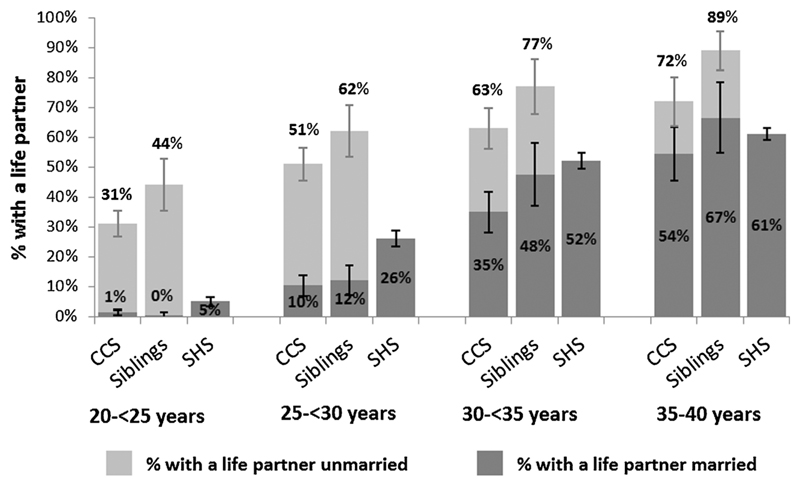
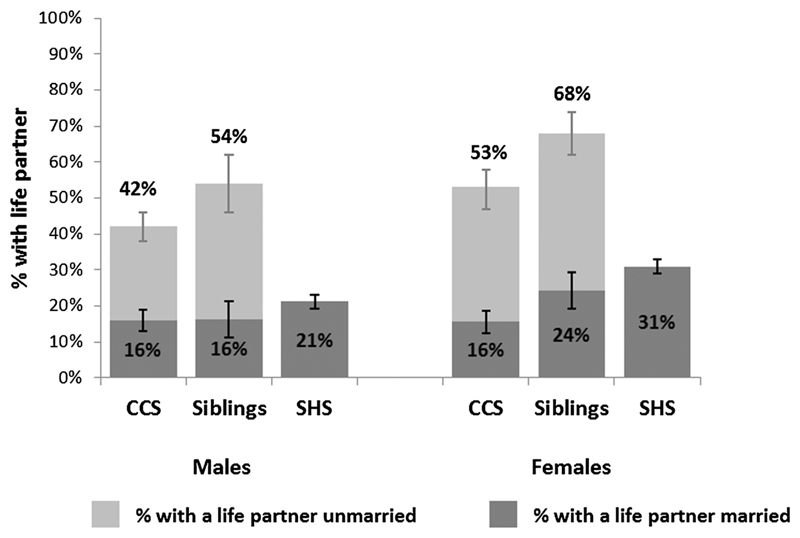
Results: We included 1,096 CCS of the SCCSS, 500 siblings and 5,593 participants of the SHS. Fewer CCS (47%) than siblings (61%, P < 0.001) had life partners, and fewer CCS were married (16%) than among the SHS population (26%, P > 0.001). Older (OR = 1.14, P < 0.001) and female CCS (OR = 1.85, <0.001) were more likely to have life partners. CCS who had undergone radiotherapy, bone marrow transplants (global P Treatment = 0.018) or who had a CNS diagnosis (global P Diagnosis < 0.001) were less likely to have life partners.
Conclusion: CCS are less likely to have life partners than their peers. Most CCS with a life partner were not married. Future research should focus on the effect of these disparities on the quality of life of CCS.
Keywords: childhood cancer survivors; cohort study; life partnership; marriage; questionnaire survey; siblings.
© 2013 Wiley Periodicals, Inc.
Conflict of interest statement
Conflict of interest: Nothing to declare.
Figures
References
-
- Frobisher C, Lancashire ER, Winter DL, et al. Long-term population-based marriage rates among adult survivors of childhood cancer in Britain. Int J Cancer. 2007;121:846–855. - PubMed
Publication types
MeSH terms
Grants and funding
LinkOut - more resources
Full Text Sources
Other Literature Sources
Medical
