Longitudinal trajectories of BMI and cardiovascular disease risk: the national longitudinal study of adolescent health
- PMID: 24136924
- PMCID: PMC3947414
- DOI: 10.1002/oby.20569
Longitudinal trajectories of BMI and cardiovascular disease risk: the national longitudinal study of adolescent health
Abstract
Objective: In adulthood, excess BMI is associated with cardiovascular disease (CVD); it is unknown whether risk differs by BMI trajectories from adolescence to adulthood.
Design and methods: The National Longitudinal Study of Adolescent Health, a nationally representative, longitudinal adolescent cohort (mean age: 16.9 years) followed into adulthood (mean age: 28.8 years) [n = 13,984 individuals (41,982 observations)] was examined. Separate logistic regression models for diabetes, hypertension, and inflammation were used to examine odds of risk factors at given adult BMI according to varying BMI trajectories from adolescence to adulthood.
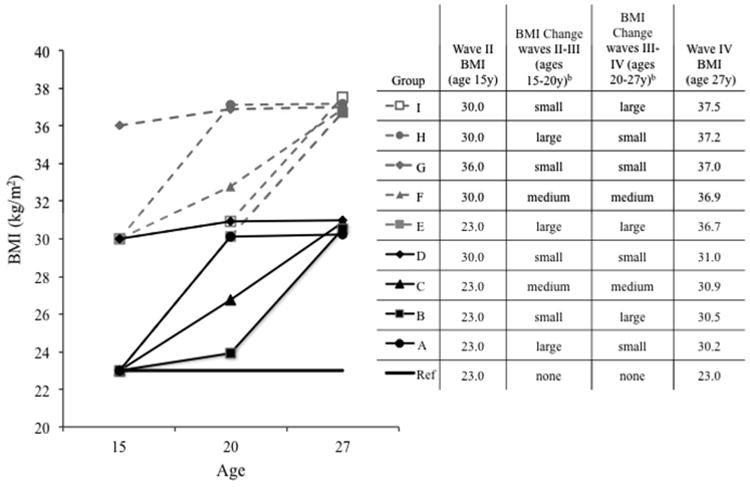
Results: CVD risk factor prevalence at follow-up ranged from 5.5% (diabetes) to 26.4% (hypertension) and 31.3% (inflammation); risk differed across BMI trajectories. For example, relative to men aged 27 years (BMI = 23 kg/m(2) maintained over full study period), odds for diabetes were comparatively higher for men of the same age and BMI ≈ 30 kg/m(2) with ≈8 BMI unit gain between 15 and 20 years (OR = 2.35; 95% CI, 1.51, 3.66) or in those who maintained BMI ≈ 30 kg/m(2) across the study period (OR = 2.33; 1.92, 2.83) relative to the same ≈8 BMI unit gain, but between 20 and 27 years (OR = 1.44; 1.10, 1.87).
Conclusions: Specific periods and patterns of weight gain in the transition from adolescence to adulthood might be critical for CVD preventive efforts.
Copyright © 2013 The Obesity Society.
Conflict of interest statement
Figures
References
-
- McTigue KM, Harris R, Hemphill B, et al. Screening and interventions for obesity in adults: summary of the evidence for the U.S. Preventive Services Task Force. Ann Intern Med. 2003;139(11):933–949. - PubMed
-
- Chobanian AV, Bakris GL, Black HR, et al. The Seventh Report of the Joint National Committee on Prevention, Detection, Evaluation, and Treatment of High Blood Pressure: the JNC 7 report. JAMA. 2003 May 21;289(19):2560–2572. - PubMed
-
- Felber JP, Golay A. Pathways from obesity to diabetes. Int J Obes. 2002;26(Suppl 2):S39–S45. - PubMed
-
- Pearson TA, Mensah GA, Alexander RW, et al. Markers of inflammation and cardiovascular disease: application to clinical and public health practice: A statement for healthcare professionals from the Centers for Disease Control and Prevention and the American Heart Association. Circulation. 2003 Jan 28;107(3):499–511. - PubMed
Publication types
MeSH terms
Grants and funding
LinkOut - more resources
Full Text Sources
Other Literature Sources
Medical