


Solid fat and added sugar intake among U.S. children: The role of stores, schools, and fast food, 1994-2010
- PMID: 24139767
- PMCID: PMC3806190
- DOI: 10.1016/j.amepre.2013.06.013
Solid fat and added sugar intake among U.S. children: The role of stores, schools, and fast food, 1994-2010
Abstract
Background: Little is known about the role of location in U.S. children's excess intake of energy from solid fat and added sugar, collectively referred to as SoFAS.
Purpose: The goal of this study was to compare the SoFAS content of foods consumed by children from stores, schools, and fast-food restaurants and to determine whether trends from 1994 to 2010 differ across these locations.
Methods: Children aged 2-18 years (N=22,103) from five nationally representative surveys of dietary intake from 1994 to 2010 were studied. SoFAS content was compared across locations for total intake and key foods. Regression models were used to test and compare linear trends across locations. Data were analyzed in 2012.
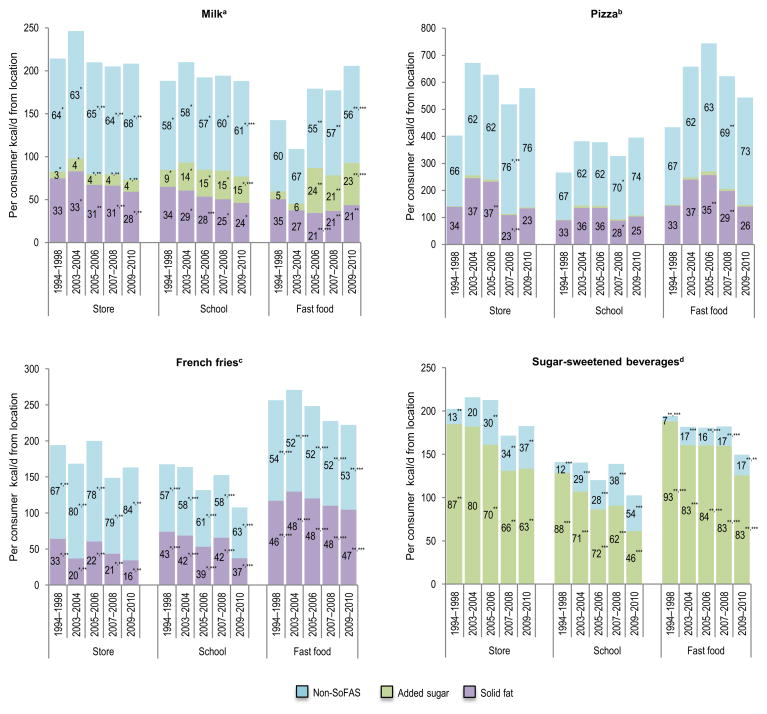
Results: The mean percentage of total energy intake consumed from each location that was provided by SoFAS remained above recommendations, despite significant improvements between 1994 and 2010 at stores (1994, 38.3%; 2004, 33.2%); schools (1994, 38.7%; 2004, 31.2%); and fast-food restaurants (1994, 34.6%; 2004, 34.6%). For each key food, SoFAS content decreased significantly at stores and schools, yet progress at schools was comparatively slower. Milk was higher in SoFAS at schools compared to stores because of shifts toward flavored milk at schools. Schools provided french fries that were higher in solid fat than store-bought versions and pizza that was not significantly different in SoFAS content than fast-food pizza. However, schools made significantly greater progress for sugar-sweetened beverages, as lower-sugar beverages replaced regular sodas. Key fast foods showed little improvement.
Conclusions: These findings can inform future strategies targeted to the specific locations and foods where continued progress is needed to reduce children's SoFAS consumption.
© 2013 American Journal of Preventive Medicine.
Figures
References
-
- U.S. Department of Agriculture, DHHS. Dietary Guidelines for Americans, 2010. Washington, DC: U.S. Government Printing Office; 2010.
-
- Taveras EM, Berkey CS, Rifas-Shiman SL, et al. Association of consumption of fried food away from home with body mass index and diet quality in older children and adolescents. Pediatrics. 2005;116(4):e518–24. - PubMed
-
- Kant AK. Reported consumption of low-nutrient-density foods by American children and adolescents: nutritional and health correlates, NHANES III, 1988 to 1994. Arch Pediatr Adolesc Med. 2003;157(8):789–96. - PubMed
-
- Templeton SB, Marlette MA, Panemangalore M. Competitive foods increase the intake of energy and decrease the intake of certain nutrients by adolescents consuming school lunch. J Am Diet Assoc. 2005;105(2):215–20. - PubMed
Publication types
MeSH terms
Substances
Grants and funding
LinkOut - more resources
Full Text Sources
Other Literature Sources
Medical
