. 2014 Jan 25;382(1):358-367.
doi: 10.1016/j.mce.2013.10.010. Epub 2013 Oct 17.

COUP-TFII inhibits NFkappaB activation in endocrine-resistant breast cancer cells

Affiliations

COUP-TFII inhibits NFkappaB activation in endocrine-resistant breast cancer cells

Lacey M Litchfield et al. Mol Cell Endocrinol. .

Abstract

Reduced COUP-TFII expression contributes to endocrine resistance in breast cancer cells. Endocrine-resistant breast cancer cells have higher NFkappa B (NFκB) activity and target gene expression. The goal of this study was to determine if COUP-TFII modulates NFκB activity. Endocrine-resistant LCC9 cells with low endogenous COUP-TFII displayed ∼5-fold higher basal NFκB activity than parental endocrine-sensitive MCF-7 breast cancer cells. Transient transfection of LCC9 cells with COUP-TFII inhibited NFκB activation and reduced NFκB target gene expression. COUP-TFII and NFκB were inversely correlated in breast cancer patient samples. Endogenous COUP-TFII coimmunoprecipitated with NFκB subunits RelB and NFκB1 in MCF-7 cells. COUP-TFII inhibited NFκB-DNA binding in vitro and impaired coactivator induced NFκB transactivation. LCC9 cells were growth-inhibited by an NFκB inhibitor and 4-hydroxytamoxifen compared to MCF-7 cells. Together these data indicate a novel role for COUP-TFII in suppression of NFκB activity and explain, in part, why decreased COUP-TFII expression results in an endocrine-resistant phenotype.

Keywords: 4-OHT; 4-hydroxytamoxifen; A20/TNFAIP3; Antiestrogens; COUP-TFII; Drug resistance; ERα; ICAM1; IL6; NFκB/NFkappa B; Nuclear receptors; RE; SERD; SERM; TAM; TNFα; TNFα-induced protein 3; Tamoxifen; Transcription factors; chicken ovalbumin upstream promoter transcription factor II; estrogen receptor; intercellular adhesion molecule 1; interleukin 6 (IL6); nuclear factor κB; qPCR; quantitative real-time PCR; response element; selective estrogen receptor downregulator; selective estrogen receptor modulator; tamoxifen; tumor necrosis factor.


Figures

Fig. 1
Fig. 1
COUP-TFII suppresses NFκB activity in LCC9 cells. (A) MCF-7 and LCC9 cells were transfected with a NFκB luciferase reporter and increasing concentrations of pcDNA3.1 or pcDNA3.1-COUP-TFII for 48 h and treated with 10 ng/ml TNFα for 6 h before performing dual luciferase assay (Promega). Firefly luciferase values are shown relative to protein concentration for a representative experiment of quadruplicate values ± SEM. *Significantly different P < 0.05 from pcDNA + TNFα in LCC9. The numerical values over the data bars for LCC9 cells are fold relative to pcDNA-transfected LCC9. (B) Comparison of NFκB subunit mRNA expression in MCF-7 vs. LCC9 cells. Values are the mean of 4–8 separate experiments ± SEM. *P < 0.05 vs. MCF-7.
Fig. 2
Fig. 2
COUP-TFII inhibits expression of NFκB target genes. MCF-7 and LCC9 cells were transfected with pcDNA3.1 or pcDNA3.1-COUP-TFII for 48 h and treated with 10 ng/ml TNFα for 6 h before preparing RNA and cDNA. mRNA expression of NFκB target genes identified in the NFκB pathway array (A) IL6, (B) ICAM1, (C) TNFAIP3 was analyzed by qPCR. Note that relative expression of each gene was normalized to pcDNA-transfected, control treated cells within each cell line. Values are the mean of 2–7 separate experiments ± SEM. Bars indicate significant differences (p < 0.05) between the indicated samples, demonstrating the effect of COUP-TFII on basal or TNFα-induced gene expression in each cell line.
Fig. 3
Fig. 3
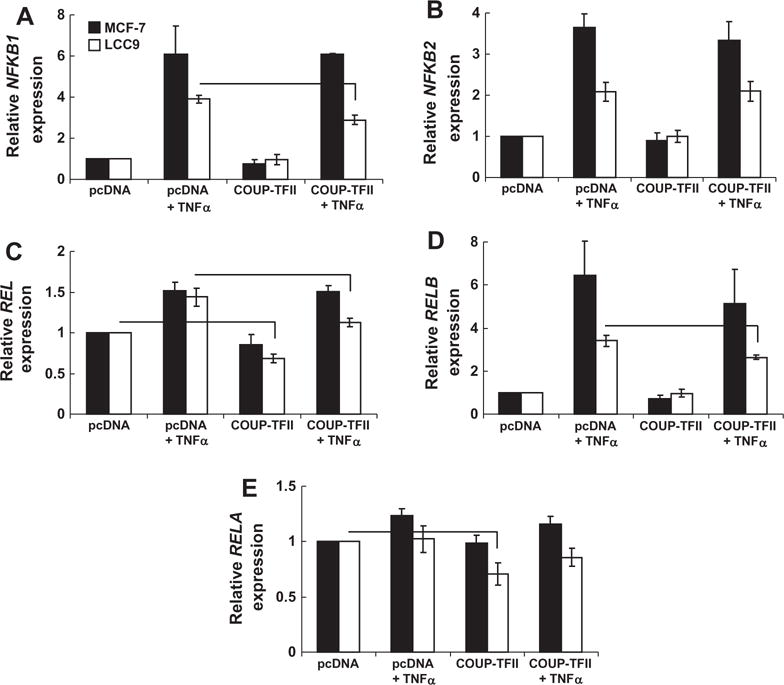
COUP-TFII inhibits mRNA expression of NFκB subunits in LCC9 cells. MCF-7 and LCC9 cells were transfected with pcDNA3.1 or pcDNA3.1-COUP-TFII for 48 h and treated with 10 ng/ml TNFα for 6 h before preparing RNA and cDNA. mRNA expression of NFκB subunits (A) NFKB1, (B) NFKB2, (C) REL, (D) RELB, (E) RELA was analyzed by qPCR. Bars indicate significant differences (p < 0.05) between the indicated samples, demonstrating the effect of COUP-TFII on basal or TNFα-induced gene expression in each cell line.
Fig. 4
Fig. 4
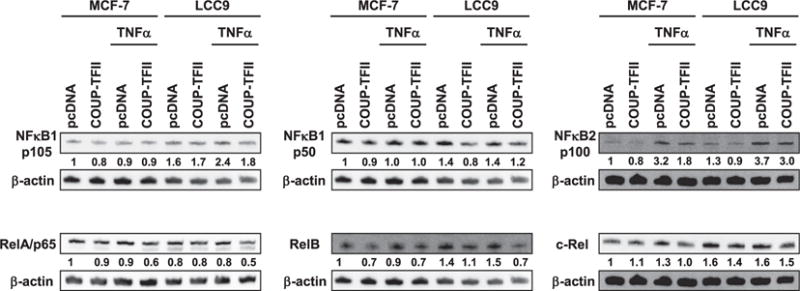
COUP-TFII inhibits protein expression of NFκB subunits. MCF-7 and LCC9 cells were transfected with pcDNA3.1 or pcDNA3.1-COUP-TFII for 48 h and treated with 10 ng/ml TNFα for 6 h before preparing whole cell extracts. Expression of NFκB subunits (NFκB1 p105/p50, NFκB2 p100, RelA p65, RelB, c-Rel) was analyzed by western blot with specific antibodies and normalized to the β-actin control in each lane. The NFκB subunit/β-actin value of the pcDNAcontrol was set to 1 for comparison between separate experiments. The expression of each protein was normalized to pcDNA-transfected untreated MCF-7 cells which was set to 1. Note: NFκB2 p52 was not detectable.
Fig. 5
Fig. 5
COUP-TFII decreases NFκB1 p50 and RelA-DNA binding. TransAM NFκB family assays were performed to measure NFκB subunit activation by quantification of NFκB-DNA response element binding in an ELISA assay using 15 μg NE from MCF-7 and LCC9 cells transfected with pcDNA3.1 or pcDNA3.1-COUP-TFII for 48 h and treated with TNFα for 6 h. Values are the average of two determinations ± SEM. *Significantly different p < 0.05 from pcDNA-transfected cells.
Fig. 6
Fig. 6
COUP-TFII interacts with NFκB subunits and inhibits coactivator function in NFκB activation. (A) 500 μg NE from MCF-7 cells treated with TNFα for 6 h was immunoprecipitated (IP) using a COUP-TFII antibody and separated on a 10% SDS PAGE gel prior to transfer to a PVDF membrane. Interaction with NFκB subunits NFκB1 p105/p50 and RelB was identified using specific antibodies on western blot. B) LCC9 cells were transfected with a NFκB luciferase reporter and pcDNA3.1 or pcDNA3.1-COUP-TFII for 48 h +/− expression plasmids for the coactivators SRC-1, SRC-2, SRC-3, and CBP. Cells were treated with 10 ng/ml TNFα for 6 h before performing dual luciferase assay. Firefly luciferase values are shown relative to protein concentration for a representative experiment of quadruplicate values ± SEM. Values were normalized to TNFα-treated pcDNA vector (negative control) transfected cells. *Significantly different P < 0.05 from pcDNA-transfected cells. Bars connect values which are significantly inhibited by COUP-TFII-transfection vs. that particular coactivator alone (p < 0.05).
Fig. 7
Fig. 7
COUP-TFII inhibits phosphorylation of p65/RelA. MCF-7 and LCC9 cells were transfected with pcDNA3.1 or pcDNA3.1-COUP-TFII for 48 h and treated with 10 ng/ml TNFα for 6 h before preparing whole cell extracts. Expression of total p65/RelA and p-RelA Ser 529 were analyzed by western blot with specific antibodies compared to β-actin control. Values represent p-RelA relative to total RelA.
Fig. 8
Fig. 8
LCC9 cells are growth inhibited by NFκB inhibitor BMS-345541. MCF-7 and LCC9 cells were serum-starved for 24 h before being treated with the indicated concentrations of BMS-345541 for 5 days for an MTT assay. Relative proliferation for untreated cells within each cell line was set to 1. Values are the average of 4 separate treatments ± SEM. **p < 0.05 vs. no added (0) BMS.
Fig. 9
Fig. 9
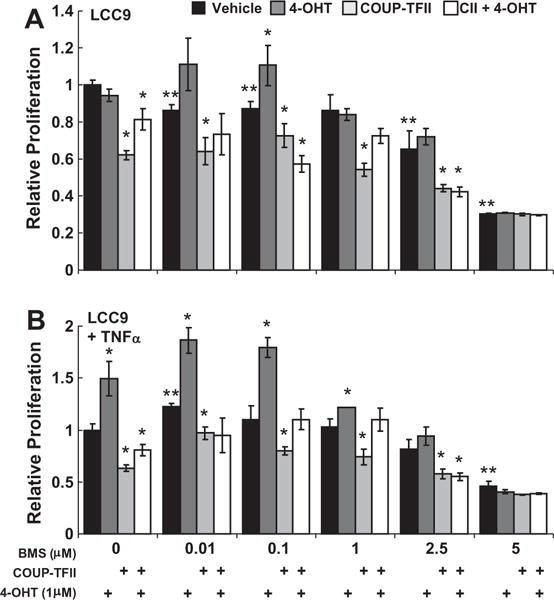
Overexpression of COUP-TFII increases endocrine sensitivity in LCC9 endocrine-resistant breast cancer cells. LCC9 cells were serum starved for 24 h before being transfected with pcDNA3.1 or pcDNA3.1-COUP-TFII for 24 h. Cells were treated with the concentrations of BMS-345541 indicated +/− 1 μM 4-OHT and 10 ng/ml TNFα (B) for 5 days before performing MTT assay to assess changes in cell viability. Values are the average of 4 separate treatments ± SEM. *p < 0.05 vs. vehicle control within each set of 4 treatment/transfection groups, i.e., within each set of BMS concentrations (0–5 μM) +/− COUP-TFII transfection +/− 4-OHT. **p < 0.05 vs. 0 BMS for BMS comparisons only, i.e., 0 BMS vs. 0.01–5 μM BMS with no added 4-OHT or COUP-TFII transfection.

References

    1. Bren GD, Solan NJ, Miyoshi H, Pennington KN, Pobst LJ, Paya CV. Transcription of the RelB gene is regulated by NF-kappaB. Oncogene. 2001;20:7722–7733. - PubMed
    1. Brunner N, Boysen B, Jirus S, Skaar TC, Holst-Hansen C, Lippman J, Frandsen T, Spang-Thomsen M, Fuqua SA, Clarke R. MCF7/LCC9: an antiestrogen-resistant MCF-7 variant in which acquired resistance to the steroidal antiestrogen ICI 182,780 confers an early cross-resistance to the nonsteroidal antiestrogen tamoxifen. Cancer Res. 1997;57:3486–3493. - PubMed
    1. Burke JR, Pattoli MA, Gregor KR, Brassil PJ, MacMaster JF, McIntyre KW, Yang X, Iotzova VS, Clarke W, Strnad J, Qiu Y, Zusi FC. BMS-345541 is a highly selective inhibitor of I kappa B kinase that binds at an allosteric site of the enzyme and blocks NF-kappa B-dependent transcription in mice. J Biol Chem. 2003;278:1450–1456. - PubMed
    1. Chew J, Biswas S, Shreeram S, Humaidi M, Wong ET, Dhillion MK, Teo H, Hazra A, Fang CC, Lopez-Collazo E, Bulavin DV, Tergaonkar V. WIP1 phosphatase is a negative regulator of NF-kappaB signalling. Nat Cell Biol. 2009;11:659–666. - PubMed
    1. Cogswell PC, Guttridge DC, Funkhouser WK, Baldwin AS., Jr Selective activation of NF-kappa B subunits in human breast cancer: potential roles for NF-kappa B2/p52 and for Bcl-3. Oncogene. 2000;19:1123–1131. - PubMed

Publication types

MeSH terms