


Does Powerlessness Explain Elevated HIV Risk Amongst Tajik Labor Migrants? An Ethnographic Study
- PMID: 24143129
- PMCID: PMC3798015
- DOI: 10.1080/15381501.2012.678114
Does Powerlessness Explain Elevated HIV Risk Amongst Tajik Labor Migrants? An Ethnographic Study
Abstract
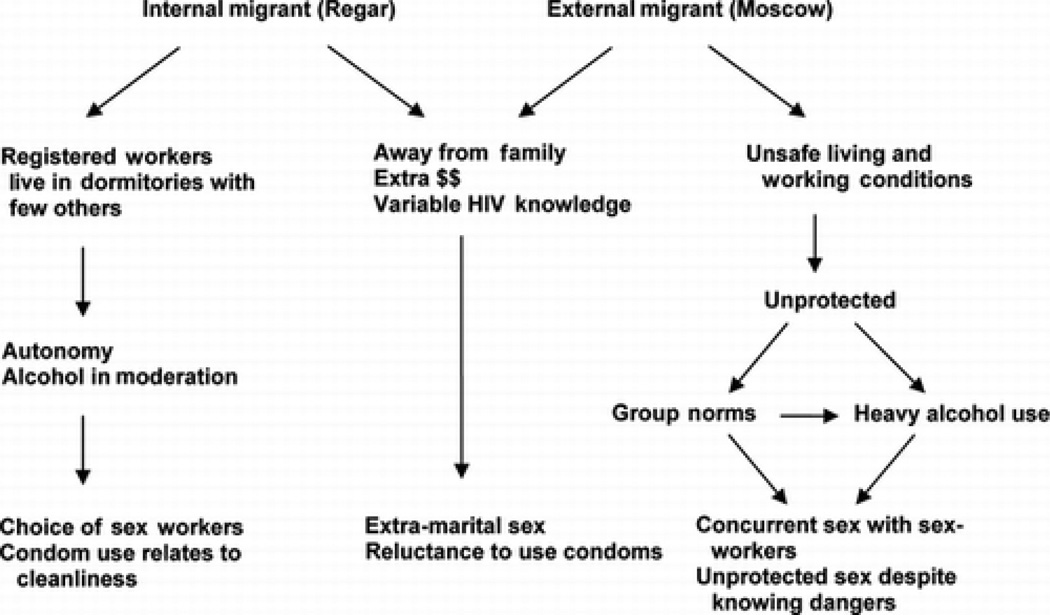
To investigate the role of powerlessness in elevated HIV risk among labor migrants, we compared internal verses external male migrant workers from Tajikistan using minimally structured interviews and focused field observations. The sample included 30 male labor migrants who traveled to work in Regar, Tajikistan (internal labor migrants), and 30 who traveled to work in Moscow, Russia (external labor migrants). Though powerlessness did not appear to account for whether labor migrants engaged in more HIV risk behaviors, the harsh living and working conditions of external labor migration impacted how the migrants manifested these HIV risks by amplifying group masculine norms and behaviors. Progress in preventing HIV infection amid the difficult social conditions of labor migration is contingent upon adequate conceptualization of how such conditions impact HIV risk behaviors.
Figures
References
-
- Ashforth BE, Mael F. Social identity theory and the organization. Academy of Management Review. 1989;14(1):20–39.
-
- Asthana S, Oostvogels R. Community participation in HIV prevention: Problems and prospects for community-based strategies among female sex workers in Madras. Social Science & Medicine. 1996;43(2):133–148. - PubMed
-
- Bryant A, Charmaz K. The Sage handbook of grounded theory. Thousand Oaks, CA: Sage Publications; 2010.
-
- Campbell C. Migrancy, masculine identities and AIDS: The psychosocial context of HIV transmission on the South African gold mines. Social Science & Medicine. 1997;45(2):273–281. - PubMed
Grants and funding
LinkOut - more resources
Full Text Sources