


The anteroventral third ventricle region is critical for the behavioral desensitization caused by repeated injections of angiotensin II
- PMID: 24144549
- PMCID: PMC3886285
- DOI: 10.1016/j.bbr.2013.10.013
The anteroventral third ventricle region is critical for the behavioral desensitization caused by repeated injections of angiotensin II
Abstract
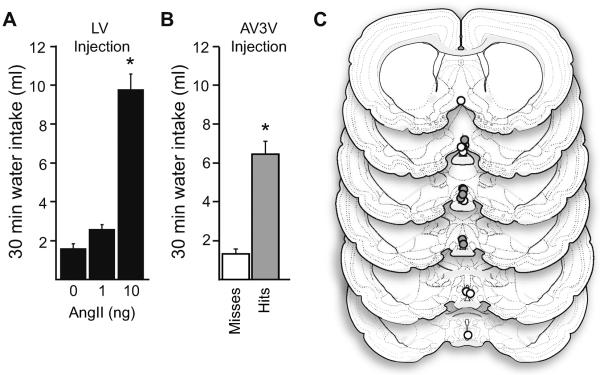
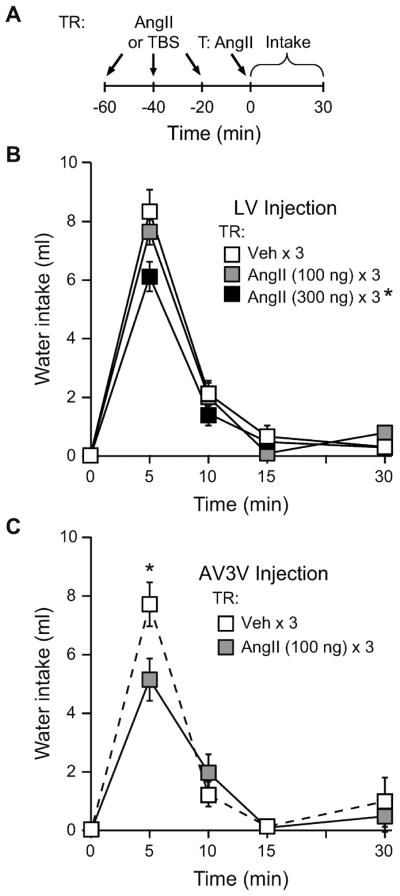
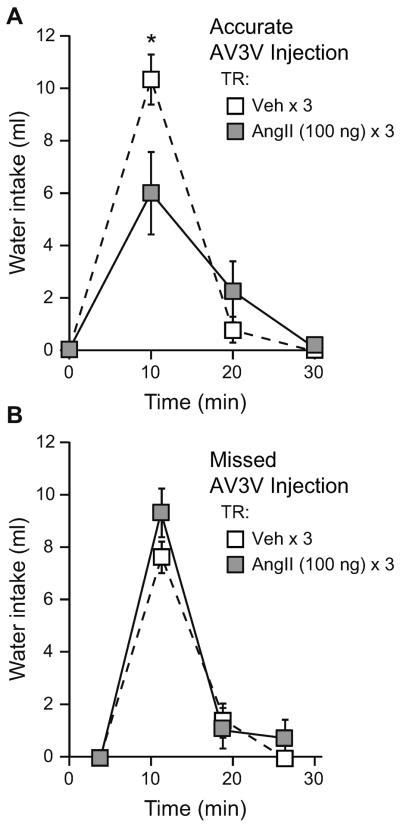
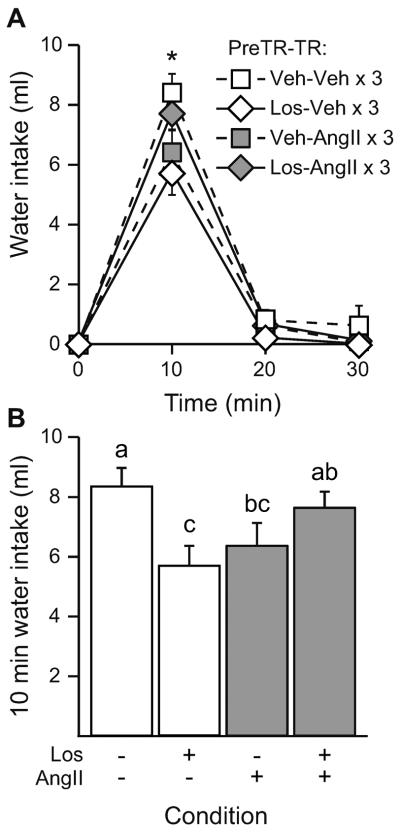
A single central injection of angiotensin II (AngII) potently increases water intake; however, a growing body of research suggests that repeated, acute intracerebroventricular injections of AngII cause a reduction in the dipsogenic response to subsequent AngII. This AngII-induced behavioral desensitization is specific to the effects of angiotensin and mediated by the angiotensin type-1 (AT1) receptor. The neuroanatomical substrate for this phenomenon, however, remains unknown. The anteroventral third ventricle (AV3V) region is an important site for the behavioral and physiological actions of AngII. Therefore, we hypothesized that this region also mediates the effects of repeated central AngII administration. In support of this hypothesis, we found that repeated injections of AngII into the AV3V reduced water intake stimulated by a test injection of AngII given into this region. Moreover, repeated AngII injections in the AV3V reduced water intake after AngII was injected into the lateral ventricle. These studies also demonstrate that activation of the AT1 receptor within the AV3V is required for AngII-induced behavioral desensitization because direct injection of the AT1 receptor antagonist, losartan, into the AV3V blocked the desensitizing effect of repeated AngII injections into the lateral ventricle. These findings provide additional support for a role of the AV3V in the dipsogenic actions of AngII, and suggest that this region is critical for the desensitization that occurs after acute repeated central injections of AngII.
Keywords: AV3V; Angiotensin; Desensitization; Thirst.
Copyright © 2013 Elsevier B.V. All rights reserved.
Figures
References
-
- Fitzsimons JT. Angiotensin, thirst, and sodium appetite. Physiol Rev. 1998;78:583–686. - PubMed
-
- Johnson AK, Thunhorst RL. The neuroendocrinology of thirst and salt appetite: visceral sensory signals and mechanisms of central integration. Front Neuroendocrinol. 1997;18:292–353. - PubMed
-
- McKinley MJ, Johnson AK. The physiological regulation of thirst and fluid intake. News Physiol Sci. 2004;19:1–6. - PubMed
-
- Goodfriend TL, Elliott ME, Catt KJ. Angiotensin receptors and their antagonists. N Engl J Med. 1996;334:1649–54. - PubMed
-
- de Gasparo M, Levens N. Does blockade of angiotensin II receptors offer clinical benefits over inhibition of angiotensin-converting enzyme? Pharmacol Toxicol. 1998;82:257–71. - PubMed
Publication types
MeSH terms
Substances
Grants and funding
LinkOut - more resources
Full Text Sources
Other Literature Sources
Research Materials
