


Early human speciation, brain expansion and dispersal influenced by African climate pulses
- PMID: 24146922
- PMCID: PMC3797764
- DOI: 10.1371/journal.pone.0076750
Early human speciation, brain expansion and dispersal influenced by African climate pulses
Abstract
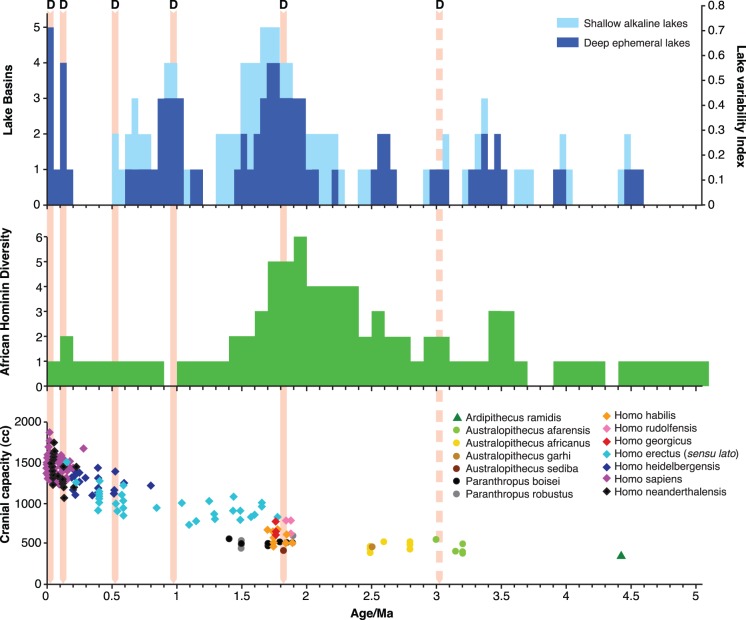
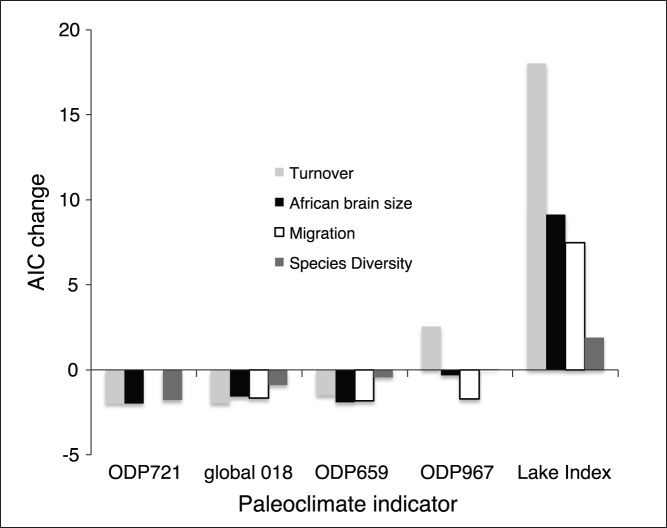
Early human evolution is characterised by pulsed speciation and dispersal events that cannot be explained fully by global or continental paleoclimate records. We propose that the collated record of ephemeral East African Rift System (EARS) lakes could be a proxy for the regional paleoclimate conditions experienced by early hominins. Here we show that the presence of these lakes is associated with low levels of dust deposition in both West African and Mediterranean records, but is not associated with long-term global cooling and aridification of East Africa. Hominin expansion and diversification seem to be associated with climate pulses characterized by the precession-forced appearance and disappearance of deep EARS lakes. The most profound period for hominin evolution occurs at about 1.9 Ma; with the highest recorded diversity of hominin species, the appearance of Homo (sensu stricto) and major dispersal events out of East Africa into Eurasia. During this period, ephemeral deep-freshwater lakes appeared along the whole length of the EARS, fundamentally changing the local environment. The relationship between the local environment and hominin brain expansion is less clear. The major step-wise expansion in brain size around 1.9 Ma when Homo appeared was coeval with the occurrence of ephemeral deep lakes. Subsequent incremental increases in brain size are associated with dry periods with few if any lakes. Plio-Pleistocene East African climate pulses as evinced by the paleo-lake records seem, therefore, fundamental to hominin speciation, encephalisation and migration.
Conflict of interest statement
Figures
References
-
- Trauth MH, Larrasoaña JC, Mudelsee M (2009) Trends, rhythms and events in Plio-Pleistocene African climate. Quaternary Science Reviews 28: 399–411 10.1016/j.quascirev.2008.11.003 - DOI
-
- Donges JF, Donner RV, Trauth MH, Marwan N, Schellnhuber H-J (2011) Nonlinear detection of paleoclimate-variability transitions possibly related to human evolution. Proceedings of the National Academy of Sciences of the United States of America 108: 20422–20427 10.1073/pnas.1117052108 - DOI - PMC - PubMed
-
- Antón SC, Swisher CC (2004) Early Dispersals of Homo from Africa. Annual Review of Anthropology 33: 271–296.
Publication types
MeSH terms
LinkOut - more resources
Full Text Sources
Other Literature Sources
