. 2013 Oct 23:6:426.
doi: 10.1186/1756-0500-6-426.

snOPY: a small nucleolar RNA orthological gene database

Affiliations

snOPY: a small nucleolar RNA orthological gene database

Maki Yoshihama et al. BMC Res Notes. .

Abstract

Background: Small nucleolar RNAs (snoRNAs) are a class of non-coding RNAs that guide the modification of specific nucleotides in ribosomal RNAs (rRNAs) and small nuclear RNAs (snRNAs). Although most non-coding RNAs undergo post-transcriptional modifications prior to maturation, the functional significance of these modifications remains unknown. Here, we introduce the snoRNA orthological gene database (snOPY) as a tool for studying RNA modifications.

Findings: snOPY provides comprehensive information about snoRNAs, snoRNA gene loci, and target RNAs. It also contains data for orthologues from various species, which enables users to analyze the evolution of snoRNA genes. In total, 13,770 snoRNA genes, 10,345 snoRNA gene loci, and 133 target RNAs have been registered. Users can search and access the data efficiently using a simple web interface with a series of internal links. snOPY is freely available on the web at http://snoopy.med.miyazaki-u.ac.jp.

Conclusions: snOPY is the database that provides information about the small nucleolar RNAs and their orthologues. It will help users to study RNA modifications and snoRNA gene evolution.


Figures
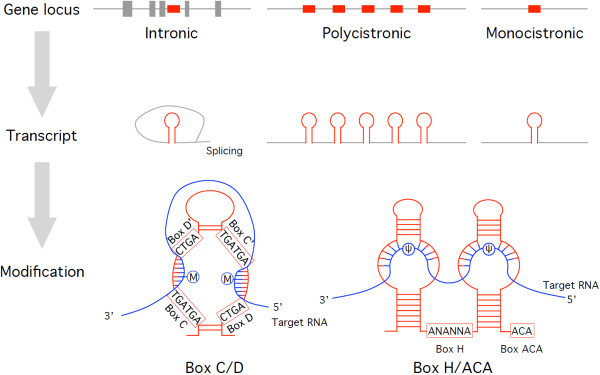
Figure 1
Figure 1
Secondary structure of snoRNAs and genomic loci. Three types of snoRNA gene loci (top), intermediate transcripts (middle), and mature box C/D and box H/ACA snoRNAs associated with target RNAs (bottom) are shown. Circles indicate modification sites for methylation (m) and pseudouridylation (Ψ). snoRNAs, snoRNA gene loci, and target RNAs are shown in red, gray, and blue, respectively.
Figure 2
Figure 2
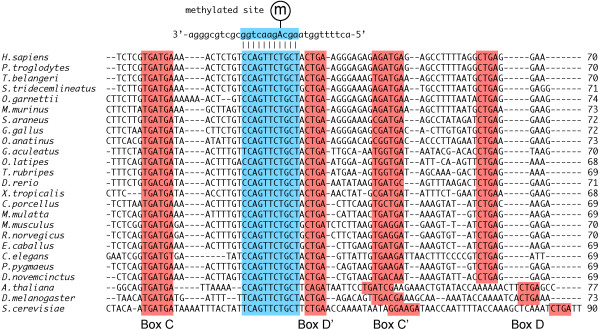
A multiple sequence alignment of snoRNAs (SNORD38) from 25 species. Part of the target RNA sequence (H. sapiens) and modification site are also included. Box motifs and complementary sequences are highlighted in red and blue, respectively. The multiple alignment was generated by ClustalW [17].
Figure 3
Figure 3
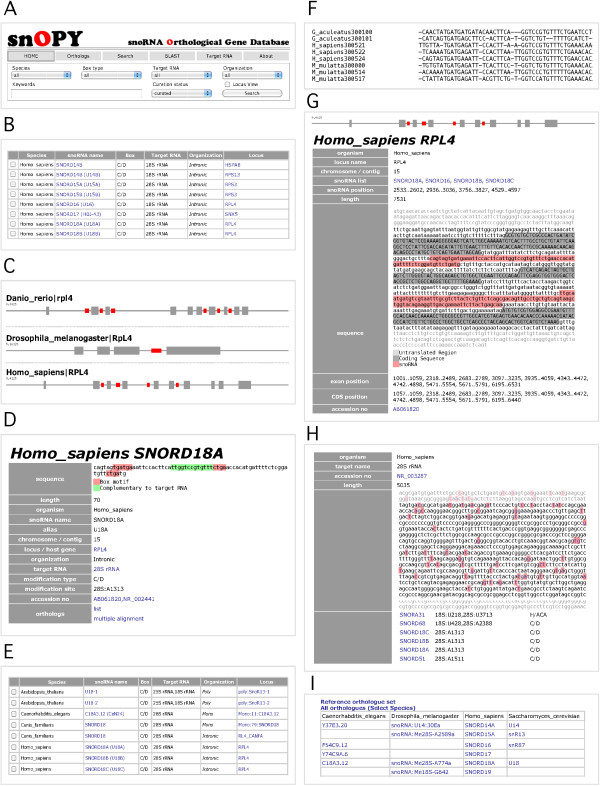
Representative snapshots of snOPY pages. A, search form; B, search results selected with “Homo sapiens”; C, results retrieved from “Locus View” using “RPL4” as a keyword; D, individual snoRNA entry page for H. sapiens SNORD18A, with box motifs and complementary sequences highlighted in red and green, respectively; E, orthologues retrieved using “list” in the human SNORD18A page; F, multiple sequence alignment for SNORD18A; G, snoRNA gene locus of the human RPL4 gene for SNORD18A; H, target RNA and modification sites for human 28S rRNA; I, an orthologue table for four representative species. With the exception of A and C, only a part of each page is shown in the snapshot.

References

    1. The ENCODE Project Consortium. An integrated encyclopedia of DNA elements in the human genome. Nature. 2012;6:57–74. doi: 10.1038/nature11247. - DOI - PMC - PubMed
    1. Amaral PP, Dinger ME, Mercer TR, Mattick JS. The eukaryotic genome as an RNA machine. Science. 2008;6:1787–1789. doi: 10.1126/science.1155472. - DOI - PubMed
    1. Decatur WA, Fournier MJ. rRNA modifications and ribosome function. Trends Biochem Sci. 2002;6:344–351. doi: 10.1016/S0968-0004(02)02109-6. - DOI - PubMed
    1. Darzacq X, Jady BE, Verheggen C, Kiss AM, Bertrand E, Kiss T. Cajal body-specific small nuclear RNAs: A novel class of 2′-O-methylation and pseudouridylation guide RNAs. EMBO J. 2002;6:2746–2756. doi: 10.1093/emboj/21.11.2746. - DOI - PMC - PubMed
    1. Johansson M, Byström A. In: Fine-Tuning of RNA Functions by Modification and Editing, Topics in Current Genetics. Volume 12. Grosjean H, editor. Springer: Heidelberg/Berlin; 2005. Transfer RNA modifications and modifying enzymes in Saccharomyces cerevisiae; pp. 87–120.

Publication types

LinkOut - more resources