


Resistance training for explosive and maximal strength: effects on early and late rate of force development
- PMID: 24149144
- PMCID: PMC3772581
Resistance training for explosive and maximal strength: effects on early and late rate of force development
Abstract
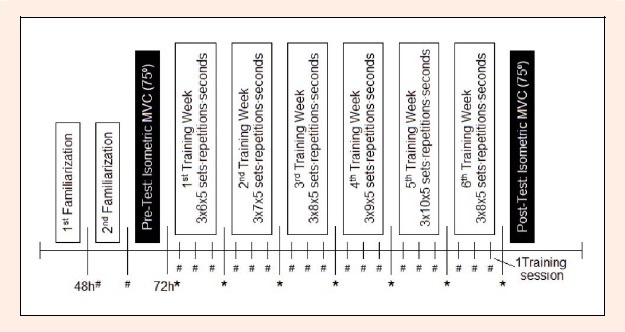
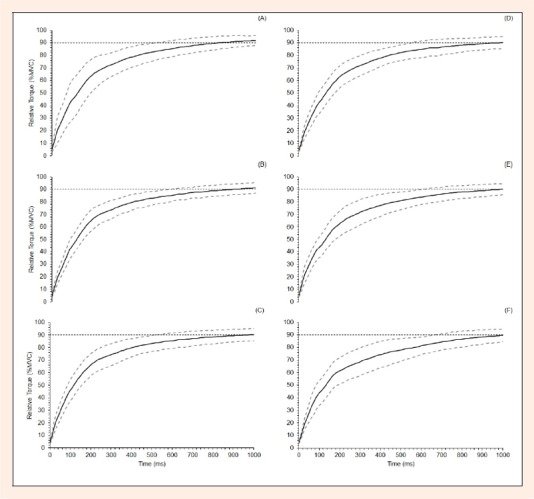
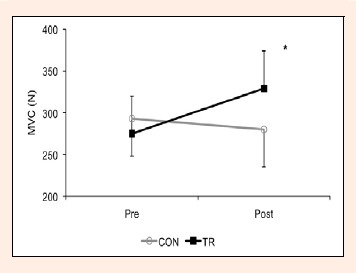
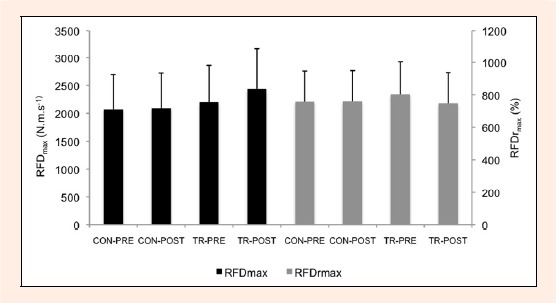
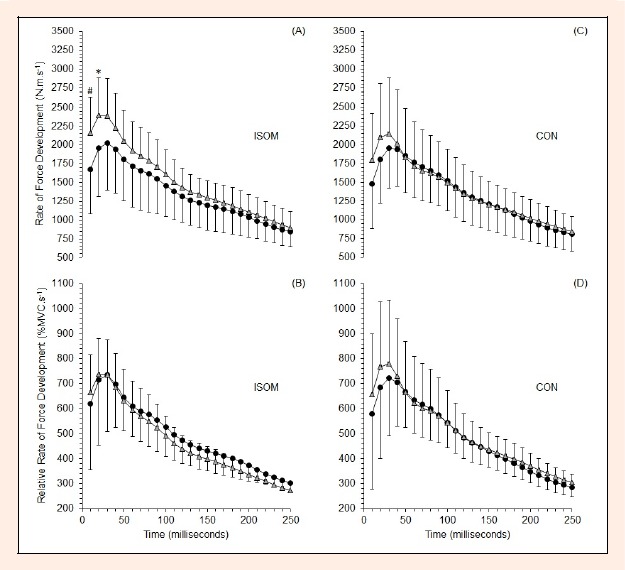
The aim of the present study was to verify whether strength training designed to improve explosive and maximal strength would influence rate of force development (RFD). Nine men participated in a 6-week knee extensors resistance training program and 9 matched subjects participated as controls. Throughout the training sessions, subjects were instructed to perform isometric knee extension as fast and forcefully as possible, achieving at least 90% maximal voluntary contraction as quickly as possible, hold it for 5 s, and relax. Fifteen seconds separated each repetition (6-10), and 2 min separated each set (3). Pre- and post-training measurements were maximal isometric knee extensor (MVC), RFD, and RFD relative to MVC (i.e., %MVC·s(-1)) in different time-epochs varying from 10 to 250 ms from the contraction onset. The MVC (Nm) increased by 19% (275.8 ± 64.9 vs. 329.8 ± 60.4, p < 0.001) after training. In addition, RFD (Nm·s(-1)) increased by 22-28% at time epochs up to 20 ms from the contraction onset (0-10 ms = 1679. 1 ± 597.1 vs. 2159.2 ± 475.2, p < 0.001; 0-20 ms = 1958.79 ± 640.3 vs. 2398.4 ± 479.6, p < 0. 01), with no changes verified in later time epochs. However, no training effects on RFD were found for the training group when RFD was normalized to MVC. No changes were found in the control group. In conclusion, very early and late RFD responded differently to a short period of resistance training for explosive and maximal strength. This time-specific RFD adaptation highlight that resistance training programs should consider the specific neuromuscular demands of each sport. Key PointsThe time-specific RFD adaptation evoked by resistance training highlight that the method of analyzing RFD is essential for the interpretation of results.Confirming previous data, maximal contractile RFD and maximal force can be differently influenced by resistance training. Thus, the resistance training programs should consider the specific neuromuscular demands of each sport.In active non-strength trained individuals, a short-term resistance training program designed to increase both explosive and maximal strength seems to reduce the adaptive response (i.e. increased RFDMAX) evoked by training with an intended ballistic effort (i.e. high-RFD contraction).
Keywords: Quadriceps; muscle adaptation; muscle strength; peak torque; power.
Figures
References
-
- Aagaard P., Simonsen E.B., Andersen J.L., Magnusson P., Dyhre-Poulsen P. (2002) Increased rate of force development and neural drive of human skeletal muscle following resistance training. Journal of Applied Physiology 93(4), 1318-1326 - PubMed
-
- Aagaard P., Suetta C., Caserotti P., Magnusson S.P., Kjaer M. (2010) Role of the nervous system in sarcopenia and muscle atrophy with aging: strength training as a countermeasure. Scandinavian Journal of Medicine and Science in Sports 20(1), 49-64 - PubMed
-
- Aagaard P., Andersen J.L., Bennekou M., Larsson B., Olesen J.L., Crameri R., Magnusson S.P., Kjaer M. (2011) Effects of resistance training on endurance capacity and muscle fiber composition in young top-level cyclists. Scandinavian Journal of Medicine and Science in Sports 21(6), e298-307 - PubMed
-
- Andersen L.L., Aagaard P. (2006) Influence of maximal muscle strength and intrinsic muscle contractile properties on contractile rate of force development. European Journal of Applied Physiology 96(1), 46-52 - PubMed
-
- Andersen L.L., Andersen J.L., Zebis M.K., Aagaard P. (2010) Early and late rate of force development: differential adaptive responses to resistance training? Scandinavian Journal of Medicine and Science in Sports 20(1), 162-169 - PubMed
LinkOut - more resources
Full Text Sources