


Energy system contributions during incremental exercise test
- PMID: 24149151
- PMCID: PMC3772588
Energy system contributions during incremental exercise test
Abstract
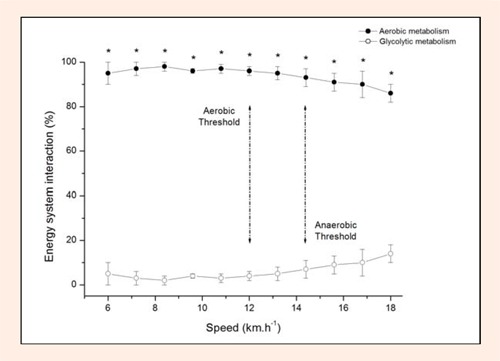
The main purpose of this study was to determine the relative contributions of the aerobic and glycolytic systems during an incremental exercise test (IET). Ten male recreational long-distance runners performed an IET consisting of three-minute incremental stages on a treadmill. The fractions of the contributions of the aerobic and glycolytic systems were calculated for each stage based on the oxygen uptake and the oxygen energy equivalents derived by blood lactate accumulation, respectively. Total metabolic demand (WTOTAL) was considered as the sum of these two energy systems. The aerobic (WAER) and glycolytic (WGLYCOL) system contributions were expressed as a percentage of the WTOTAL. The results indicated that WAER (86-95%) was significantly higher than WGLYCOL (5-14%) throughout the IET (p < 0.05). In addition, there was no evidence of the sudden increase in WGLYCOL that has been previously reported to support to the "anaerobic threshold" concept. These data suggest that the aerobic metabolism is predominant throughout the IET and that energy system contributions undergo a slow transition from low to high intensity. Key PointsThe aerobic metabolism contribution is the predominant throughout the maximal incremental test.The speed corresponding to the aerobic threshold can be considered the point in which aerobic metabolism reaches its maximal contribution.Glycolytic metabolism did not contribute largely to the energy expenditure at intensities above the anaerobic threshold.
Keywords: Oxygen uptake; aerobic threshold; anaerobic threshold; blood lactate; energy metabolism contribution; onset of blood lactate accumulation.
Figures
References
-
- Achten J., Jeukendrup A.E. (2004) Relation between plasma lactate concentration and fat oxidation rates over a wide range of exercise intensities. International Journal Sports Medicine 25, 32-37 - PubMed
-
- Bentley D.J., Newell J., Bishop D. (2007) Incremental exercise test design and analysis: implications for performance diagnostics in endurance athletes. Sports Medicine 37, 575-586 - PubMed
-
- Bertuzzi R., Bueno S., Pasqua L.A., Acquesta F.M., Batista M.B., Roschel H., Kiss M.A., Serrão J.C., Tricoli V., Ugrinowitsch C. (2012) Bioenergetics and neuromuscular determinants of the time to exhaustion at velocity corresponding to VO2max in recreational long-distance runners. Journal of Strength and Conditioning Research 26, 2096-2102 - PubMed
-
- Bertuzzi R.C., Franchini E., Kokubun E., Kiss M.A. (2007) Energy system contributions in indoor rock climbing. European Journal or Applied Physiology 101, 293-300 - PubMed
-
- Bertuzzi R.C., Franchini E., Ugrinowitsch C., Kokubun E., Lima-Silva A.E., Pires F.O., Nakamura F.Y., Kiss M.A. (2010) Predicting MAOD using only a supramaximal exhaustive test. International Journal of Sports Medicine 31, 477-481 - PubMed
LinkOut - more resources
Full Text Sources