


Assessment of the quadriceps femoris muscle in women after injury induced by maximal eccentric isokinetic exercise with low angular speed
- PMID: 24149232
- PMCID: PMC3778686
Assessment of the quadriceps femoris muscle in women after injury induced by maximal eccentric isokinetic exercise with low angular speed
Abstract
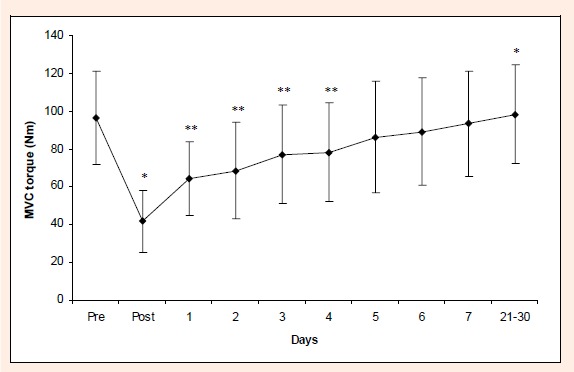
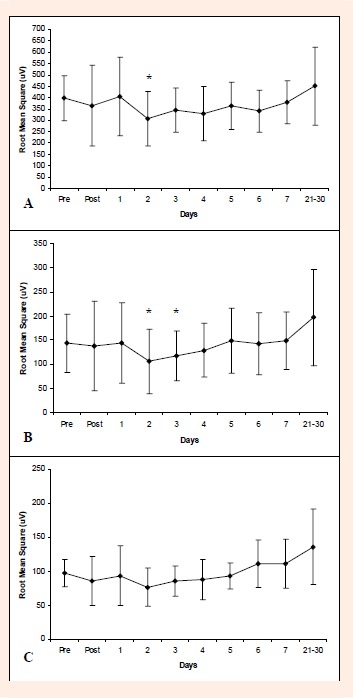
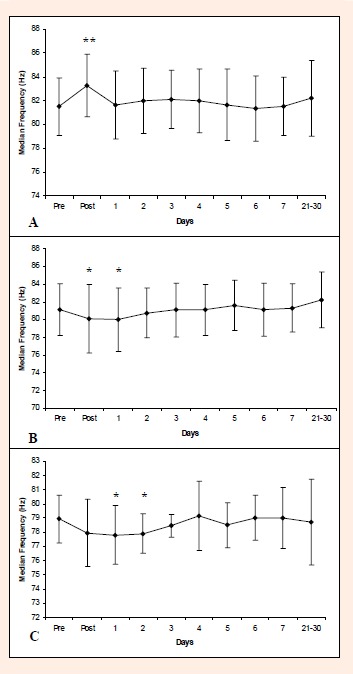
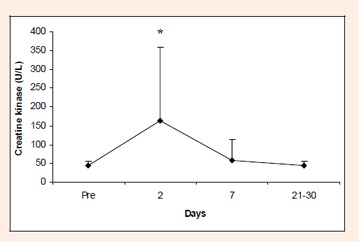
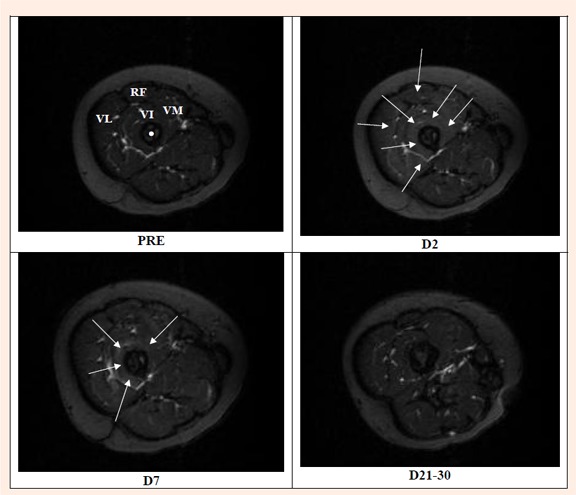
The objectives of this study were to propose a model for exercise- induced muscle injury by way of a maximal eccentric isokinetic exercise at low angular speed, and assess the time course of functional recovery of the injured quadriceps femoris muscle from the maximal voluntary contraction (MVC) torque and electrical activity (root mean square - RMS and median frequency - MDF). The effectiveness of the proposed eccentric exercise in inducing injury was assessed from the activity of creatine kinase (CK). In addition, the presence of edema of the quadriceps femoris muscle was assessed by a visual inspection of the intensity of the magnetic resonance imaging (MRI) signal. These measurements were carried out before and after the exercise. Ten healthy women (21.9 ± 1.5) took part in this study. The injury was induced by 4 series of 15 maximal eccentric isokinetic contractions at 5°/s. The MVC torque reduced up to the 4(th) day after the exercise (p < 0.05). The RMS of the vastus medialis oblique (VMO) and the rectus femoris (RF) muscles decreased on the 2(nd) (VMO and RF; p < 0.05) and 3(rd) (RF; p < 0.05) days after. The MDF of the VMO increased immediately after (p < 0.05), whilst the MDF of the RF and VL decreased immediately after (RF; p < 0.05), on the 1(st) (RF and VL; p < 0.05) and on the 2(nd) (VL; p < 0.05) days after. The CK activity increased on the 2(nd) day after (p < 0.05). An increase in the intensity of the MRI signal was observed on the 2(nd) and 7(th) days after.
In conclusion: 1- the eccentric exercise with low angular speed was effective in inducing injury, 2- the quadriceps femoris already started its functional recovery, as shown by the MVC torque and electrical activity, in the first week after the exercise, despite the presence of an increase in the intensity of the MRI signal. Key pointsThe low angular speed eccentric exercise was effec-tive in inducing injury of the quadriceps femoris muscle, and could be used as a muscle injury induc-ing model in future studies;The quadriceps femoris muscle injured by eccentric exercise started its functional recovery in the first week after low angular speed eccentric exercise.
Keywords: Muscle damage; creatine kinase; electromyography; magnetic resonance imaging; torque.
Figures
References
-
- Arendt-Nielsen L., Mills K. (1985) The relationship between mean power frequency of the EMG spectrum and muscle fiber conduction velocity. Electroencephalography and Clinical Neurophysiology 660, 130-134 - PubMed
-
- Babul S., Rhodes E.C., Taunton J.E., Lepawsky M. (2003) Effects of intermittent exposure to hyperbaric oxygen for the treatment of an acute soft tissue injury. Clinical Journal of Sport Medicine 13, 138-147 - PubMed
-
- Bajaj P., Graven-Nielsen T., Arendt-Nielsen L. (2001) Post-exercise muscle soreness after eccentric exercise: psychophysical effects and implications on mean arterial pressure. Scandinavian Journal of Medicine and Science in Sports 11, 266-273 - PubMed
-
- Bajaj P., Madeleine P., SjØgaard, G., Arendt-Nielsen L. (2002) Assessment of postexercise muscle soreness by electromyography and mechanomyography. Journal of Pain 33(2), 126-136 - PubMed
-
- Bär, P. R. (1990) The influence of sex hormones on the plasma activity of muscle enzymes. International Journal of Sports Medicine 11, 409-410 - PubMed
LinkOut - more resources
Full Text Sources
Research Materials
Miscellaneous