


Functional status and inflammation after preseason training program in professional and recreational soccer players: a proteomic approach
- PMID: 24149294
- PMCID: PMC3737914
Functional status and inflammation after preseason training program in professional and recreational soccer players: a proteomic approach
Abstract
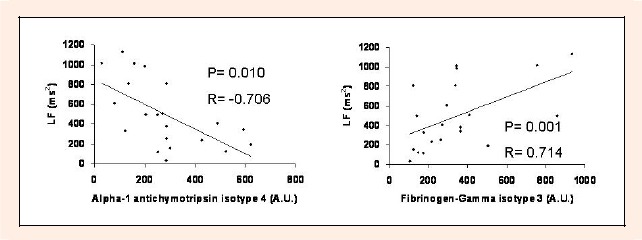
The purpose of the study was to determine if an intensive pre- season training program modifies the inflammatory status in professional soccer players and if this inflammatory profile may be associated with the physical state. We compared plasma protein biomarkers, using proteomics, and the physiological state and cardiac function in 12 professional soccer players and 9 recreational soccer players. Reduced cardiac low frequency [LF] after the pre- season training program previous competition with respect to recreational soccer players was found. No differences were found in cardiac high frequency, cardiac high frequency/low frequency ratio, tension index and oxygen volume consumption. Alpha-1-antitrypsin isotype-3, fibrinogen-gamma isotypes-1, 2 and 3 and vitamin-D-binding protein isotype-1 were reduced in professionals players compared with those in recreational players. However, an increased content of alpha-1-antitrypsin isotype-6 and alpha-1-antichymotrypsin 1 and 4 were found in professional soccer players. Spearman's analysis showed a positive correlation between LF and fibrinogen-gamma chain isotype 3; but LF was negatively correlated with alpha-antichymotrypsin isotype 4. Professional soccer players submitted to an intensive training showed differences in the content of plasma proteins associated with inflammatory/oxidative stress and thrombosis with respect to recreational soccer players. Proteomics analysis in combination with the analysis of cardiac function assessment may be useful to know more in depth molecular processes associated with sport and intensive exercise. Key pointsProteomics allow us to find differences in the plasma protein content in sportsmen.Just after pre-season training program, professional soccer players showed lower content of circulating proteins associated with inflammation compared to recreational soccer players.Proteomic analysis in combination with the analysis of cardiac function may be useful to know more in depth molecular inflammatory and oxidative processes associated with the sport.
Keywords: Inflammation; physical performance; proteomics; soccer.
Figures
References
-
- Alonso-Orgaz S., Moreno L., Macaya C., Rico L., Mateos-Cáceres P.J., Sacristán D., Pérez-Vizcaíno F., Segura A., Tamargo J., López-Farré A. (2006) Proteomic study of plasma from moderate hypercholesterolemic patients. Journal Proteome Research 5, 2301-2308 - PubMed
-
- Ascensão A., Rebelo A., Oliveira E., Marques F., Pereira L., Magalhães J. (2008) Biochemical impact of a soccer match - analysis of oxidative stress and muscle damage markers throughout recovery. Clinical Biochemistry 41, 841-851 - PubMed
-
- Berkoff D.J., Cairns C.B., Sanchez L.D., Moorman C.T., 3rd. (2007) Heart rate variability in elite American track-and-field athletes. Journal of Strength Conditioning Research 21, 227-231 - PubMed
-
- Boluyt M.O., Brevick J.L., Rogers D.S., Randall M.J., Scalia A.F., Li Z.B. (2006) Changes in the rat heart proteome induced by exercise training: Increased abundance of heat shock protein hsp20. Proteomics 6, 3154-3169 - PubMed
-
- Bombeli T., Schwartz B.R., Harlan J.M. (1998) Adhesion of activated platelets to endothelial cells: evidence for a GPIIbIIIa-dependent bridging mechanism and novel roles for endothelial intercellular adhesion molecule 1 (ICAM-1), alphavbeta3 integrin, and GPIbalpha. Journal Experimental Medicine 187, 329-339 - PMC - PubMed
LinkOut - more resources
Full Text Sources