


A comparison between ventilation and heart rate as indicator of oxygen uptake during different intensities of exercise
- PMID: 24149394
- PMCID: PMC3737974
A comparison between ventilation and heart rate as indicator of oxygen uptake during different intensities of exercise
Abstract
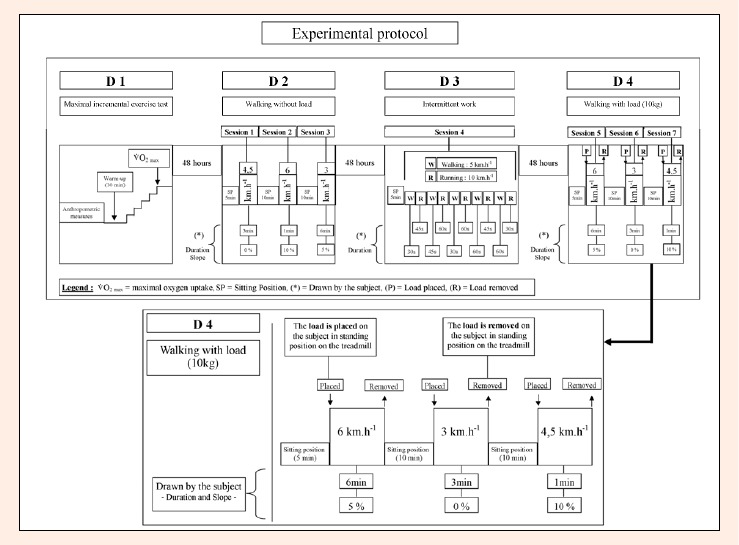
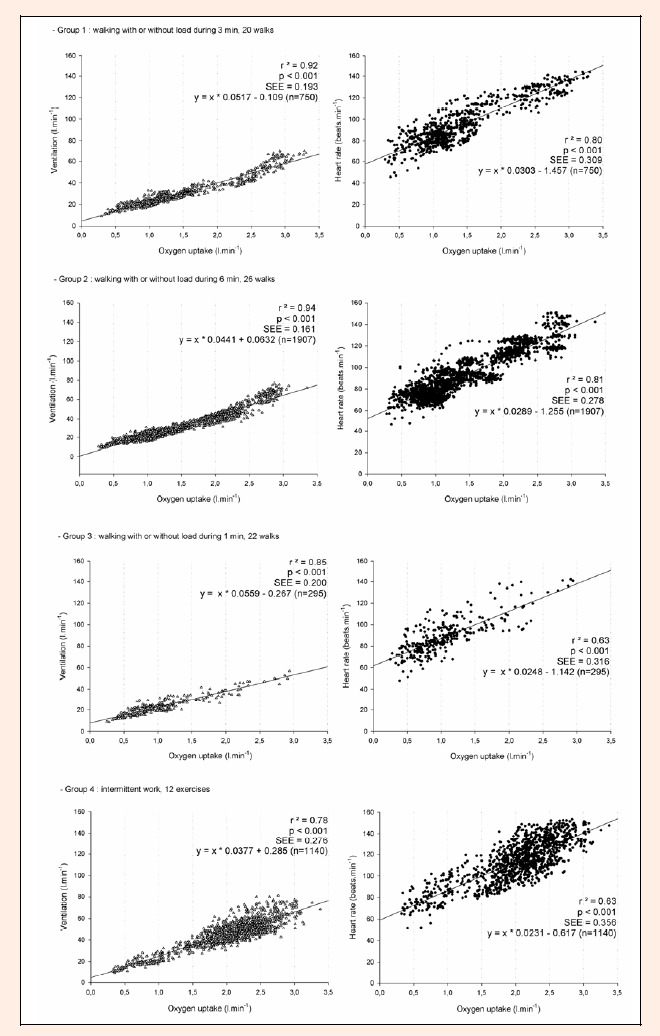
The aim of this study is to compare the relation between ventilation (VE) and oxygen uptake (VO2) [VO2=ƒ(VE)] and between heart rate (HR) and VO2 [VO2=ƒ(HR)]. Each one of the subjects performed three types of activities of different intensities (walking without load, walking with load and intermittent work). VO2, VE, and HR were measured continuously by using indirect calorimetry and an electrocardiogram. Linear regressions and coefficients of determination (r(2)) were calculated to compare the relation VO2 =ƒ(VE) and VO2 =ƒ(HR) for two different regroupings: by session duration (r(2) session) and by subject (r(2) subject). Results showed that r(2) session of the relation VO2 =ƒ(VE) were significantly higher than those of the relation VO2 =ƒ(HR) for steady state activities (walking with or without load during 3 or 6 min, p < 0.01) and for activities without oxygen consumption steady state (walking with or without load during 1 min, p < 0.01 and intermittent work, p < 0.05). VE is more strongly correlated with VO2 than with HR. This is a very promising approach to develop a new method to estimate energy expenditure. Key pointsVentilation is more strongly correlated with oxygen uptake than heart rate during physical activities of different intensities.This study shows the interest to looking for ventilation to estimate energy expenditure.This study is a promising approach to develop a new method to estimate energy expenditureAn interesting perspective could be to develop a light and portable device to measure ventilation based on the coupling of four magnetometers.
Keywords: Physical activities; light to moderate intensities; non-steady state activities.; steady state activities.
Figures
References
-
- Achten J., Jeukendrup A.E. (2003) Heart rate monitoring: applications and limitations. Sports Medicine 33(7), 517-538 - PubMed
-
- Ainsworth B.E., Haskell W.L., Whitt M.C., Irwin M.L., Swartz A.M., Strath S.J., O'Brien W.L., Bassett D.R., Jr., Schmitz K.H., Emplaincourt P.O., Jacobs D.R., Jr., Leon A.S. (2000) Compendium of physical activities: an update of activity codes and MET intensities. Medicine and Science in Sports and Eexercise 32, S498-504 - PubMed
-
- Astrand P.O., Ryhming I. (1954) A nomogram for calculation of aerobic capacity (physical fitness) from pulse rate during sub-maximal work. Journal of Applied Physiology 7, 218-221 - PubMed
-
- Bassett D.R., Ainsworth B.E., Swartz A.M. (2000) Validity of four motion sensors in measuring moderate intensity physical activity. Medicine and Science in Sports and Exercise 32, S471-S480 - PubMed
-
- Bouchard D.R., Trudeau F. (2008) Estimation of energy expenditure in a work environment: comparison of accelerometry and oxygen consumption/heart rate regression. Ergonomics 51, 663-670 - PubMed
LinkOut - more resources
Full Text Sources