


Physical activity - a neat solution to an impending crisis
- PMID: 24149423
- PMCID: PMC3787287
Physical activity - a neat solution to an impending crisis
Abstract
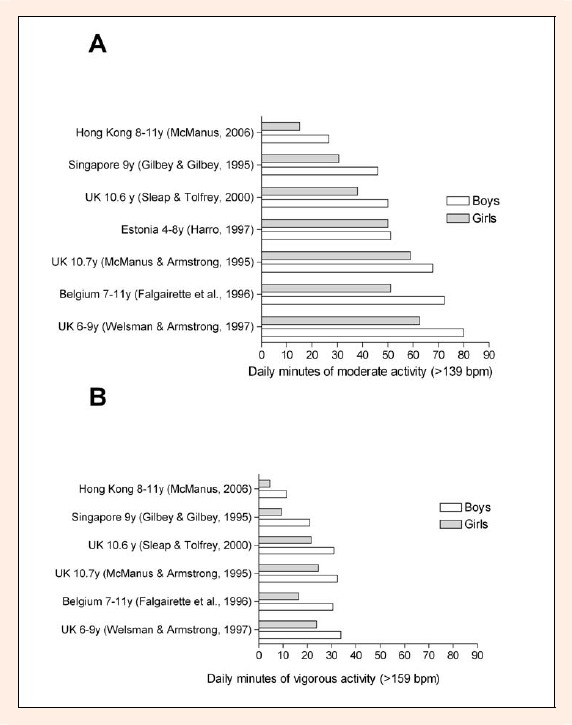
Childhood obesity is arguably the most significant global public health threat, yet effective strategies to contain or prevent the disease are not available. This review examines the physical activity patterns of children and the role physical activity plays in daily energy expenditure. The prevailing focus on moderate to vigorous activity in childhood means there is limited objective information on either sedentary behaviour or non-exercise activity thermogenesis (NEAT), the energy expended during the activities of daily living. Most strategies targeting the prevention of childhood obesity have focused upon adding moderate to vigorous activity and have not been particularly successful. The low efficacy of more purposeful activity is perhaps not surprising because of the small variance in children's physical activity levels explained by moderate to vigorous activity. Subtle changes in NEAT have in contrast been shown to account for differences in fat-mass gain or resistance in adults. Theoretically, manipulating a child's living environment to enhance NEAT would create a positive gain in TDEE, a gain that could lead to the prevention of excess fat-mass. More careful consideration of the specific aspects of physical activity that are most influential in the maintenance of body weight in childhood is a priority. Appreciating the role NEAT may play in the variation of total daily energy expenditure in children is a future challenge for physical activity research. Key pointsExcessive weight gain affects children in both developed and developing countries alike, and results initially from small energy imbalances. Increasing the energy expended in daily living has the potential to re-adjust energy balance and prevent initial excess weight gain.Sedentary behaviour and light intensity movement, as opposed to moderate or vigorous movement, dominate a child's day. We need to understand more about which aspects of activity account for variance in total daily energy expenditure in children.Finding innovative and creative ways to increase the daily energy children expend should be a priority.
Keywords: Physical activity; children; energy expenditure; obesity.
Figures
References
-
- Armstrong N. (1998) Young people’s physical activity patterns as assessed by heart rate monitoring. Journal of Sports Science 16 (Suppl), 9-16 - PubMed
-
- Armstrong N., Welsman J. (2006) The physical activity patterns of European youth with reference to methods of assessment. Sports Medicine 36, 1067-1086 - PubMed
-
- Astrand P. (1952) Experimental studies of physical working capacity in relation to sex and age. Copenhagen: Munksgaard
-
- Bailey R., Olson J., Pepper S., Porszasz J., Barstow T., Cooper D. (1995) The level and tempo of children’s physical activities: an observation study. Medicine and Science in Sports and Exercise 27, 1033-1041 - PubMed
Publication types
LinkOut - more resources
Full Text Sources