


Lactate kinetics after intermittent and continuous exercise training
- PMID: 24149461
- PMCID: PMC3761459
Lactate kinetics after intermittent and continuous exercise training
Abstract
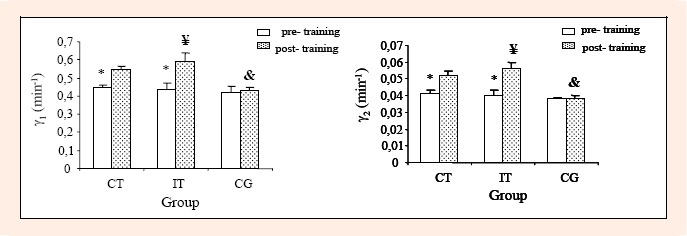
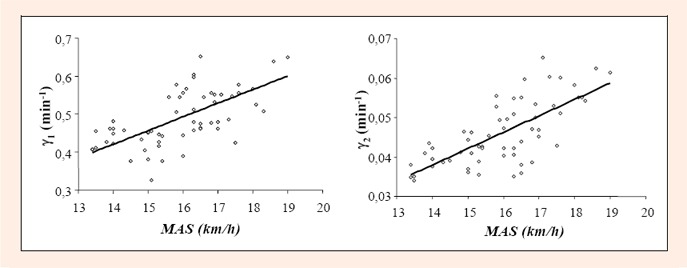
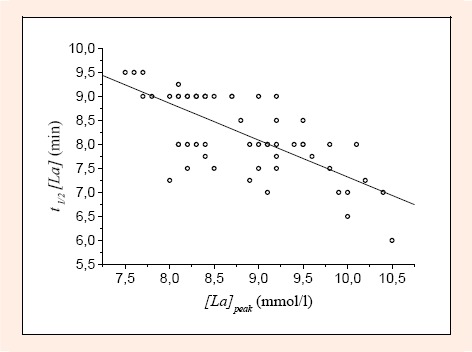
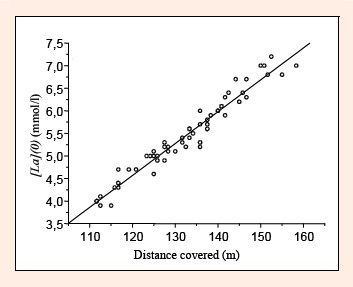
The purpose of this study was to assess, the effects of continuous and intermittent exercise training on lactate kinetic parameters and maximal aerobic speed (MAS) using field tests. Twenty-four male sport students were equally divided into continuous (CT) and intermittent (IT) physically trained groups. Another six participants acted as non-trained controls (CG). The trained participants practiced 6-days per week for 6 weeks. Before and after training, all participants completed an incremental exercise test to assess their MAS, and a 30- second supra-maximal exercise followed by 30 minutes of active recovery to determine the individual blood lactate recovery curve. It was found that exercise training has significantly increased MAS (p < 0.001), the lactate exchange and removal abilities as well as the lactate concentrations at the beginning of the recovery ([La]-(0)); for both CT and IT groups; this was accompanied by a significant reduction of the time to lactate-peak. Nevertheless, the improvement in MAS was significantly higher (p < 0.001) post-intermittent (15.1 % ± 2.4) than post-continuous (10.3 % ± 3.2) training. The lactate-exchange and removal abilities were also significantly higher for IT than for CT-group (P<0.05). Moreover, IT-group showed a significantly shorter half-time of the blood lactate (t-½-[La]) than CT-group (7.2 ± 0.5 min vs 7.7 ± 0.3 min, respectively) (p < 0.05). However, no significant differences were observed in peak blood lactate concentration ([La]peak), time to reach [La]peak (t-[La]peak), and [La]-(0) between the two physically-trained groups. We conclude that both continuous and intermittent training exercises were equally effective in improving t-[La]peak and [La]peak, although intermittent training was more beneficial in elevating MAS and in raising the lactate exchange (γ1) and removal (γ2) indexes. Key pointsCoaches and athletes need to be aware of the potentiality positive effects of exercise intensity.Improvements in physical fitness are associated with a concomitant increase in the lactate removal ability.In order to reduce lactate accumulation and increase maximal aerobic speed maximally, interval training method, with work speeds equal to 90% - 100% of MAS, may be the effective way when compared with continuous training method.
Keywords: Biexponential mathematical model; recovery; supra-maximal exercise..
Figures
References
-
- Bassett D.R., Merrill P.W., Nagle F.J., Sampedro R. (1991) Rate of decline in blood lactate after cycling exercise in endurance-trained and untrained subjects. Journal of Physiology 70, 1816-1820 - PubMed
-
- Billat V., Sirvent P., Lepretre P.M., Koralsztein J.P. (2004) Training effect on performance, substrate balance and blood lactate concentration at maximal lactate steady state in master endurance-runners. European Journal of Physiology 447, 875-883 - PubMed
-
- Billat V., Slawinski J., Bocquet V., Demarle A., Lafitte L., Chassaing P., Koralsztein JP. (2000) Intermittent runs at the velocity associated with maximal oxygen uptake enables subjects to remain at maximal oxygen uptake for a longer time than intense but submaximal runs. European Journal of Applied Physiology 81, 188-196 - PubMed
-
- Bonen A. (2000) Lactate transporters (MCT proteins) in heart and skeletal muscles. Medicine Science Sports and Exercise 32, 778-789 - PubMed
-
- Bret C., Messonnier L., Nouck J M., Freund H., Dufour AB., Lacour J R. (2003) Differences in lactate exchange and removal abilities in athletes specialised in different track running events (100 to 1500 m). International Journal of Sports Medicine 24, 108-113 - PubMed
LinkOut - more resources
Full Text Sources