


Women and Men in Sport Performance: The Gender Gap has not Evolved since 1983
- PMID: 24149688
- PMCID: PMC3761733
Women and Men in Sport Performance: The Gender Gap has not Evolved since 1983
Abstract
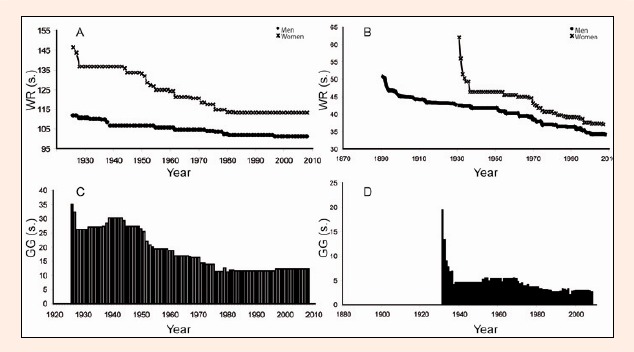
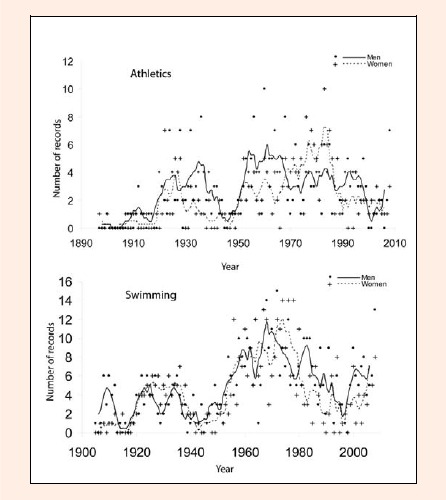
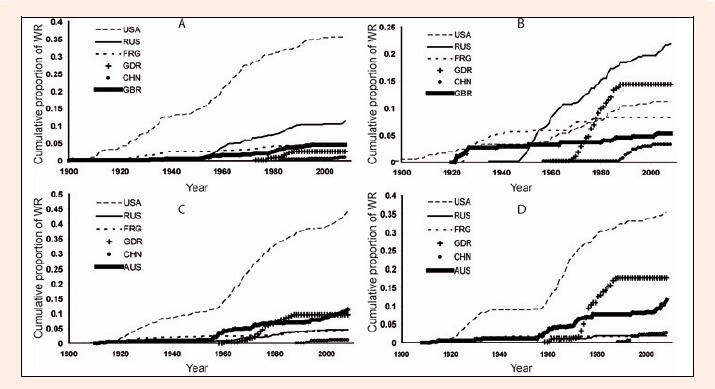
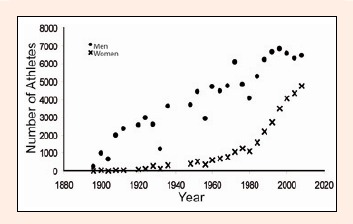
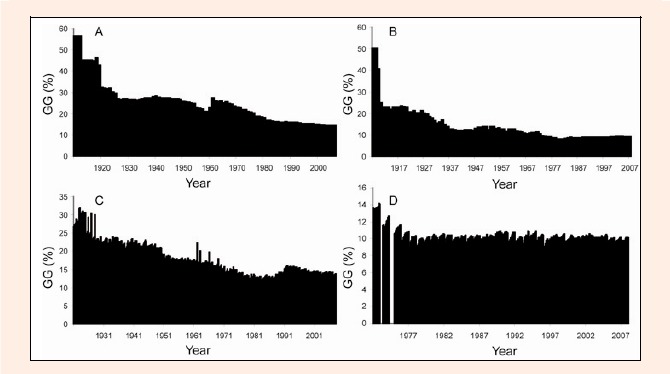
Sex is a major factor influencing best performances and world records. Here the evolution of the difference between men and women's best performances is characterized through the analysis of 82 quantifiable events since the beginning of the Olympic era. For each event in swimming, athletics, track cycling, weightlifting and speed skating the gender gap is fitted to compare male and female records. It is also studied through the best performance of the top 10 performers in each gender for swimming and athletics. A stabilization of the gender gap in world records is observed after 1983, at a mean difference of 10.0% ± 2.94 between men and women for all events. The gender gap ranges from 5.5% (800-m freestyle, swimming) to 18.8% (long jump). The mean gap is 10.7% for running performances, 17.5% for jumps, 8.9% for swimming races, 7.0% for speed skating and 8.7% in cycling. The top ten performers' analysis reveals a similar gender gap trend with a stabilization in 1982 at 11.7%, despite the large growth in participation of women from eastern and western countries, that coincided with later- published evidence of state-institutionalized or individual doping. These results suggest that women will not run, jump, swim or ride as fast as men. Key pointsSex is a major factor influencing best performances and world records.A stabilization of the gender gap in world records is observed after 1983, at a mean difference of 10.0% ± 2.94 between men and women for all events.The gender gap ranges from 5.5% (800-m freestyle, swimming) to 36.8% (weight lifting).The top ten performers' analysis reveals a similar gender gap trend with a stabilization in 1982 at 11.7%.Results suggest that women will not run, jump, swim or ride as fast as men.
Keywords: World records; best performances; elite sport; gender difference.
Figures
References
-
- Berthelot G., Thibault V., Tafflet M., Escolano S., El Helou N., Jouven X., Hermine O., Toussaint J.F. (2008) The Citius End: World Records progression announces the completion of a brief ultra-physiological quest. PLoS ONE 33(2). Available from URL: http://www.plosone.org - PMC - PubMed
-
- Cheuvront S.N., Carter R., Deruisseau K.C., Moffatt R.J. (2005) Running performance differences between men and women: an update. Sports Medicine 35, 1017-1024 - PubMed
-
- Courtenay W.H. (2000) Constructions of masculinity and their influence on men's well-being: a theory of gender and health. Social Science and Medicine 550, 1385-1401 - PubMed
-
- Cureton K., Bishop P., Hutchinson P., Newland H., Vickery S., Zwiren L. (1986) Sex difference in maximal oxygen uptake. European Journal of Applied Physiology and Occupational Physiology 54, 656-660 - PubMed
LinkOut - more resources
Full Text Sources
Miscellaneous