


Analysis of the vertical ground reaction forces and temporal factors in the landing phase of a countermovement jump
- PMID: 24149697
- PMCID: PMC3761745
Analysis of the vertical ground reaction forces and temporal factors in the landing phase of a countermovement jump
Abstract
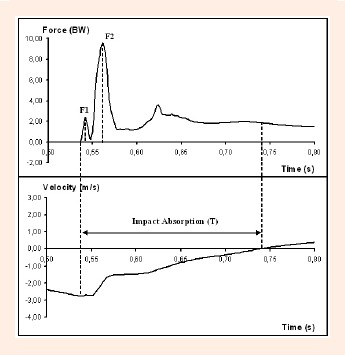
In most common bilateral landings of vertical jumps, there are two peak forces (F1 and F2) in the force-time curve. The combination of these peak forces and the high frequency of jumps during sports produce a large amount of stress in the joints of the lower limbs which can be determinant of injury. The aim of this study was to find possible relationships between the jump height and F1 and F2, between F1 and F2 themselves, and between F1, F2, the time they appear (T1 and T2, respectively) and the length of the impact absorption phase (T). Thirty semi-professional football players made five countermovement jumps and the highest jump of each player was analyzed. They were instructed to perform the jumps with maximum effort and to land first with the balls of their feet and then with their heels. All the data were collected using a Kistler Quattro Jump force plate with a sample rate of 500 Hz. Quattro Jump Software, v.1.0.9.0., was used. There was neither significant correlation between T1 and F1 nor between T1 and F2. There was a significant positive correlation between flight height (FH) and F1 (r = 0.584, p = 0.01) but no significant correlation between FH and F2. A significant positive correlation between F1 and T2 (r = 0.418, p < 0.05) and a significant negative correlation between F2 and T2 (r = -0.406, p < 0.05) were also found. There is a significant negative correlation between T2 and T (r = -0. 443, p < 0.05). T1 has a little effect in the impact absorption process. F1 increases with increasing T2 but F2 decreases with increasing T2. Besides, increasing T2, with the objective of decreasing F2, makes the whole impact absorption shorter and the jump landing faster. Key pointsIn the landing phase of a jump there are always sev-eral peak forces. The combination of these peaks forces and the high frequency of jumps during sports produces a large amount of stress in the joints of the lower limbs which can be determinant of injury.In the most common two-footed landings usually appear two peak forces (F1 and F2) in the force-time curve and the second one is usually related to injury's risk. In this article it is shown that increasing the time F2 appears decrease F2.Increasing landing times could be counterproductive with respect to the goals of the sport. In this article it is shown that increasing the time F2 appears makes, however, the whole impact absorption shorter in du-ration.
Keywords: Impact absorption; injuries; peak forces; vertical jump.
Figures
References
-
- Abián J., Alegre L.M., Lara A.J., Aguado X. (2006) Diferencias de sexo durante la amortiguación de caídas en tests de salto. Archivos de Medicina del Deporte 116, 441-449 (In Spanish: English abstract)
-
- Abián J., Alegre L.M., Lara A.J., Rubio J.A., Aguado X. (2008) Landing differences between men and women in a maximal vertical jump aptitude test. Journal of Sports Medicine & Physical Fitness 48, 305-310 - PubMed
-
- Aura O., Viitasalo J.T. (1989) Biomechanical Characteristics of Jumping. International Journal of Sports Biomechanics 5, 89-98
-
- Bobbert M.F., Van Ingen Schenau G.J. (1988) Coordination in Vertical Jump. Journal of Biomechanics 21(3), 249-262 - PubMed
-
- Bosco C. (1999) Strength Assessment with the Bosco’s Test. Rome: Italian Society of Sport Science.68
LinkOut - more resources
Full Text Sources
Miscellaneous