


Spinal posture of thoracic and lumbar spine and pelvic tilt in highly trained cyclists
- PMID: 24149883
- PMCID: PMC3761866
Spinal posture of thoracic and lumbar spine and pelvic tilt in highly trained cyclists
Abstract
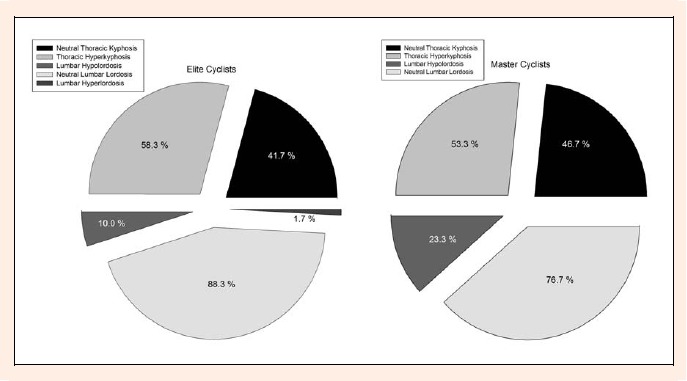
The aim of this study was to evaluate sagittal thoracic and lumbar spinal curvatures and pelvic tilt in elite and master cyclists when standing on the floor, and sitting on a bicycle at three different handlebar-hand positions. A total of 60 elite male cyclists (mean age: 22.95 ± 3.38 years) and 60 master male cyclists (mean age: 34.27 ± 3.05 years) were evaluated. The Spinal Mouse system was used to measure sagittal thoracic and lumbar curvature in standing on the floor and sitting positions on the bicycle at three different handlebar-hand positions (high, medium, and low). The mean values for thoracic and lumbar curvatures and pelvic tilt in the standing position on the floor were 48.17 ± 8.05°, -27.32 ± 7.23°, and 13.65 ± 5.54°, respectively, for elite cyclists and 47.02 ± 9.24°, -25.30 ± 6.29°, and 11.25 ± 5.17° for master cyclists. A high frequency of thoracic hyperkyphosis in the standing position was observed (58.3% in elite cyclists and 53.3% in master cyclists), whereas predominately neutral values were found in the lumbar spine (88.3% and 76.7% in elite and master cyclists, respectively). When sitting on the bicycle, the thoracic curve was at a lower angle in the three handlebar-hand positions with respect to the standing position on the floor in both groups (p < 0.01). The lumbar curve adopted a kyphotic posture. In conclusion, cyclists present a high percentage of thoracic hyperkyphotic postures in standing positions on the floor. However, thoracic hyperkyphosis is not directly related to positions adopted on the bicycle. Key pointsThis study evaluated thoracic and lumbar spinal curvatures and pelvic tilt in elite and master cyclists while standing and sitting on the bicycle.Elite and master cyclists showed a high frequency of thoracic hyperkyphosis and neutral lumbar lordosis in standing.Cyclists adopted a significantly lower thoracic kyphosis on the bicycle at the three handlebar positions analysed (upper, middle and lower handlebars) than in standing posture. The lumbar spine showed a kyphotic posture.The high percentage of standing thoracic hyperkyphosis in both groups of cyclists may be related to factors other than the specific posture adopted while cycling. Lumbar kyphosis on the bicycle may not affect the sagittal configuration of the lumbar spine in standing.
Keywords: Cycling; curvature; sagittal; sport.
Figures
References
-
- Alricsson M, Werner S. (2006) Young élite cross-country skiers and low back pain. A 5-year study. Physical Therapy in Sport, 7, 181-184 - PubMed
-
- Asplund C., Webb C., Barkdull T. (2005) Neck and back pain in bicycling. Current Sports Medicine Reports 4, 271-274 - PubMed
-
- Beach T., Parkinson R., Stothart P., Callaghan J. (2005) Effects of prolonged sitting on the passive flexion stiffness of the in vivo lumbar spine. The Spine Journal 5, 145-154 - PubMed
-
- Briggs A., Van Dieën J., Wrigley T., Greig A., Phillips B., Lo S., Bennell K. (2007) Thoracic kyphosis affects spinal loads and trunk muscle force. Physical Therapy 87, 595-607 - PubMed
LinkOut - more resources
Full Text Sources