. 2014 Feb;34(2):221-7.
doi: 10.1038/jcbfm.2013.186. Epub 2013 Oct 23.

Blood glutamate scavenging as a novel neuroprotective treatment for paraoxon intoxication

Affiliations

Blood glutamate scavenging as a novel neuroprotective treatment for paraoxon intoxication

Angela Ruban et al. J Cereb Blood Flow Metab. 2014 Feb.

Abstract

Organophosphate-induced brain damage is an irreversible neuronal injury, likely because there is no pharmacological treatment to prevent or block secondary damage processes. The presence of free glutamate (Glu) in the brain has a substantial role in the propagation and maintenance of organophosphate-induced seizures, thus contributing to the secondary brain damage. This report describes for the first time the ability of blood glutamate scavengers (BGS) oxaloacetic acid in combination with glutamate oxaloacetate transaminase to reduce the neuronal damage in an animal model of paraoxon (PO) intoxication. Our method causes a rapid decrease of blood Glu levels and creates a gradient that leads to the efflux of the excess brain Glu into the blood, thus reducing neurotoxicity. We demonstrated that BGS treatment significantly prevented the peripheral benzodiazepine receptor (PBR) density elevation, after PO exposure. Furthermore, we showed that BGS was able to rescue neurons in the piriform cortex of the treated rats. In conclusion, these results suggest that treatment with BGS has a neuroprotective effect in the PO intoxication. This is the first time that this approach is used in PO intoxication and it may be of high clinical significance for the future treatment of the secondary neurologic damage post organophosphates exposure.


Figures
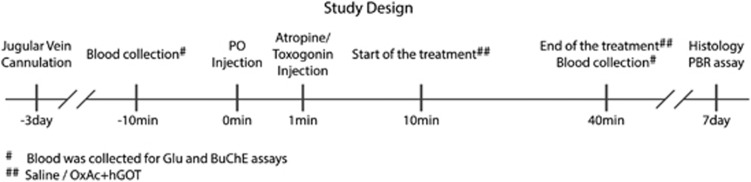
Figure 1
Figure 1
Study design. An illustration of the steps performed in the study.
Figure 2
Figure 2
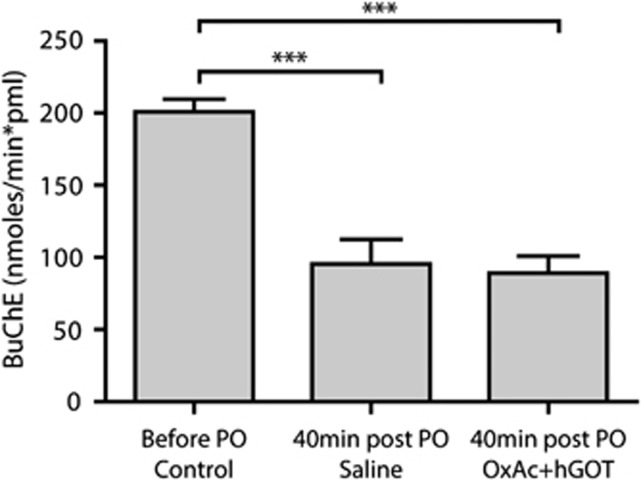
Butyrylcholinesterase activity decreases after paraoxon (PO) challenge. The rate of activity of butyrylcholinesterase (BuChE) is significantly lower 40 minutes after PO injection for both groups as compared with before the injection (control). There is no significant difference between PO and saline and PO and OxAc+hGOT (human glutamate oxaloacetate transaminase) groups indicating no direct effect of the blood glutamate scavenger (BGS) treatment on the PO activity. Control here refers to before the PO challenge (n=31). Saline n=16, OxAc+hGOT n=15, P<0.001 for both using one-way analysis of variance with Newman–Keuls multiple comparison test, ***P<0.001. OxAc, oxaloacetate.
Figure 3
Figure 3
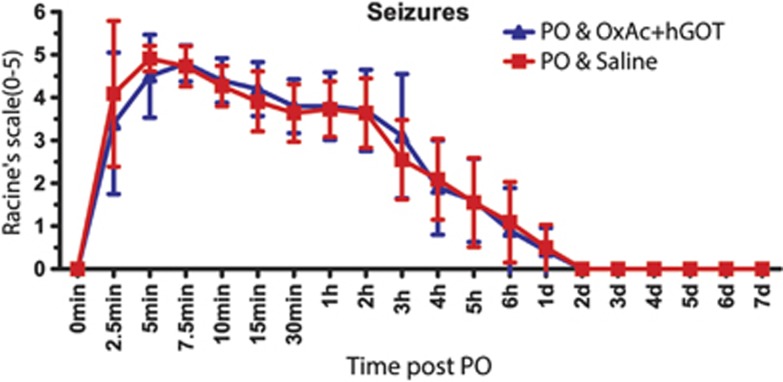
Clinical signs are similar between control and treated groups. Seizures were quantified on a Racine's scale (0 to 5). No significant difference was observed in the control (saline–red squares; n=16) versus treated (OxAc+hGOT (human glutamate oxaloacetate transaminase)–blue triangles; n=15) groups indicating that there was no direct effect of the blood glutamate scavenger treatment on the paraoxon (PO) activity. One-way analysis of variance with Newman–Keuls multiple comparison test, P>0.05. OxAc, oxaloacetate.
Figure 4
Figure 4
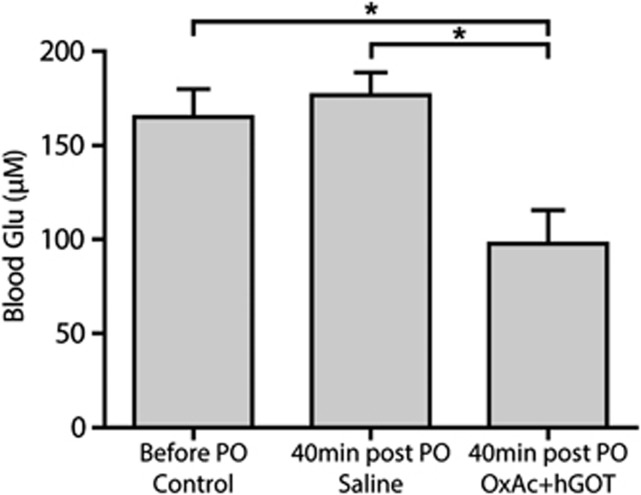
Blood glutamate (Glu) levels decreases with administration of Glu scavengers. The injection of OxAc+hGOT (human glutamate oxaloacetate transaminase) (n=15) significantly reduced the blood Glu concentration in contrast to the saline (n=16) injection P<0.05 using one-way analysis of variance with Newman–Keuls multiple comparison test. We suggest that this creates a larger brain-to-blood efflux that is a critical part of the blood glutamate scavenger method. Control here refers to 10 minutes before the paraoxon (PO) challenge of all treated animals (n=31); Two other groups are 40 minutes after PO injection. *P<0.05. OxAc, oxaloacetate.
Figure 5
Figure 5
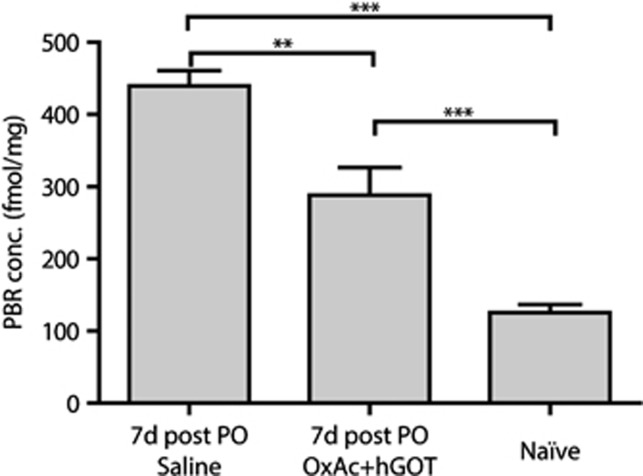
Whole-brain peripheral benzodiazepine receptor (PBR) concentration is lowered upon administration of glutamate (Glu) scavengers. Peripheral benzodiazepine receptor concentration is a good indicator of neuronal stress. Here we see a significant reduction in PBR concentration as a result of the BGS treatment. Although naïve animals (n=5) have the lowest concentration of PBR, there is a significant difference between saline (n=4) and OxAc+hGOT (human glutamate oxaloacetate transaminase) (n=4) treated groups 7 days after the paraoxon (PO) challenge. One-way analysis of variance with Newman–Keuls multiple comparison test; **P<0.01, ***P<0.001.
Figure 6
Figure 6
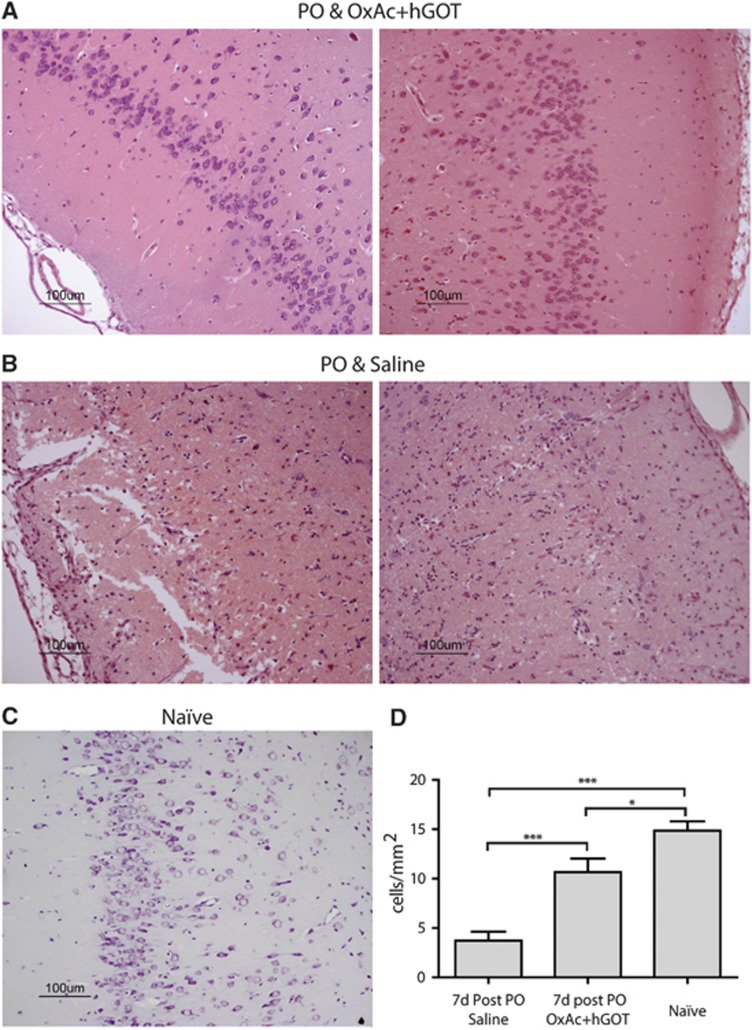
Cell numbers in the piriform cortex are rescued as a result of glutamate (Glu) scavengers. (A, B) Example sections from paraoxon (PO) and OxAc+hGOT (human glutamate oxaloacetate transaminase) (A) and PO and saline (B) groups of hematoxylin and eosin (H&E) staining. Left and right columns represent left and right piriform cortex accordingly. (C) Example section of the piriform cortex from a naïve animal of H&E staining. All scale bars are 100 μm. (D) Quantification of cell densities per mm2 from eight cortex sections of each group, each 6 μm width. Lower neuronal cell number indicates increased brain damage as a result of neuronal death. The amount of the rescued neurons is significantly higher in the OxAc+hGOT-treated group (n=8) as compared with the saline group (n=8), although the naïve group (n=5) had more neurons then both groups. *P<0.05, ***P<0.001. OxAc, oxaloacetate.

References

    1. Vinay P, Shubha S, Rao S, Charmaine S, Ashwini K, Rohith V. A case of organophosphate poisoning presenting with seizure and unavailable history of parenteral suicide attempt. J Emerg Trauma Shock. 2011;4:132–265. - PMC - PubMed
    1. Santos MD, Pereira EF, Aracava Y, Castro NG, Fawcett WP, Randall WR, et al. Low concentrations of pyridostigmine prevent soman-induced inhibition of GABAergic transmission in the central nervous system: involvement of muscarinic receptors. J Pharmacol Exp Ther. 2003;304:254–265. - PubMed
    1. Lallement G, Delamanche IS, Pernot-Marino I, Baubichon D, Denoyer M, Carpentier P, et al. Neuroprotective activity of glutamate receptor antagonists against soman-induced hippocampal damage: quantification with an omega 3 site ligand. Brain Res. 1993;618:227–237. - PubMed
    1. Granacher RP., Jr . Traumatic brain injury: methods for clinical and forensic neuropsychiatric assessment. CRC; 2007.
    1. McDonough JH, Jr., McLeod CG, Jr., Nipwoda MT. Direct microinjection of soman or VX into the amygdala produces repetitive limbic convulsions and neuropathology. Brain Res. 1987;435:123–137. - PubMed

Publication types

MeSH terms