


Genetic attributes of blood-derived subtype-C HIV-1 tat and env in India and neurocognitive function
- PMID: 24150902
- PMCID: PMC3872113
- DOI: 10.1002/jmv.23816
Genetic attributes of blood-derived subtype-C HIV-1 tat and env in India and neurocognitive function
Abstract
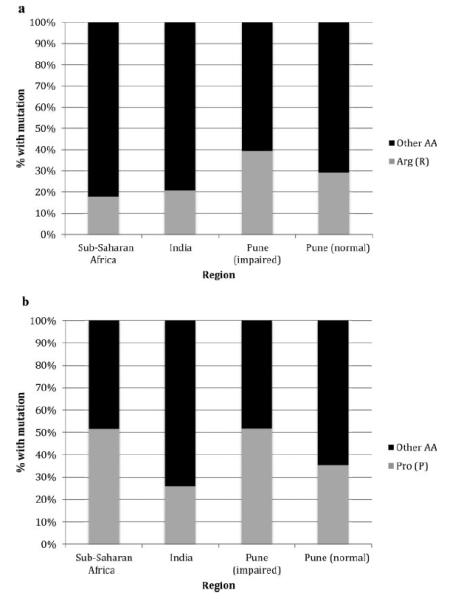
Genetic elements in HIV-1 subtype B tat and env are associated with neurotoxicity yet less is known about other subtypes. HIV-1 subtype C tat and env sequences were analyzed to determine viral genetic elements associated with neurocognitive impairment in a large Indian cohort. Population-based sequences of HIV-1 tat (exon 1) and env (C2-V3 coding region) were generated from blood plasma of HIV-infected patients in Pune, India. Participants were classified as cognitively normal or impaired based on neuropsychological assessment. Tests for signature residues, positive and negative selection, entropy, and ambiguous bases were performed using tools available through Los Alamos National Laboratory (http://www.hiv.lanl.gov) and Datamonkey (http://www.datamonkey.org). HIV-1 subtype C tat and env sequences were analyzed for 155 and 160 participants, of which 34-36% were impaired. Two signature residues were unique to impaired participants in exon 1 of tat at codons 29 (arginine) and 68 (proline). Positive selection was noted at codon 29 among normal participants and at codon 68 in both groups. The signature at codon 29 was also a signature for low CD4+ (<200 cells/mm(3)) counts but remained associated with impairment after exclusion of those with low CD4+ counts. No unique genetic signatures were noted in env. In conclusion, two signature residues were identified in exon 1 of HIV-1 subtype C tat that were associated with neurocognitive impairment in India and not completely accounted for by HIV disease progression. These signatures support a linkage between diversifying selection in HIV-1 subtype C tat and neurocognitive impairment.
Keywords: clade C; impairment; neuropsychological testing; residue; sequence; signature.
© 2013 Wiley Periodicals, Inc.
Figures
References
-
- Antinori A, Arendt G, Becker JT, Brew BJ, Byrd DA, Cherner M, Clifford DB, Cinque P, Epstein LG, Goodkin K, Gisslen M, Grant I, Heaton RK, Joseph J, Marder K, Marra CM, McArthur JC, Nunn M, Price RW, Pulliam L, Robertson KR, Sacktor N, Valcour V, Wojna VE. Updated research nosology for HIV-associated neurocognitive disorders. Neurology. 2007;69:1789–1799. - PMC - PubMed
-
- Carey CL, Woods SP, Gonzalez R, Conover E, Marcotte TD, Grant I, Heaton RK. Predictive validity of global deficit scores in detecting neuropsychological impairment in HIV infection. J Clin Exp Neuropsychol. 2004;26:307–319. - PubMed
-
- Choi JY, Hightower GK, Wong JK, Heaton R, Woods S, Grant I, Marcotte TD, Ellis RJ, Letendre SL, Collier AC, Marra CM, Clifford DB, Gelman BB, McArthur JC, Morgello S, Simpson DM, McCutchan JA, Richman DD, Smith DM. Genetic features of cerebrospinal fluid-derived subtype B HIV-1 tat. J Neurovirol. 2012;18:81–90. - PMC - PubMed
Publication types
MeSH terms
Substances
Grants and funding
- K24 AI100665/AI/NIAID NIH HHS/United States
- R01 AI047745/AI/NIAID NIH HHS/United States
- AI36214/AI/NIAID NIH HHS/United States
- AI47745./AI/NIAID NIH HHS/United States
- DP1 DA034978/DA/NIDA NIH HHS/United States
- R56 AI047745/AI/NIAID NIH HHS/United States
- MH62512/MH/NIMH NIH HHS/United States
- R01 MH083552/MH/NIMH NIH HHS/United States
- R01 MH097520/MH/NIMH NIH HHS/United States
- R01 MH078748/MH/NIMH NIH HHS/United States
- R01; MH78748/MH/NIMH NIH HHS/United States
- MH83552/MH/NIMH NIH HHS/United States
- MH097520/MH/NIMH NIH HHS/United States
- R21 AI047745/AI/NIAID NIH HHS/United States
- DA034978/DA/NIDA NIH HHS/United States
- P30 MH062512/MH/NIMH NIH HHS/United States
- P30 AI036214/AI/NIAID NIH HHS/United States
- AI100665/AI/NIAID NIH HHS/United States
LinkOut - more resources
Full Text Sources
Other Literature Sources
Medical
Research Materials
Miscellaneous
