


Predictors of significant worsening of patient-reported fatigue over a 1-month timeframe in ambulatory patients with common solid tumors
- PMID: 24151111
- PMCID: PMC4134680
- DOI: 10.1002/cncr.28437
Predictors of significant worsening of patient-reported fatigue over a 1-month timeframe in ambulatory patients with common solid tumors
Abstract
Background: Understanding the determinants of fatigue worsening may help distinguish between different fatigue phenotypes and inform clinical trial designs.
Methods: Patients with invasive cancer of the breast, prostate, colon/rectum, or lung were enrolled from multiple sites. At enrollment during an outpatient visit and 4 or 5 weeks later, patients rated their symptoms on a numerical rating scale from zero to 10. A 2-point change on that scale was considered clinically significant for a change in fatigue. Effects of demographic and clinical factors on patient-reported fatigue were examined using logistic regression models.
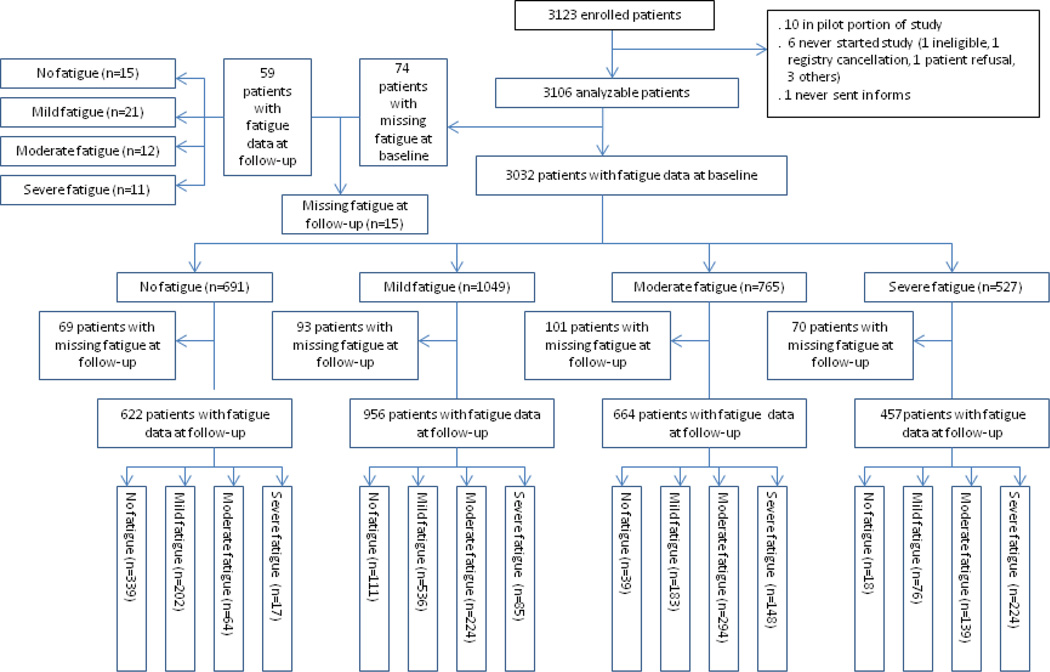
Results: In total, 3123 patients were enrolled at baseline, and 3032 patients could be analyzed for fatigue change. At baseline, 23% of patients had no fatigue, 35% had mild fatigue, 25% had moderate fatigue, and 17% had severe fatigue. Key parameters in a model of fatigue worsening included fatigue at baseline (odds ratio [OR], 0.75), disease status (OR, 1.99), performance status (OR, 1.38), history of depression (OR, 1.28), patient perception of bother because of comorbidity (OR, 1.26), and treatment exposures, including recent cancer treatment (OR, 1.77) and receipt of corticosteroids (OR, 1.37). The impact of sex was examined only in patients with colorectal and lung cancer, and it was a significant factor, with men most likely to experience worsening of fatigue (OR, 1.46).
Conclusions: Predictors of fatigue worsening included multiple factors that were difficult to modify, including the baseline fatigue level, sex, disease status, performance status, recent cancer treatment, bother because of comorbidity, and history of depression. Future fatigue prevention and treatment trial designs should account for key predictors of worsening fatigue.
Keywords: ambulatory care; cancer fatigue; medical oncology; symptom management.
© 2013 American Cancer Society.
Conflict of interest statement
Figures
References
-
- Donovan KA, McGinty HL, Jacobsen PB. A systematic review of research using the diagnostic criteria for cancer-related fatigue. Psycho-oncology. 2012 - PubMed
-
- Berger AM, Gerber LH, Mayer DK. Cancer-related fatigue: implications for breast cancer survivors. Cancer. 2012;118:2261–2269. - PubMed
-
- Campos MP, Hassan BJ, Riechelmann R, Del Giglio A. Cancer-related fatigue: a practical review. Annals of oncology : official journal of the European Society for Medical Oncology / ESMO. 2011;22:1273–1279. - PubMed
-
- Mitchell SA. Cancer-related fatigue: state of the science. PM & R. 2010;2:364–383. - PubMed
Publication types
MeSH terms
Grants and funding
LinkOut - more resources
Full Text Sources
Other Literature Sources
Medical
