


What is a representative brain? Neuroscience meets population science
- PMID: 24151336
- PMCID: PMC3816464
- DOI: 10.1073/pnas.1310134110
What is a representative brain? Neuroscience meets population science
Abstract
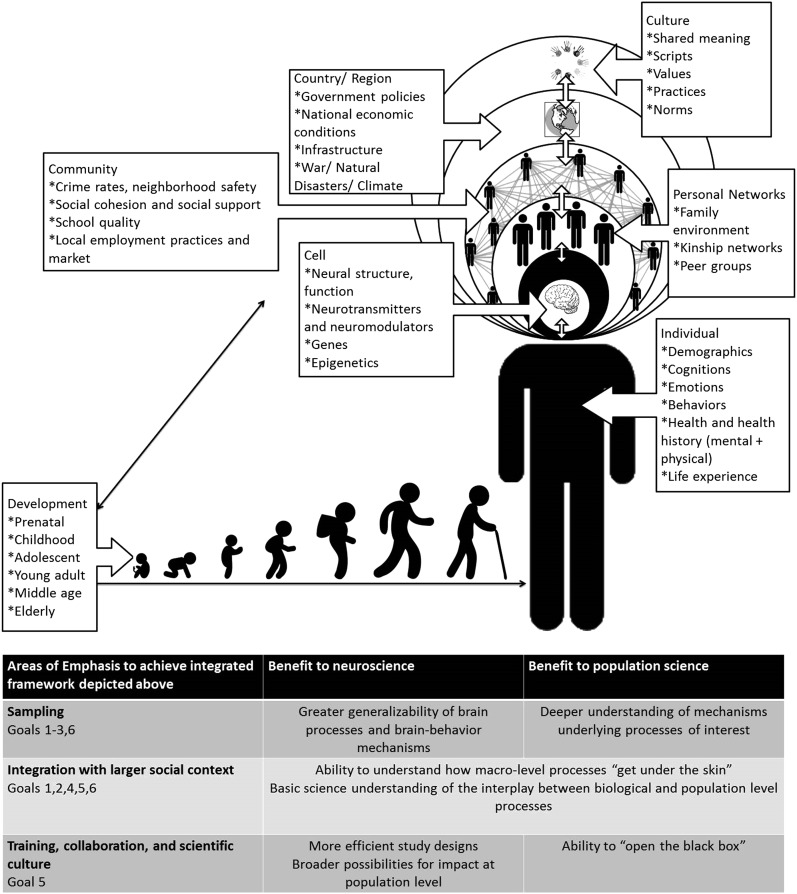
The last decades of neuroscience research have produced immense progress in the methods available to understand brain structure and function. Social, cognitive, clinical, affective, economic, communication, and developmental neurosciences have begun to map the relationships between neuro-psychological processes and behavioral outcomes, yielding a new understanding of human behavior and promising interventions. However, a limitation of this fast moving research is that most findings are based on small samples of convenience. Furthermore, our understanding of individual differences may be distorted by unrepresentative samples, undermining findings regarding brain-behavior mechanisms. These limitations are issues that social demographers, epidemiologists, and other population scientists have tackled, with solutions that can be applied to neuroscience. By contrast, nearly all social science disciplines, including social demography, sociology, political science, economics, communication science, and psychology, make assumptions about processes that involve the brain, but have incorporated neural measures to differing, and often limited, degrees; many still treat the brain as a black box. In this article, we describe and promote a perspective--population neuroscience--that leverages interdisciplinary expertise to (i) emphasize the importance of sampling to more clearly define the relevant populations and sampling strategies needed when using neuroscience methods to address such questions; and (ii) deepen understanding of mechanisms within population science by providing insight regarding underlying neural mechanisms. Doing so will increase our confidence in the generalizability of the findings. We provide examples to illustrate the population neuroscience approach for specific types of research questions and discuss the potential for theoretical and applied advances from this approach across areas.
Keywords: life course; neuroimaging; physics; statistics; survey methodology.
Conflict of interest statement
The authors declare no conflict of interest.
Figures
References
-
- Cabeza R, Nyberg L. Imaging cognition II: An empirical review of 275 PET and fMRI studies. J Cogn Neurosci. 2000;12(1):1–47. - PubMed
-
- Cacioppo JT, Berntson GG, Sheridan JF, McClintock MK. Multilevel integrative analyses of human behavior: Social neuroscience and the complementing nature of social and biological approaches. Psychol Bull. 2000;126(6):829–843. - PubMed
-
- Lieberman MD. Social cognitive neuroscience. In: Fiske S, Gilbert D, Lindzey G, editors. Handbook of Social Psychology. 5th Ed. New York: McGraw-Hill; 2010. pp. 143–193.
-
- Sanfey AG, Loewenstein G, McClure SM, Cohen JD. Neuroeconomics: Cross-currents in research on decision-making. Trends Cogn Sci. 2006;10(3):108–116. - PubMed
-
- Eisenberger NI, Cole SW. Social neuroscience and health: Neurophysiological mechanisms linking social ties with physical health. Nat Neurosci. 2012;15(5):669–674. - PubMed
Publication types
MeSH terms
Grants and funding
LinkOut - more resources
Full Text Sources
Other Literature Sources
Medical
