


IGF-1, the cross road of the nutritional, inflammatory and hormonal pathways to frailty
- PMID: 24152751
- PMCID: PMC3820068
- DOI: 10.3390/nu5104184
IGF-1, the cross road of the nutritional, inflammatory and hormonal pathways to frailty
Abstract
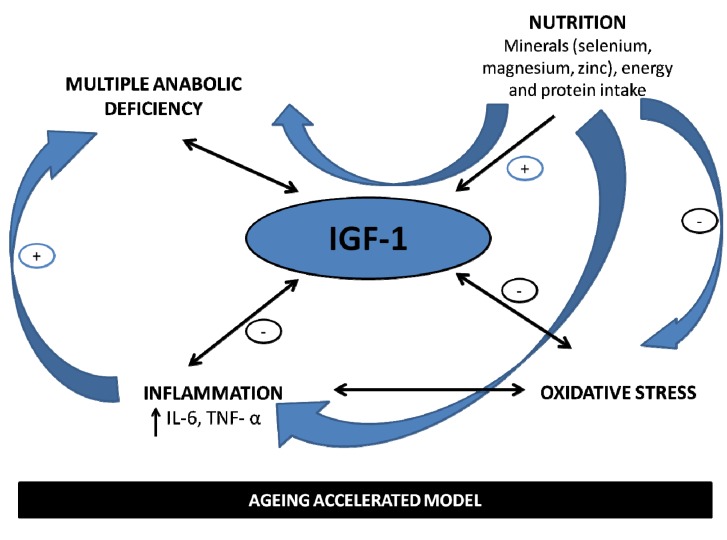
The decline in functional capacity is a heterogeneous phenomenon in the elderly. An accelerated ageing determines a frail status. It results in an increased vulnerability to stressors for decreased physiological reserves. The early identification of a frail status is essential for preventing loss of functional capacity, and its clinical consequences. Frailty and mobility limitation result from an interplay of different pathways including multiple anabolic deficiency, inflammation, oxidative stress, and a poor nutritional status. However, the age-related decline in insulin-like growth factor 1 (IGF-1) bioactivity deserves special attention as it could represent the ideal crossroad of endocrine, inflammatory, and nutritional pathways to frailty. Several minerals, namely magnesium, selenium, and zinc, appear to be important determinants of IGF-1 bioactivity. This review aims to provide an overview of the potential usefulness of nutrients modulating IGF-1 as potential therapeutic targets in the prevention of mobility limitation occurring in frail older subjects.
Figures
References
-
- Delmonico M.J., Harris T.B., Lee J.S., Visser M., Nevitt M., Kritchevsky S.B., Tylavsky F.A., Newman A.B. Health, aging and body composition study. Alternative definitions of sarcopenia, lower extremity performance, and functional impairment with aging in older men and women. J. Am. Geriatr. Soc. 2007;55:769–774. doi: 10.1111/j.1532-5415.2007.01140.x. - DOI - PubMed
-
- Goodpaster B.H., Park S.W., Harris T.B., Kritchevsky S.B., Nevitt M., Schwartz A.V., Simonsick E.M., Tylavsky F.A., Visser M., Newman A.B. The loss of skeletal muscle strength, mass, and quality in older adults: The health, aging and body composition study. J. Gerontol. 2006;61:1059–1064. doi: 10.1093/gerona/61.10.1059. - DOI - PubMed
-
- Cruz-Jentoft A.J., Baeyens J.P., Bauuer J.M., Boirie Y., Cederholm T., Landi F., Martin F.C., Michel J.P., Rolland Y., Schneider S.M., et al. Sarcopenia: European consensus on definition and diagnosis: Report of the European Working Group on Sarcopenia in Older People. Age Ageing. 2010;1:412–423. - PMC - PubMed
-
- Rosenberg I.H. Sarcopenia: Origins and clinical relevance. J. Nutr. 1997;127:990S–991S. - PubMed
Publication types
MeSH terms
Substances
LinkOut - more resources
Full Text Sources
Other Literature Sources
Miscellaneous
