. 2013 Dec;14(12):1174-81.
doi: 10.4161/cbt.26884. Epub 2013 Oct 23.

Circulating tumor cells are associated with diffuse spread in stage IV colorectal cancer patients

Affiliations

Circulating tumor cells are associated with diffuse spread in stage IV colorectal cancer patients

Jussuf T Kaifi et al. Cancer Biol Ther. 2013 Dec.

Abstract

Background: Colorectal cancer (CRC) is the second leading cause of cancer-related deaths in the United States when combining both genders. Circulating tumor cells (CTCs) are a prognostic marker for stage IV CRC patients. We hypothesized that CTC quantity varies among stage IV CRC populations.

Methods: Blood (7.5 ml) was prospectively collected from 90 stage IV CRC patients. EpCAM(+) CTCs were analyzed with the FDA-approved CellSearch(®) system. CRC tumors were immunohistochemically stained for EpCAM expression. Imaging and clinicopathological data were collected. Statistical analysis was performed using correlation analysis, Kruskal-Wallis, Fisher exact, and log-rank test.

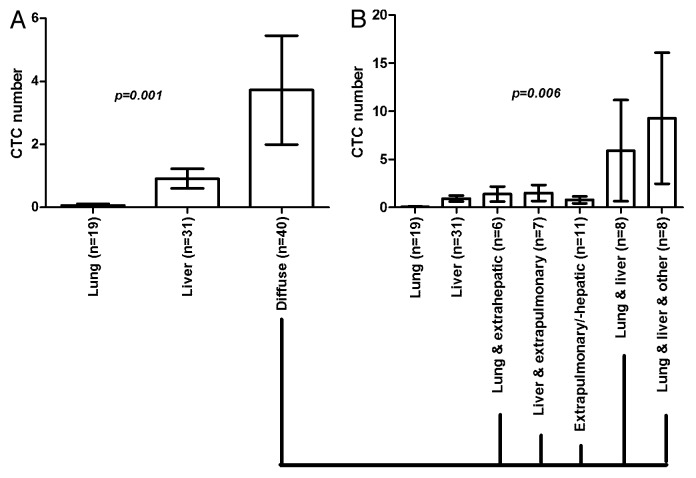
Results: CTCs were detectable in 36/90 (40%) patients. Diffuse CRC metastases were associated with the highest CTC prevalence (24/40 [60%]), in contrast to limited lung (2/19 [11%]) or liver (10/31 [32%]) metastases (P = 0.027). The overall mean CTC number was 2.0 (range 0-56.3). The mean CTC number in patients with diffuse metastases was significantly higher (3.7 [SEM ± 1.7, range 0-56.3]) than with limited lung metastases (0.1 [± 0.1; range 0-1]) or liver metastases (0.9 [± 0.3, range 0-7.0]) (P = 0.001). CRC tumors were consistently expressing EpCAM. CTC numbers did not correlate with serum CEA levels or other routine clinical parameters (P = N.S.). Patients with diffuse metastases had the poorest overall survival (P = 0.0042).

Conclusions: CRC patients with diffuse metastases have the highest number of CTCs, in contrast to limited metastases to the liver or lungs. Future studies should correlate CTCs with recurrence patterns in patients with resected CRC lung or liver metastases to investigate whether CTCs represent micrometastatic disease causing early relapses.

Keywords: circulating tumor cells; colorectal cancer; metastasis.


Figures
None
Figure 1. Bar graphs showing different metastatic spread patterns in 90 stage IV CRC patients, as determined by biopsy results and imaging. CTCs were determined in 7.5 ml of blood by EpCAM-based and FDA-approved CellSearch® analysis. (A) Patients with diffuse metastases had significantly higher CTC numbers than patients with metastases limited to the lung or liver. (B) Represents subclassification of the metastatic patterns in patients with diffuse metastases. Analysis revealed that patients with lung and liver metastases, and patients with lung and liver and additional extrapulmonary/-hepatic disease had the highest CTC numbers, in contrast to patients with isolated lung or liver, or absence of lung or liver metastases. Patient numbers are provided in brackets. Shown are mean values with standard error of the mean (SEM). P values were calculated by nonparametric Kruskal–Wallis test.
None
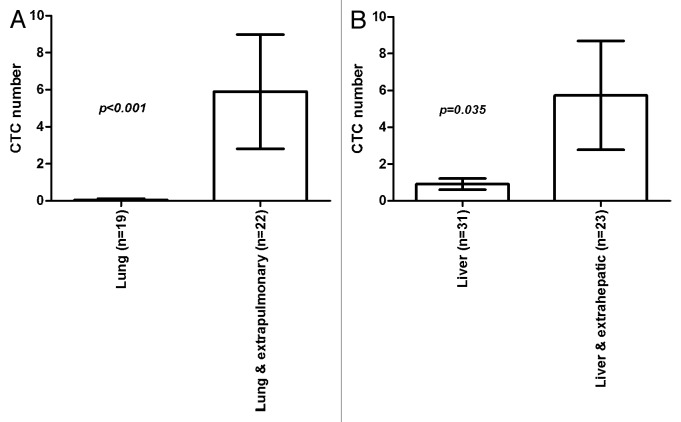
Figure 2. Bar graphs demonstrating comparison of CTC numbers determined in 7.5 ml of blood by FDA-approved CellSearch® analysis in patients with (A) isolated lung metastases vs. lung and extrapulmonary spread, and (B) isolated liver metastases vs. liver and extrahepatic spread. Stage IV CRC patients with isolated lung or liver in comparison to extrapulmonary or -hepatic metastases had significantly higher CTC numbers than patients with isolated lung or purely extrapulmonary metastases. Patient numbers are provided in brackets. Shown are mean values with standard error of the mean (SEM). P values were calculated by nonparametric Kruskal–Wallis test.
None
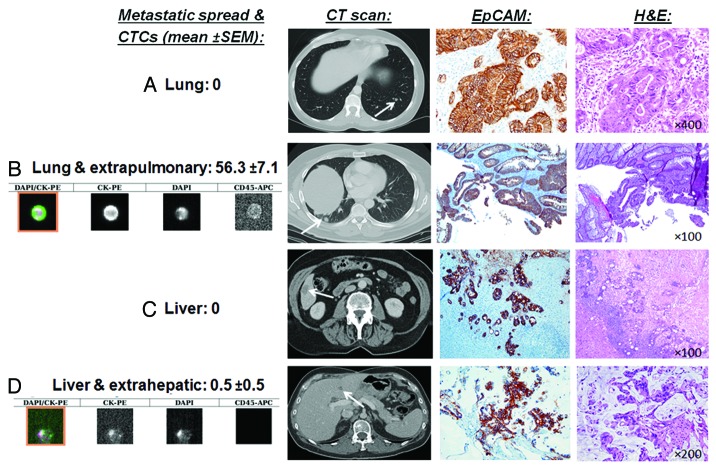
Figure 3. EpCAM is consistently expressed in CRC primary tumors, also in patients that have no CTCs detectable by EpCAM-based CellSearch® system. Illustrated are CTC images and mean CTC numbers (± SEM), CT scans of liver and lung metastases, EpCAM, and hematoxylin and eosin (H&E) stains of CRC tumors. Shown are patients with (A) resectable (oligometastatic) lung metastases with no additional spread and with zero CTCs (good surgical candidate for lung resection), (B) lung metastases and extrapulmonary spread with mean CTCs of 56.3 (poor surgical candidate for lung resection), (C) resectable (oligometastatic) liver metastases with no additional spread with zero CTCs (good surgical candidate for liver resection), and (D) liver metastases and extrahepatic spread with mean CTCs of 0.5 (poor surgical candidate for liver resection).

References

    1. Jemal A, Siegel R, Xu J, Ward E. Cancer statistics, 2010. CA Cancer J Clin. 2010;60:277–300. doi: 10.3322/caac.20073. - DOI - PubMed
    1. Chun YS, Vauthey JN. Extending the frontiers of resectability in advanced colorectal cancer. Eur J Surg Oncol. 2007;33(Suppl 2):S52–8. doi: 10.1016/j.ejso.2007.09.026. - DOI - PubMed
    1. Pantel K, Brakenhoff RH, Brandt B. Detection, clinical relevance and specific biological properties of disseminating tumour cells. Nat Rev Cancer. 2008;8:329–40. doi: 10.1038/nrc2375. - DOI - PubMed
    1. Liu MC, Shields PG, Warren RD, Cohen P, Wilkinson M, Ottaviano YL, Rao SB, Eng-Wong J, Seillier-Moiseiwitsch F, Noone AM, et al. Circulating tumor cells: a useful predictor of treatment efficacy in metastatic breast cancer. J Clin Oncol. 2009;27:5153–9. doi: 10.1200/JCO.2008.20.6664. - DOI - PMC - PubMed
    1. Hayes DF, Smerage JB. Circulating tumor cells. Prog Mol Biol Transl Sci. 2010;95:95–112. doi: 10.1016/B978-0-12-385071-3.00005-8. - DOI - PubMed

Publication types

LinkOut - more resources