


Impact of perineural invasion in the pathologically N0 neck in oral cavity squamous cell carcinoma
- PMID: 24154744
- PMCID: PMC4118458
- DOI: 10.1177/0194599813506867
Impact of perineural invasion in the pathologically N0 neck in oral cavity squamous cell carcinoma
Abstract
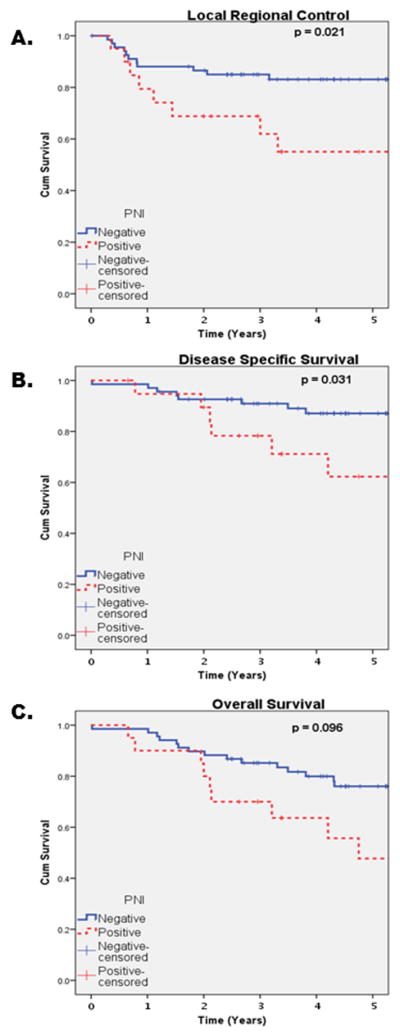
Objective: Patients with oral cavity squamous cell carcinoma (OCSCC) undergo adjuvant radiation for pathologically high-risk features including positive nodal disease and extracapsular spread (ECS). In the absence of these high-risk features, our objective was to determine if perineural invasion (PNI) is an independent risk factor and if adjuvant radiation (XRT) improves disease control rates.
Study design: Historical cohort analysis.
Setting: Tertiary university hospital.
Methods: Eighty-eight OCSCC patients (46 males, 42 females; mean age = 56.7 years; median follow-up = 4.6 years) treated surgically with pathologically N0 (pN0) necks were studied. Overall, 23% (20/88) were pN0/PNI+ and of those with PNI, 70% (14/20) underwent XRT. Survival analysis using Kaplan-Meier followed by multivariable Cox models was performed.
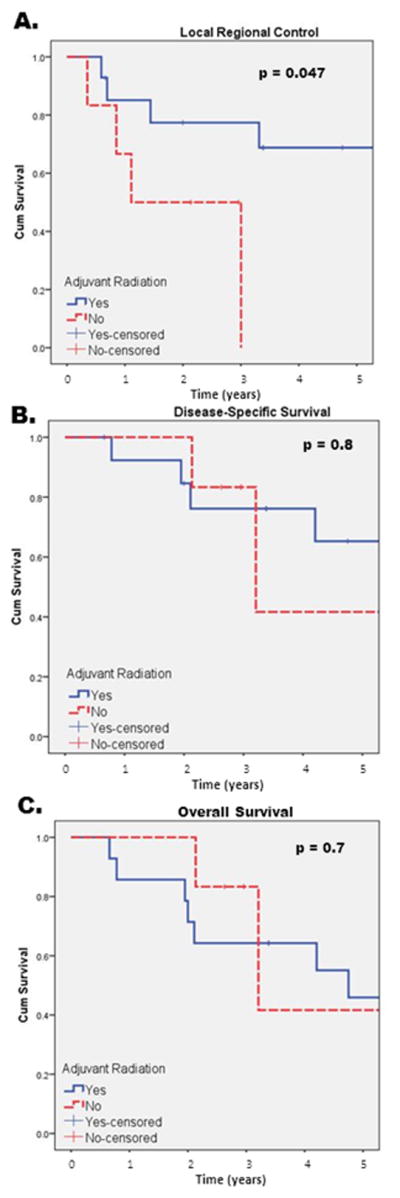
Results: Multivariate analysis verified PNI to be associated with worse disease-free interval (DFI) (P = .012) and local-regional control (LRC) (P = .005) and perivascular invasion (PVI) associated with worse DFI (P = .05). Among pN0/PNI+ patients, those who received XRT demonstrated significantly improved DFI (mean = 6.5 years vs 1.7 years; P = .014) and LRC (mean 6.7 years vs 1.9 years; P = .047). There was no improvement in overall survival (P = .68) or disease-specific survival (P = .8) in those receiving XRT.
Conclusions: PNI is an independent adverse risk factor in the absence of nodal metastasis and extracapsular spread. We observed a statistically significantly longer DFI and LRC when patients were treated with adjuvant radiation.
Keywords: oral cavity; perineural invasion; squamous cell carcinoma.
Figures
References
-
- Bernier J, Cooper JS, Pajak TF, et al. Defining risk levels in locally advanced head and neck cancers: A comparative analysis of concurrent postoperative radiation plus chemotherapy trials of the EORTC (#22931) and RTOG (# 9501) Head Neck. 2005;27:843–850. - PubMed
-
- Bernier J, Cooper JS. Chemoradiation after surgery for high-risk head and neck cancer patients: how strong is the evidence? Oncologist. 2005 Mar;10(3):215–24. - PubMed
-
- Liao CT, Lin CY, Fan KH, et al. Identification of a high-risk group among patients with oral cavity squamous cell carcinoma and pT1-2N0 disease. Int J Radiat Oncol Biol Phys. 2012 Jan 1;82(1):284–90. Epub 2010 Nov 13. - PubMed
-
- Sparano A, Weinstein G, Chalian A, et al. Multivariate predictors of occult neck metastasis in early oral tongue cancer. Otolaryngol Head Neck Surg. 2004 Oct;131(4):472–6. - PubMed
-
- Huang SH, Hwang D, Lockwood G, et al. Predictive value of tumor thickness for cervical lymph-node involvement in squamous cell carcinoma of the oral cavity: a meta-analysis of reported studies. Cancer. 2009 Apr 1;115(7):1489–97. - PubMed
Publication types
MeSH terms
Grants and funding
LinkOut - more resources
Full Text Sources
Other Literature Sources
Medical
