


T cells in atherosclerosis
- PMID: 24154816
- PMCID: PMC3806170
- DOI: 10.1093/intimm/dxt043
T cells in atherosclerosis
Abstract
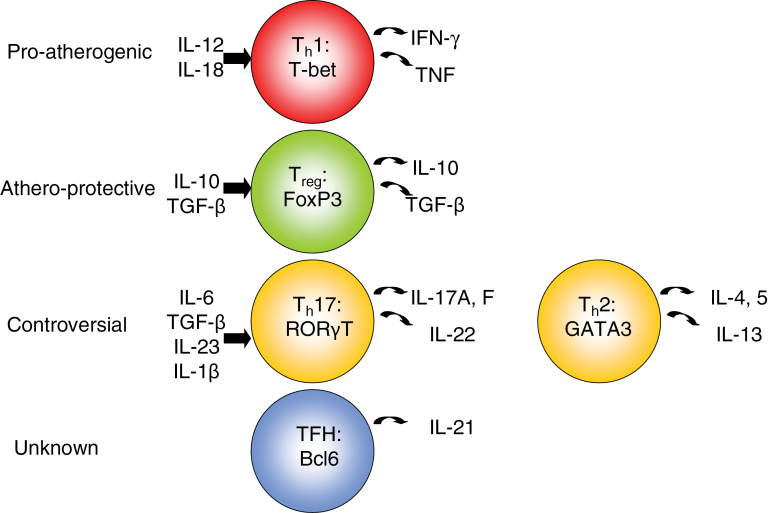
Atherosclerosis is a chronic inflammatory disease of the artery wall. Atherosclerotic lesions contain monocytes, macrophages, smooth muscle cells and T lymphocytes. Here, we review the role of T-lymphocyte subsets in atherosclerosis. Among CD4⁺T cells, T(h)1 cells are pro-atherogenic, T(reg) cells are athero-protective and the role of T(h)2 and T(h)17 cells remains unclear. The role of follicular helper T cells in atherosclerosis remains unknown, as is the role of CD8⁺T cells. NKT cells bind glycolipid antigens and exert a pro-atherogenic role. The antigen specificity of T-cell responses in atherosclerosis is poorly understood. In order to enable antigen-specific prevention or therapy, a better understanding of these mechanisms is needed.
Keywords: T cell; atherosclerosis; inflammation.
Figures
References
-
- Kavey R. E., Daniels S. R., Lauer R. M., Atkins D. L., Hayman L. L., Taubert K. American Heart Association 2003. American Heart Association guidelines for primary prevention of atherosclerotic cardiovascular disease beginning in childhood. Circulation 107:1562. - PubMed
-
- Hansson G. K., Hermansson A. 2011. The immune system in atherosclerosis. Nat. Immunol. 12:204. - PubMed
-
- Wick G., Perschinka H., Millonig G. 2001. Atherosclerosis as an autoimmune disease: an update. Trends Immunol. 22:665. - PubMed
-
- Silverstein R. L., Febbraio M. 2000. CD36 and atherosclerosis. Curr. Opin. Lipidol. 11:483. - PubMed
-
- Libby P., Ridker P. M., Hansson G. K. 2011. Progress and challenges in translating the biology of atherosclerosis. Nature 473:317. - PubMed
Publication types
MeSH terms
Grants and funding
LinkOut - more resources
Full Text Sources
Other Literature Sources
Medical
Research Materials
