. 2014 Jan;88(1):354-63.
doi: 10.1128/JVI.02444-13. Epub 2013 Oct 23.

Discovery of novel ribonucleoside analogs with activity against human immunodeficiency virus type 1

Affiliations

Discovery of novel ribonucleoside analogs with activity against human immunodeficiency virus type 1

Michael J Dapp et al. J Virol. 2014 Jan.

Abstract

Reverse transcription is an important early step in retrovirus replication and is a key point targeted by evolutionarily conserved host restriction factors (e.g., APOBEC3G, SamHD1). Human immunodeficiency virus type 1 (HIV-1) reverse transcriptase (RT) is a major target of antiretroviral drugs, and concerns regarding drug resistance and off-target effects have led to continued efforts for identifying novel approaches to targeting HIV-1 RT. Several observations, including those obtained from monocyte-derived macrophages, have argued that ribonucleotides and their analogs can, intriguingly, impact reverse transcription. For example, we have previously demonstrated that 5-azacytidine has its greatest antiviral potency during reverse transcription by enhancement of G-to-C transversion mutations. In the study described here, we investigated a panel of ribonucleoside analogs for their ability to affect HIV-1 replication during the reverse transcription process. We discovered five ribonucleosides-8-azaadenosine, formycin A, 3-deazauridine, 5-fluorocytidine, and 2'-C-methylcytidine-that possess anti-HIV-1 activity, and one of these (i.e., 3-deazauridine) has a primary antiviral mechanism that involves increased HIV-1 mutational loads, while quantitative PCR analysis determined that the others resulted in premature chain termination. Taken together, our findings provide the first demonstration of a series of ribonucleoside analogs that can target HIV-1 reverse transcription with primary antiretroviral mechanisms that include premature termination of viral DNA synthesis or enhanced viral mutagenesis.


Figures
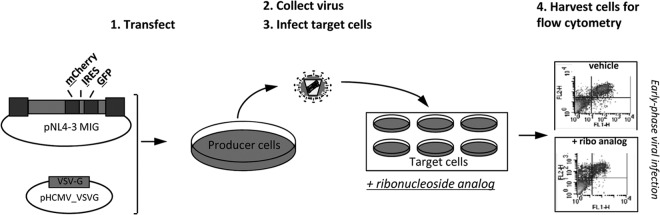
FIG 1
FIG 1
Single-cycle HIV-1 vector assay to determine the antiviral potency and mutation frequency of ribonucleoside analogs. The HIV-1 vector pNL4-3 MIG containing the dual-reporter mCherry and GFP cassette was cotransfected with the VSV-G envelope to produce pseudotyped vector virus. The titer in the cell-free viral supernatant was determined, and the supernatant was used to infect permissive U373-MAGICXCR4 target cells. Cells were collected and analyzed for fluorescent marker gene expression by flow cytometry to determine relative infectivity and the mutation frequency. Experimental drugs could be used to treat either the target cells (top right) or the virus-producing cells (bottom right) in order to investigate the antiretroviral targets in the early or late phase of HIV-1 replication.
FIG 2
FIG 2
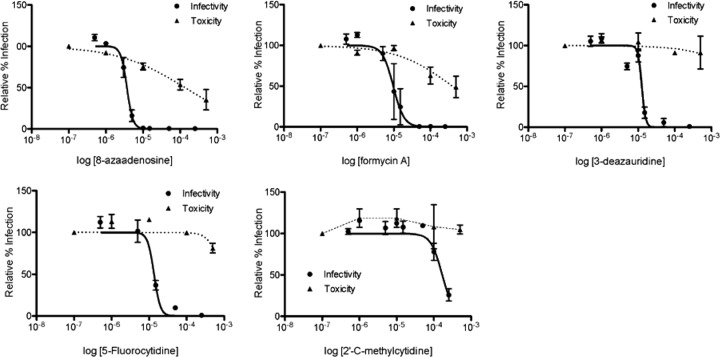
Anti-HIV-1 activity of ribonucleoside analogs. Permissive target cells were pretreated with increasing concentrations of each ribonucleoside analog under investigation and then infected with equivalent amounts of the HIV-1 vector. At 48 h postinfection, cells were analyzed by flow cytometry to determine the percentage of infected cells, displayed relative to the amount of the vehicle control on a log-linear plot. Cell viability was determined by measuring the abundance of ATP after a 24-h exposure to each ribonucleoside analog. The EC50s and the TC50s were determined using a nonlinear regression equation for best fit.
FIG 3
FIG 3
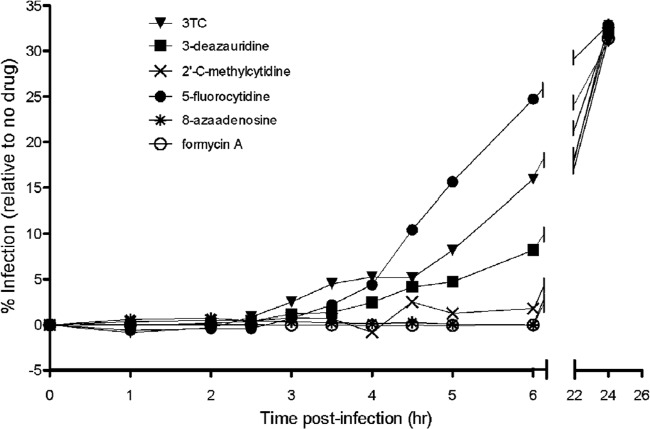
Time-of-addition assay defines reverse transcription to be the antiretroviral target of ribonucleoside analogs. Permissive target cells were synchronously infected with the HIV-1 vector (time zero). At sequential time intervals postinfection, each ribonucleoside analog was added at the EC75 and EC90 to monitor the increase in viral infectivity, which is indicative of a phase during viral replication that is no longer susceptible to inhibition. The nucleoside reverse transcriptase inhibitor 3TC, which is a chain terminator of reverse transcription, was used as a control (it blocked replication at ∼2.5 h postinfection). HIV-1 vector replication was blocked at ∼3.5 h for 3-deazauridine and between 2 and 4 h for 2′-C-methylcytidine, 8-azaadenosine, and formycin A. The data shown are representative of those from three independent experiments.
FIG 4
FIG 4
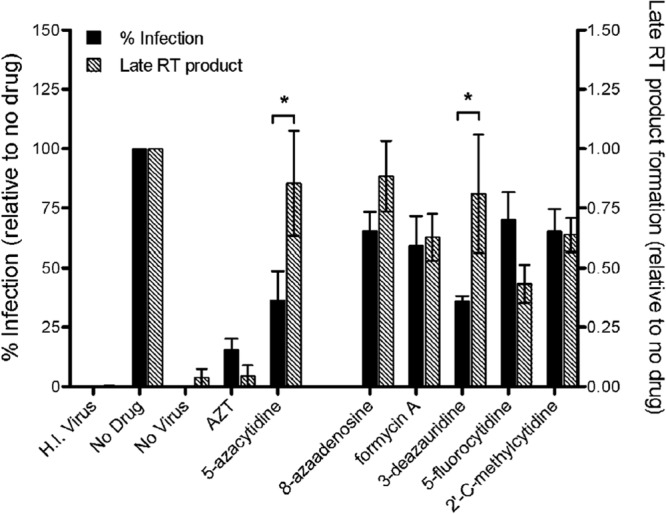
Loss of infectivity does not correlate with decreased viral DNA product formation when virus is exposed to 3-deazauridine. Targets cells were pretreated with each ribonucleoside analog at its EC50 (AZT was used at the EC75) and infected with the HIV-1 vector. At 18 h postinfection (i.e., after the completion of reverse transcription), cells were harvested and 90% of the total was used for qPCR analysis of the relative amount of late (U5-gag) viral DNA product formation. The remaining 10% of the cells were cultured until 72 h postinfection and then analyzed for marker gene expression by flow cytometry. The percentage of cells infected and the amount of viral DNA normalized to the amount of the cellular 18S rRNA gene were set relative to those for the no-drug viral controls. H.I. Virus, heat-inactivated virus. Data shown are from 4 independent experiments. *, P < 0.05.
FIG 5
FIG 5
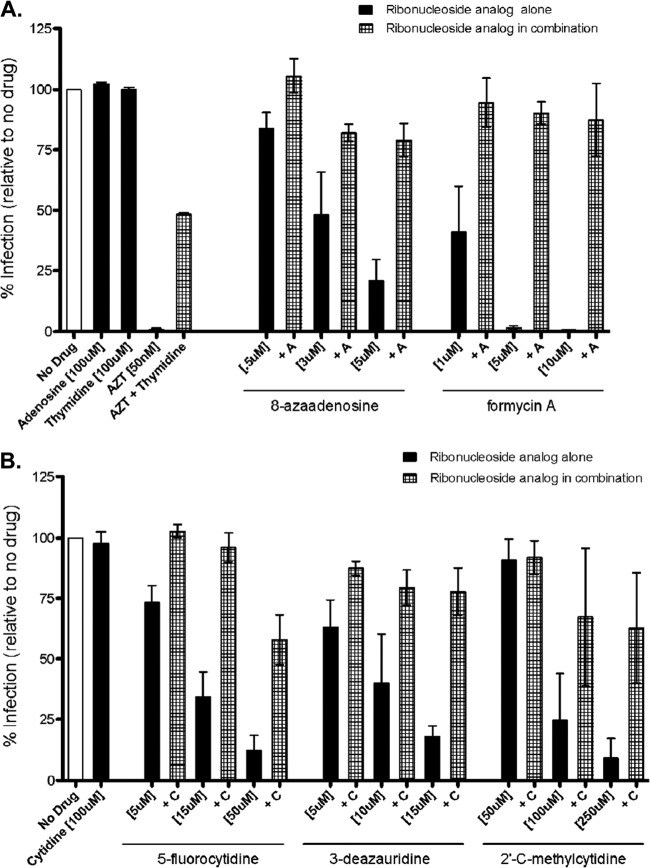
The antiviral activity of ribonucleoside analogs is antagonized by competition with natural ribonucleosides. Target cells were pretreated either with a ribonucleoside analog alone or together with its corresponding natural ribonucleoside prior to infection with the HIV-1 vector. At 48 h postinfection, cells were harvested and analyzed by flow cytometry. (A) Results for cells treated with either 8-azaadenosine or formycin A alone or with 8-azaadenosine or formycin A in combination with adenosine and cells treated with AZT alone or with AZT in combination with thymidine; (B) results for cells treated with 5-flurocytidine, 3-deazauridine, or 2′-C-methylcytidine alone or with 5-flurocytidine, 3-deazauridine, or 2′-C-methylcytidine in combination with cytidine. Data shown are from 3 independent experiments.
FIG 6
FIG 6
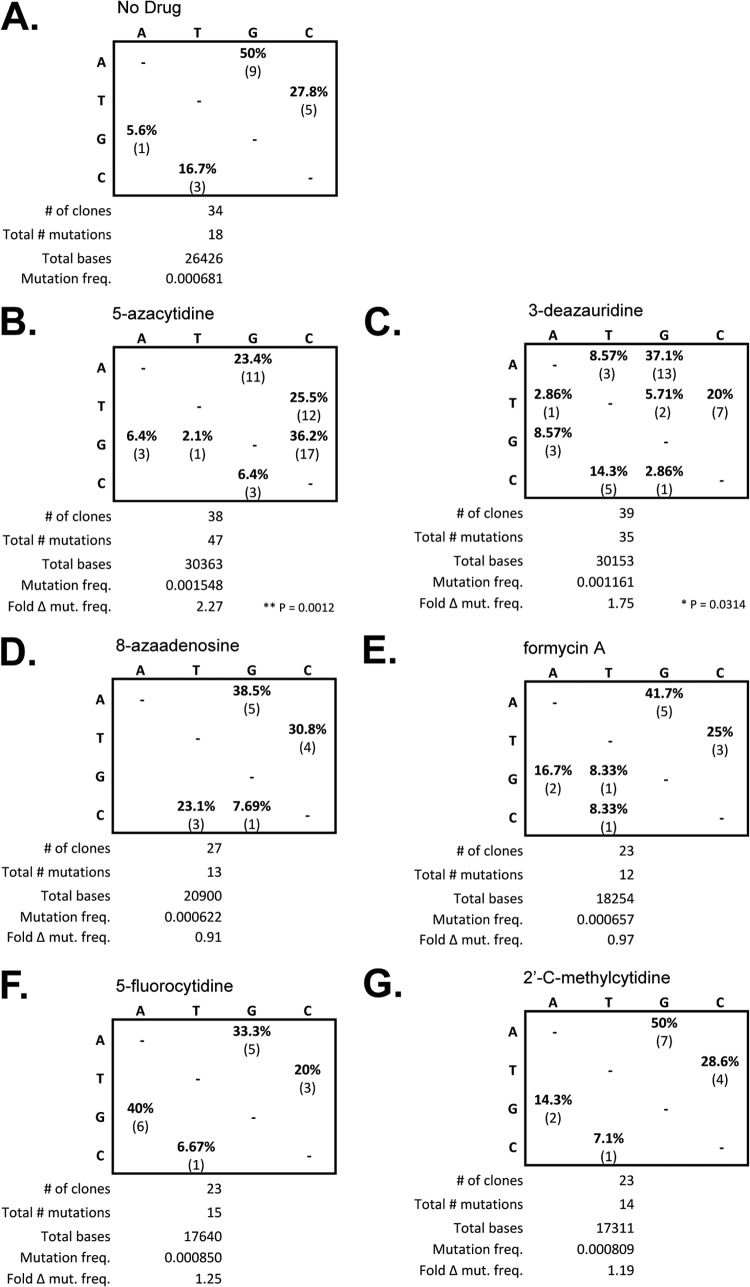
The ribonucleoside 3-deazauridine causes altered mutation spectra and increased mutation frequencies in HIV-1. Targets cells were treated at the EC75 for each ribonucleoside analog, and at 48 h postinfection, cells were harvested and the total genomic DNA was purified. The HIV-1 pol gene (specifically, the 5′ region of the HIV-1 RT open reading frame, corresponding to amino acids 1 to 366) was amplified by PCR and cloned. (A to G) Tabulated summary of the mutation spectra as a percentage of the total mutations as well as the absolute values. The total number of clones sequenced, the total number of mutations scored, and the total number of bases sequenced are also indicated. Mutation frequency (freq.) was calculated on the basis of the ratio of the total numbers of mutations to the total number of bases sequenced. The fold difference in mutation frequency (Fold Δ mut. freq.) relative to that of the no-drug control was determined.

References

    1. Baltimore D. 1970. RNA-dependent DNA polymerase in virions of RNA tumor viruses. Nature 226:1209–1211. 10.1038/2261209a0 - DOI - PubMed
    1. Temin HM, Mitzutani S. 1970. RNA-dependent DNA polymerase in virions of Rous sarcoma virus. Nature 226:1211–1213. 10.1038/2261211a0 - DOI - PubMed
    1. Laguette N, Sobhian B, Casartelli N, Ringeard M, Chable-Bessia C, Segeral E, Yatim A, Emiliani S, Schwartz O, Benkirane M. 2011. SAMHD1 is the dendritic- and myeloid-cell-specific HIV-1 restriction factor counteracted by Vpx. Nature 474:654–657. 10.1038/nature10117 - DOI - PMC - PubMed
    1. Sheehy AM, Gaddis NC, Choi JD, Malim MH. 2002. Isolation of a human gene that inhibits HIV-1 infection and is suppressed by the viral Vif protein. Nature 418:646–650. 10.1038/nature00939 - DOI - PubMed
    1. Arribas JR, Eron J. 2013. Advances in antiretroviral therapy. Curr. Opin. HIV AIDS 8:341–349. 10.1097/COH.0b013e328361fabd - DOI - PubMed

Publication types

LinkOut - more resources