


Differential accessibility of a rotavirus VP6 epitope in trimers comprising type I, II, or III channels as revealed by binding of a human rotavirus VP6-specific antibody
- PMID: 24155406
- PMCID: PMC3911710
- DOI: 10.1128/JVI.01665-13
Differential accessibility of a rotavirus VP6 epitope in trimers comprising type I, II, or III channels as revealed by binding of a human rotavirus VP6-specific antibody
Abstract
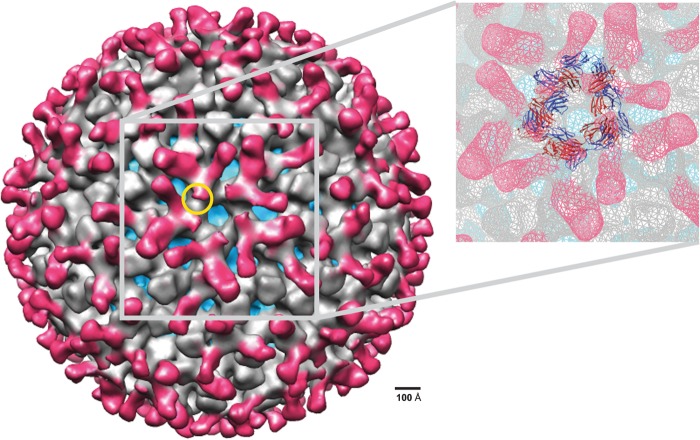
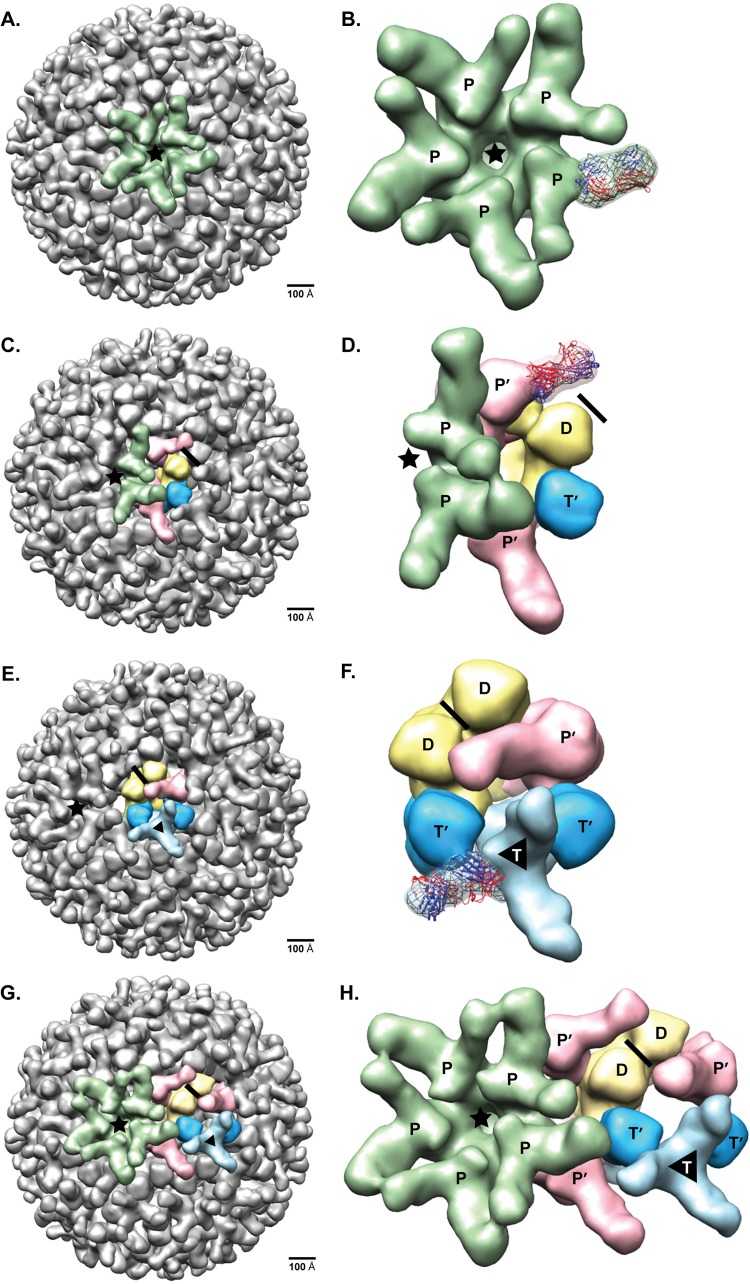
Previous human antibody studies have shown that the human VH1-46 antibody variable gene segment encodes much of the naturally occurring human B cell response to rotavirus and is directed to virus protein 6 (VP6). It is currently unknown why some of the VH1-46-encoded human VP6 monoclonal antibodies inhibit viral transcription while others do not. In part, there are affinity differences between antibodies that likely affect inhibitory activity, but we also hypothesize that there are differing modes of binding to VP6 that affect the ability to block the transcriptional pore on double-layered particles. Here, we used a hybrid method approach for antibody epitope mapping, including single-particle cryo-electron microscopy (cryo-EM) and enhanced amide hydrogen-deuterium exchange mass spectrometry (DXMS) to determine the location and mode of binding of a VH1-46-encoded antibody, RV6-25. The structure of the RV6-25 antibody-double-layered particle (DLP) complex indicated a very complex binding pattern that revealed subtle differences in accessibility of the VP6 epitope depending on its position in the type I, II, or III channels. These subtle variations in the presentation or accessibility of the RV VP6 capsid layer led to position-specific differences in occupancy for binding of the RV6-25 antibody. The studies also showed that the location of binding of the noninhibitory antibody RV6-25 on the apical surface of RV VP6 head domain does not obstruct the transcription pore upon antibody binding, in contrast to binding of an inhibitory antibody, RV6-26, deeper in the transcriptional pore.
Figures

References
-
- Estes MK. 2001. Rotavirus and their replication, p 1747–1785 In Knipe DM, Howley PM, Griffin DE, Lamb RA, Martin MA, Roizman B, Straus SE. (ed), Fields virology, 4th ed, vol 2 Lippincott Williams & Wilkins, Philadelphia, PA
-
- Estes MK, Kapikian AZ. 2007. Rotaviruses, p 1918–1974 In Knipe DM, Howley PM, Griffin DE, Lamb RA, Martin MA, Roizman B, Straus SE. (ed), Fields virology, 5th ed, vol 2 Lippincott Williams & Wilkins, Philadelphia, PA
Publication types
MeSH terms
Substances
Grants and funding
LinkOut - more resources
Full Text Sources
Other Literature Sources
Miscellaneous
