. 2013 Oct 24:10:108.
doi: 10.1186/1743-0003-10-108.

Sub-threshold spinal cord stimulation facilitates spontaneous motor activity in spinal rats

Affiliations

Sub-threshold spinal cord stimulation facilitates spontaneous motor activity in spinal rats

Parag Gad et al. J Neuroeng Rehabil. .

Abstract

Background: Epidural stimulation of the spinal cord can be used to enable stepping on a treadmill (electrical enabling motor control, eEmc) after a complete mid-thoracic spinal cord transection in adult rats. Herein we have studied the effects of eEmc using a sub-threshold intensity of stimulation combined with spontaneous load-bearing proprioception to facilitate hindlimb stepping and standing during daily cage activity in paralyzed rats.

Methods: We hypothesized that eEmc combined with spontaneous cage activity would greatly increase the frequency and level of activation of the locomotor circuits in paralyzed rats. Spontaneous cage activity was recorded using a specially designed swivel connector to record EMG signals and an IR based camcorder to record video.

Results and conclusion: The spinal rats initially were very lethargic in their cages showing little movement. Without eEmc, the rats remained rather inactive with the torso rarely being elevated from the cage floor. When the rats used their forelimbs to move, the hindlimbs were extended and dragged behind with little or no flexion. In contrast, with eEmc the rats were highly active and the hindlimbs showed robust alternating flexion and extension resulting in step-like movements during forelimb-facilitated locomotion and often would stand using the sides of the cages as support. The mean and summed integrated EMG levels in both a hindlimb flexor and extensor muscle were higher with than without eEmc. These data suggest that eEmc, in combination with the associated proprioceptive input, can modulate the spinal networks to significantly amplify the amount and robustness of spontaneous motor activity in paralyzed rats.


Figures
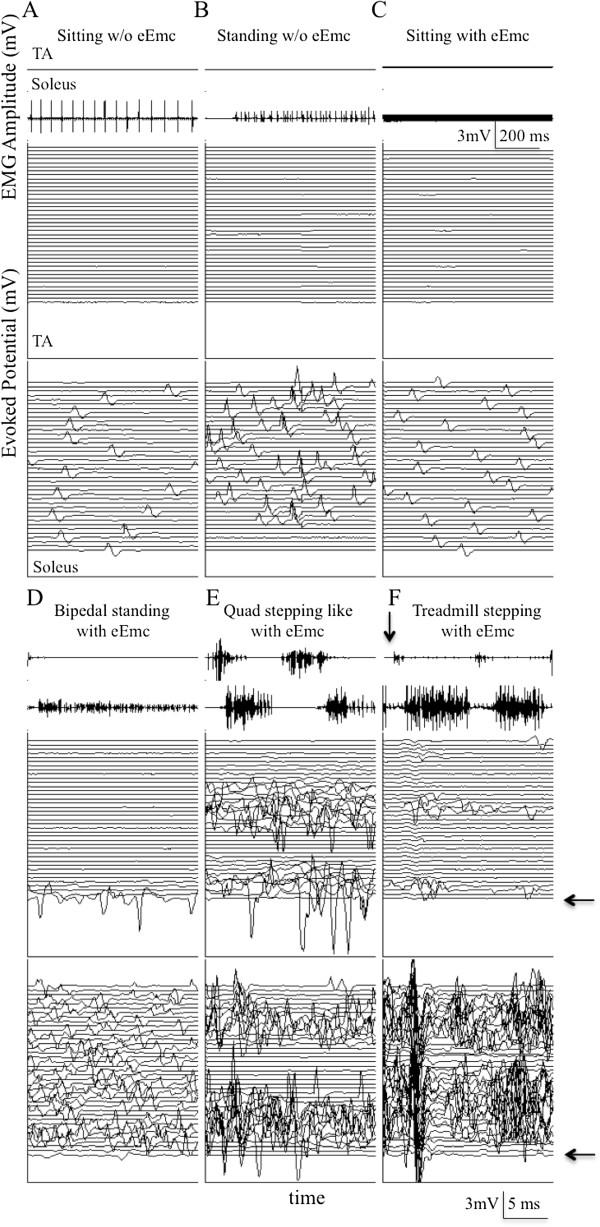
Figure 1
Figure 1
Representative EMG and evoked potentials with and without eEmc. Representative raw EMG and evoked potentials from the soleus and tibialis anterior (TA) muscles without eEmc from one spinal rat during (A) sitting, (B) attempted bipedal standing, and with eEmc (1.5 V, 40 Hz between L2 and S1) during (C) sitting, (D) bipedal standing, and (E) quadrupedal (Quad) stepping-like movement during the 6-hr recording period in its home cage. (F) Representative EMG and evoked potential from the soleus and TA from the same rat during body weight supported bipedal treadmill stepping facilitated by eEmc (2.0 V, 40 Hz between L2 and S1). The start of each trace with eEmc is synchronized with the initiation of the eEmc pulse. Each trace is 25 msec, i.e., the time between successive eEmc pulses. The arrow placed on the EMG signals denotes the time of the initial 25 msec scan.
Figure 2
Figure 2
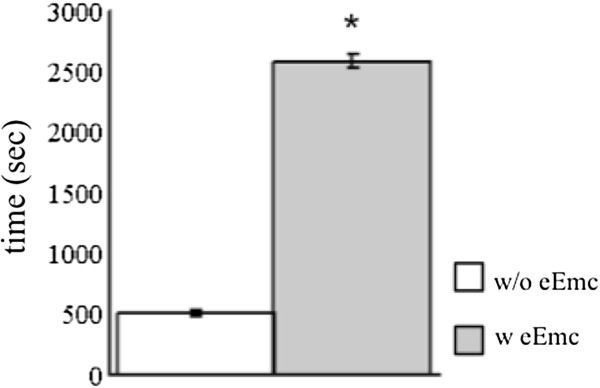
Total activity time with and without eEmc. Mean (±SEM, n = 4) duration of spontaneous cage activity during the 6-hr recording period with and without eEmc. *, significantly different from without eEmc at P < 0.05.
Figure 3
Figure 3
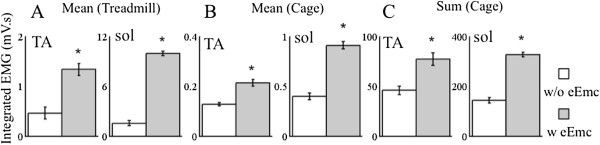
Integrated EMG during spontaneous cage activity and treadmill locomotion. (A) Integrated EMG during body weight supported treadmill stepping at 13.5 cm/sec for 1 min, (B) integrated EMG per min for the TA and soleus (sol) during the 6-hr recording period in the cage, and (C) sum of the integrated EMG during the 6-hr recording period in the cage for the TA and soleus muscles without and with eEmc. Values are mean ± SEM for 4 rats. *, significantly different from without eEmc at P < 0.05.
Figure 4
Figure 4
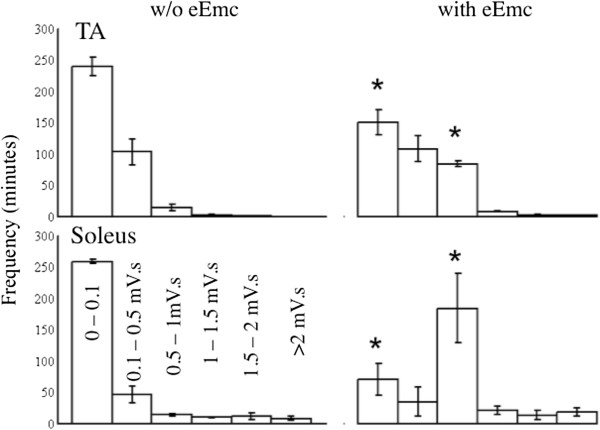
Frequency distribution of integrated EMG. Frequency distribution of the mean (±SEM, n = 4 rats) integrated EMG amplitudes for the TA and soleus with and without eEmc during the 6-hr recording period in the cage expressed in one-min bins. *, significantly different from the corresponding bin without eEmc at P < 0.05.
Figure 5
Figure 5
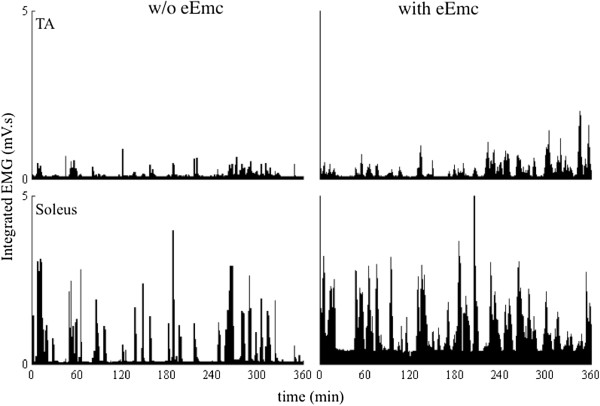
Average integrated EMG with and without eEmc. Mean (±SEM) frequency of occurrence of different ranges of integrated EMG amplitudes with and without eEmc during the 6-hr recording period of cage activity expressed in one-min bins.
Figure 6
Figure 6
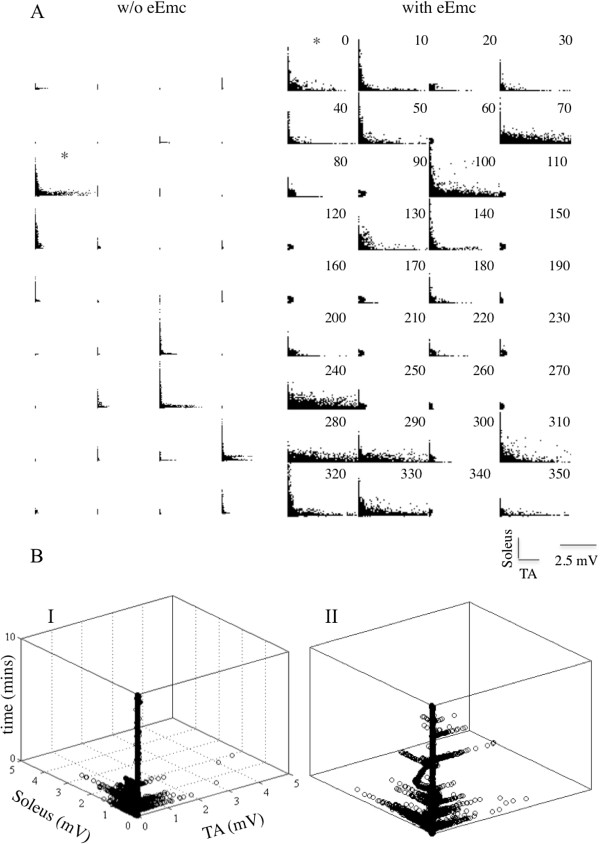
JPD plots from a single animal throughout the 6 hours with and without eEmc. (A) Joint probability distribution plots showing the relationship between the soleus and TA activity expressed in 10-min bins during the 6-hr recording period for a representative spinal rat. The 6-hr recording occurred during the dark period (8:00 pm to 2:00 am), i.e., the active period of the rats. (B) The incidence of occurrence of different joint probability distributions for 10 min of activity without (I) and with (II) eEmc. The asterisks in (A) identify the two bins being compared in (B), without eEmc (I) and with eEmc (II). Note the lack of consistent alternating flexor-extensor activation without compared to with eEmc.

References

    1. Iwahara T, Atsuta Y, Skinner RD. Locomotion induced by spinal cord stimulation in the neonate rat in vitro. Somatosens Mot Res. 1991;10:281–287. doi: 10.3109/08990229109144751. - DOI - PubMed
    1. Gerasimenko YP, Avelev VD, Nikitin OA, Lavrov IA. Initiation of locomotor activity in spinal cats by epidural stimulation of the spinal cord. Neurosci Behav Physiol. 2003;10:247–254. doi: 10.1023/A:1022199214515. - DOI - PubMed
    1. Ichiyama RM, Gerasimenko YP, Zhong H, Roy RR, Edgerton VR. Hindlimb stepping movements in complete spinal rats induced by epidural spinal cord stimulation. Neurosci Lett. 2005;10:339–344. doi: 10.1016/j.neulet.2005.04.049. - DOI - PubMed
    1. Gerasimenko Y, Roy RR, Edgerton VR. Comparison of the spinal circuits that generate and control locomotion in rats, cats and humans. Exp Neurol. 2008;10:417–425. - PMC - PubMed
    1. Courtine G, Gerasimenko Y, van den Brand R, Yew A, Musienko P, Zhong H, Song B, Ao Y, Ichiyama RM, Lavrov I, Roy RR, Sofroniew MV, Edgerton VR. Transformation of nonfunctional spinal circuits into functional states after the loss of brain input. Nat Neurosci. 2009;10:1333–1342. doi: 10.1038/nn.2401. - DOI - PMC - PubMed

Publication types