


Investigating the effects of three needling parameters (manipulation, retention time, and insertion site) on needling sensation and pain profiles: a study of eight deep needling interventions
- PMID: 24159337
- PMCID: PMC3789497
- DOI: 10.1155/2013/136763
Investigating the effects of three needling parameters (manipulation, retention time, and insertion site) on needling sensation and pain profiles: a study of eight deep needling interventions
Abstract
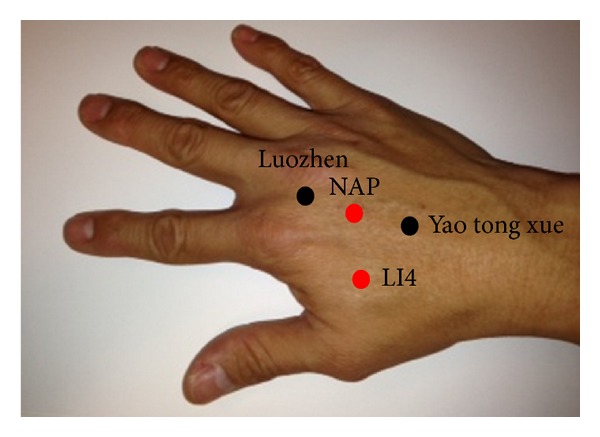
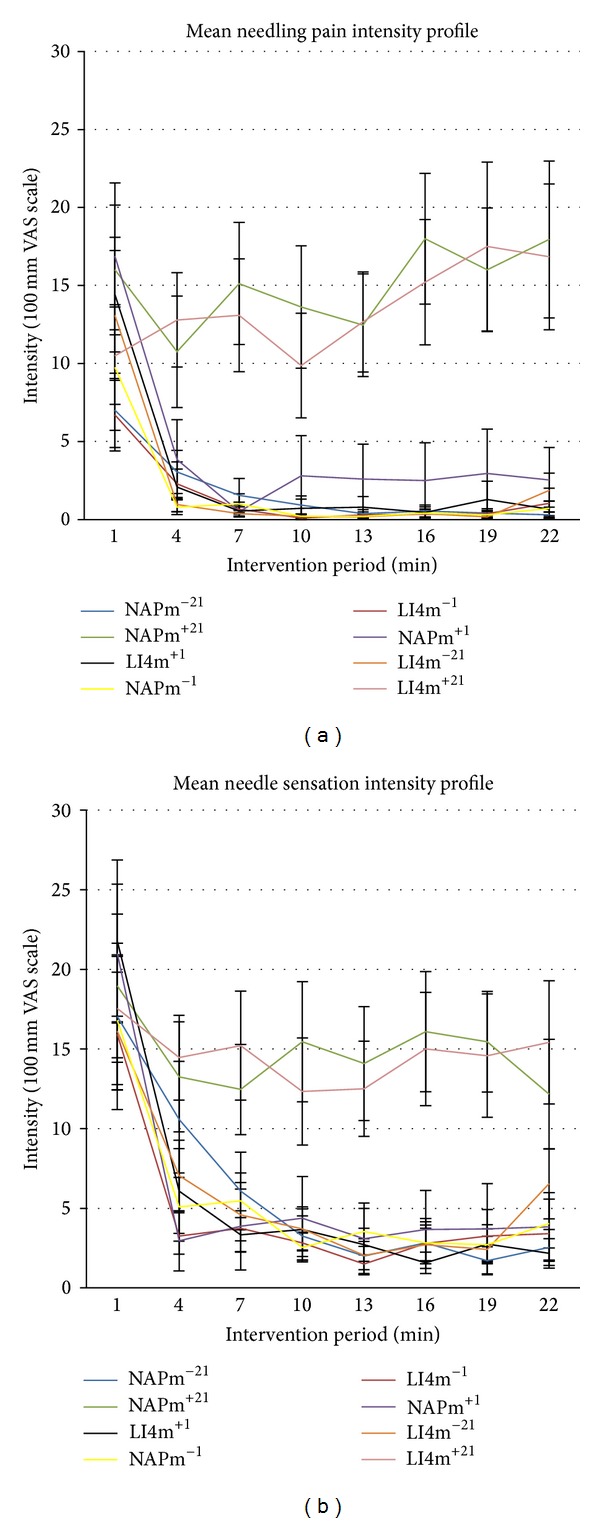
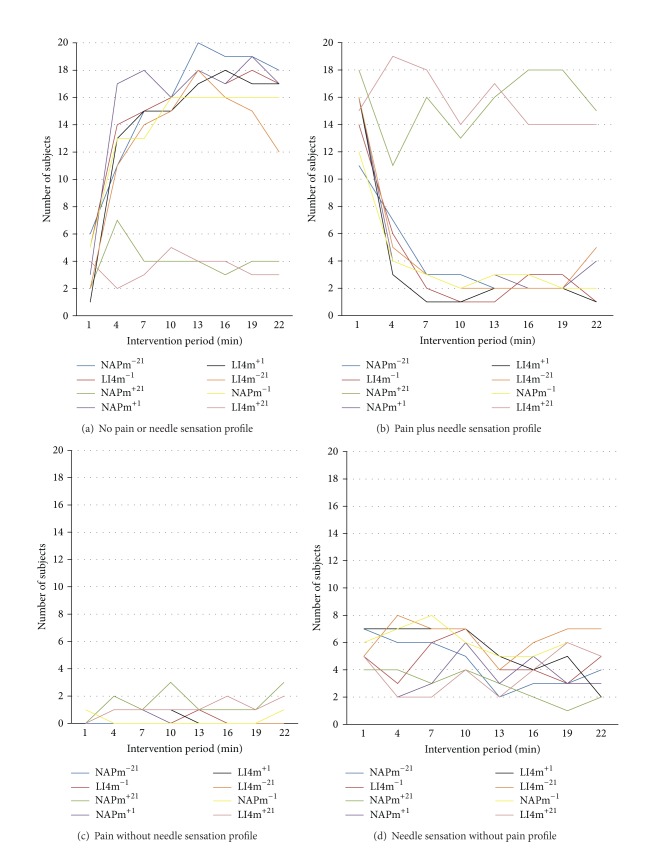
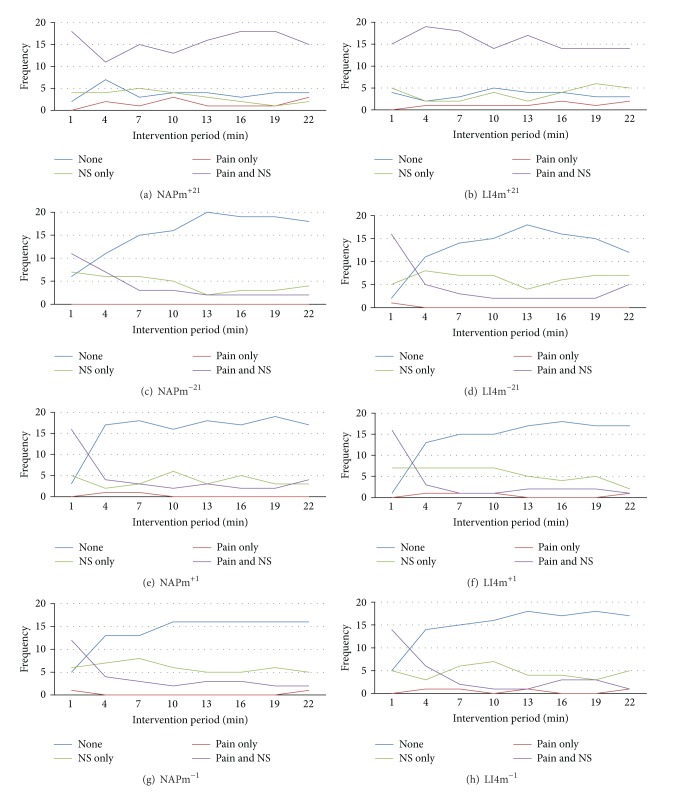
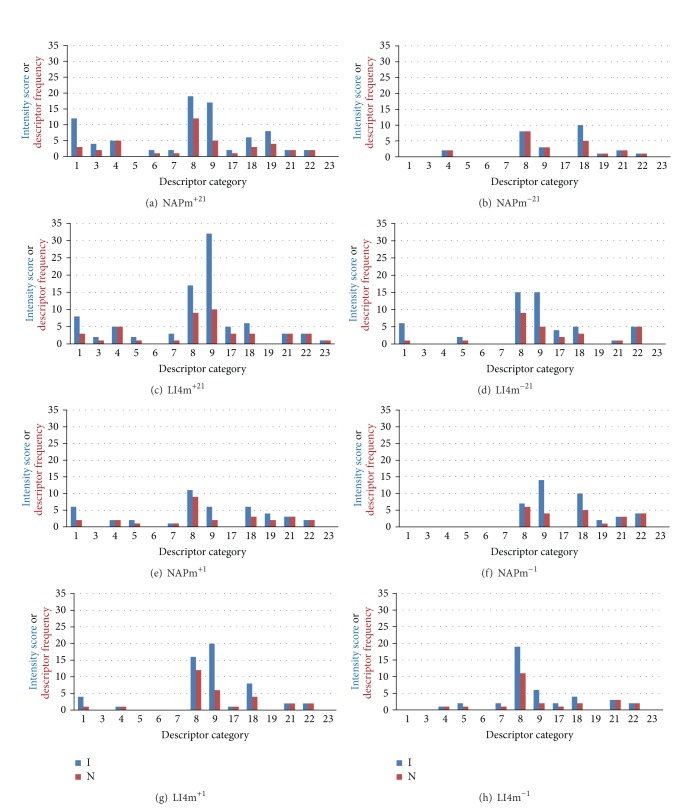
Introduction. In traditional Chinese acupuncture, needle sensation (deqi) is purported to contribute to a therapeutic outcome. While researchers have attempted to define deqi qualitatively, few have examined the effects of needling parameters on its intensity. Methods. 24 healthy subjects completed eight interventions scheduled at least one week apart, which involved manual acupuncture to LI4 or a designated nonacupoint (NAP) on the hand, with real or simulated manipulation each three minutes and needle retentions of one or 21 minutes. Intensities of needling sensation and pain were reported every three minutes and sensation qualities were reported post-intervention. Results. Immediately after needle insertion, similar levels of mean needle sensation and of pain were reported independent of intervention. At subsequent measurement times, only two interventions (one at LI4 and one at NAP) maintained statistically significantly elevated needle sensation and pain scores and reported higher numbers of needle sensation descriptors. For both, the needle was retained for 21 minutes and manipulated every three minutes. Neither intervention differed significantly in terms of levels of pain, and needle sensation or numbers and qualities of needle sensation described. Conclusion. In this group of healthy subjects, the initial needling for all eight interventions elicited similar levels of needle sensation and pain. These levels were only maintained if there was ongoing of needle manipulation and retention of the needle. By contrast, the strength of needle sensation or pain experienced was independent of insertion site.
Figures
References
-
- Benham A, Phillips G, Johnson MI. An experimental study on the self-report of acupuncture needle sensation during deep needling with bi-directional rotation. Acupuncture in Medicine. 2010;28(1):16–20. - PubMed
-
- Lai XS, Tong Z. A study on the classification and the “Catching” of the “Arrived Qi” in Acupuncture. Journal of Traditional Chinese Medicine. 2010;30(1):3–8. - PubMed
-
- Bovey M. Deqi. Journal of Chinese Medicine. 2006;(81):18–29.
-
- Melzack R. The Puzzle of Pain. New York, NY, USA: Basic Books; 1973.
-
- Melzack R. The McGill pain questionnaire: major properties and scoring methods. Pain. 1975;1(3):277–299. - PubMed
LinkOut - more resources
Full Text Sources
Other Literature Sources
Research Materials
