


Obesity and Black Women: Special Considerations Related to Genesis and Therapeutic Approaches
- PMID: 24159367
- PMCID: PMC3804270
- DOI: 10.1007/s12170-013-0328-7
Obesity and Black Women: Special Considerations Related to Genesis and Therapeutic Approaches
Abstract
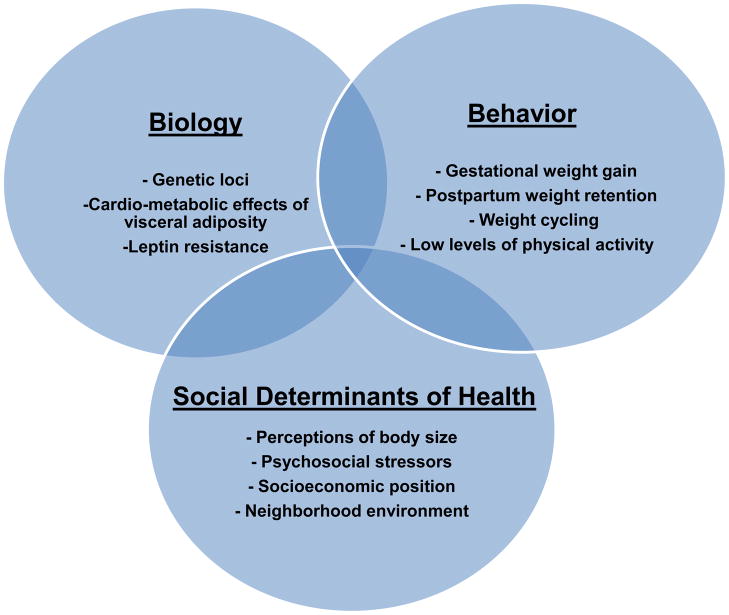
Black women in the United States are disproportionately affected by obesity, with almost two-thirds considered obese based on body mass index. Obesity has been directly linked to cardiovascular morbidity and mortality in black women. Therefore, understanding contributors to the genesis of obesity in black women is imperative. While biologic differences likely result in varying obesity prevalence across racial/ethnic groups, behaviors such as post-partum weight retention and limited leisure-time physical activity, may especially contribute to obesity in black women. Black women also appear to be particularly susceptible to cultural, psychosocial, and environmental factors that can promote weight gain. Therapeutic interventions are being tailored to specifically address these social determinants of health and to foster lifestyle modification; however, more work is needed to understand barriers to behavior change for black women. Knowledge gaps also remain in identifying mechanisms by which pharmacologic and surgical treatments for obesity modify cardiovascular risk in black women.
Keywords: Black women; behavior; cultural norms; environmental factors; genetics; lifestyle modification; obesity; psychosocial stress; therapeutics.
Conflict of interest statement
Priscilla Agyemang and Tiffany M. Powell-Wiley declare that they have no conflict of interest.
Figures
References
-
- National Center for Health Statistics. Health. United States, 2011: With Special Feature on Socioeconomic Status and Health. Hyattsville, MD: 2012. - PubMed
-
- Flegal KM, Carroll MD, Kit BK, et al. Prevalence of obesity and trends in the distribution of body mass index among US adults, 1999–2010. JAMA. 2012;307:491–497. - PubMed
-
- Das SR, Alexander KP, Chen AY, et al. Impact of body weight and extreme obesity on the presentation, treatment, and in-hospital outcomes of 50,149 patients with ST-Segment elevation myocardial infarction results from the NCDR (National Cardiovascular Data Registry) J Am Coll Cardiol. 2011;58:2642–50. This study examined the impact of morbid obesity on treatment patterns and 30-day in- hospital mortality in patients following ST-segment elevation myocardial infarction. - PMC - PubMed
Grants and funding
LinkOut - more resources
Full Text Sources
Other Literature Sources
Molecular Biology Databases