. 2011 Sep;2(2):109-14.
doi: 10.1016/j.phrp.2011.07.001. Epub 2011 Aug 3.

Ingenol Protects Human T Cells From HIV-1 Infection

Affiliations

Ingenol Protects Human T Cells From HIV-1 Infection

Kee-Jong Hong et al. Osong Public Health Res Perspect. 2011 Sep.

Abstract

Objectives: Many natural compounds have been investigated as drug candidates to prevent human immunodeficiency virus (HIV) with low cytotoxicity. We tested whether ingenol from Euphorbia ingens exerts anti-HIV effects in human T cell lines.

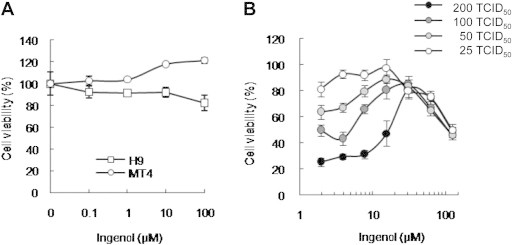
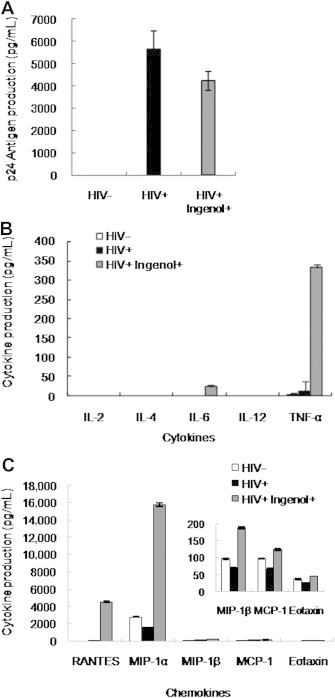
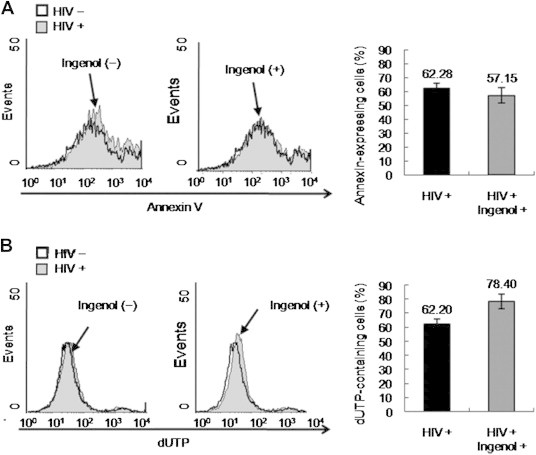
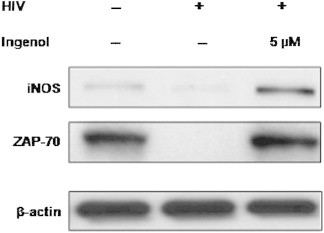
Methods and results: Ingenol effectively maintained high cell viability (CD50, >1 mM) in H9 and MT4 T cells. The efficacy of ingenol to inhibit HIV-1 infection was dose dependent. ED50 for 100 and 200 TCID50 of HIV-1 was 5.06 and 16.87 μM, respectively. Gag p24 antigen production in ingenol-treated MT4 cells was reduced by 24.5% on day 6 post-infection. While p24 antigen was reduced in ingenol-treated cells, levels of cytokines such as TNF-α and IL-6 and chemokines such as RANTES and MCP-1 were increased. dUTP level related to late apoptotic events was increased on day 2 post-infection of HIV by ingenol treatment, whereas expression of annexin V was unchanged. Reduced levels of iNOS and ZAP-70 after HIV infection were recovered by ingenol treatment.

Conclusion: Ingenol helps T cells to survive longer against viremia after HIV-1 infection, without exerting cytotoxic effects. Ingenol can be considered a safe and efficacious candidate for immune-boosting therapy for AIDS patients.

Keywords: Euphorbia ingens; Gag p24; HIV-1; anti-HIV activity; natural products.


Figures
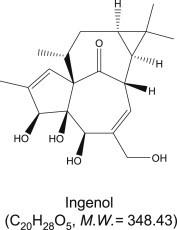
Figure 1
Figure 1
Chemical structure of ingenol.
Figure 2
Figure 2
Ingenol revealed low cytotoxicity and dose-dependent anti-HIV infection activity. Viable cells were counted using a tetrazolium-based colorimetric method (MTT). (A) Ingenol revealed good cell viability in MT4 cells and H9 cells. MT4 and H9 cells were allowed to proliferate for 24 hours in the presence of serially diluted ingenol. (B) Anti-HIV infection activity was measured on day 6 postinfection. MT4 cells were infected with HIV-1IIIB at multiplicity of infection (MOI; 0.002–0.016 [25-200 TCID50]) with 1.95–250 μM ingenol. Data represent means ± SD of three independent experiments.
Figure 3
Figure 3
Ingenol treatment reduced Gag p24 production, whereas cytokines and chemokines were induced during HIV infection after ingenol treatment. MT4 cells were infected with HIV-1IIIB at multiplicity of infection (MOI; 0.004 [50 TCID50]) after treatment with 5 μM ingenol and supernatants analyzed every 3 days thereafter . (A) p24 antigen production measured by ELISA showed reduced level by ingenol treatment. (B) Cytokine production including TNF-α and IL-6 was induced by ingenol during HIV infection at day 6 postinfection. (C) Chemokine production was induced by ingenol during HIV infection at day 6 postinfection. RANTES and MIP-1α were highly increased whereas MIP-1β, MCP-1, and eotaxin were moderately or slightly increased by ingenol treatment. Data represent means ± SD of three independent experiments.
Figure 4
Figure 4
Late apoptotic events induced by ingenol during HIV infection. MT4 cells were infected with HIV-1IIIB at multiplicity of infection (MOI; 0.004 [50 TCID50]) after addition of 5 μM ingenol into culture media, and cells were analyzed using flow cytometry at 24 hours postinfection. (A) Annexin V expression as early apoptotic marker analyzed by flow cytometry. (B) dUTP level as late apoptotic marker investigated by flow cytometry using BrdU staining. Bar graphs on the right side represent calculated ratio of annexin V– or dUTP-expressing cells. Data represent means ± SD of three independent experiments.
Figure 5
Figure 5
Western blot analysis of iNOs and ZAP-70 in MT4 cells. Ingenol treatment during HIV infection resulted in recovery of iNOS and ZAP-70. MT-4 cells were infected with HIV-1IIIB at multiplicity of infection (MOI; 0.004 [50 TCID50]) after 5 μM ingenol treatment then protein expression in cell lysate was analyzed by western blot 24 hours after HIV infection. iNOS, inducible nitric oxide synthase; ZAP-70, zeta chain-associated protein kinase 70. β-actin was used as loading control.

References

    1. Matthee G., Wright A.D., Konig G.M. HIV reverse transcriptase inhibitors of natural origin. Planta Med. 1999 Aug;65(6):493–506. - PubMed
    1. De Clercq E. Current lead natural products for the chemotherapy of human immunodeficiency virus (HIV) infection. Med Res Rev. 2000 Sep;20(5):323–349. - PubMed
    1. Yu D., Morris-Natschke S.L., Lee K.H. New developments in natural products-based anti-AIDS research. Med Res Rev. 2007 Jan;27(1):108–132. - PubMed
    1. Jassbi A.R. Chemistry and biological activity of secondary metabolites in Euphorbia from Iran. Phytochemistry. 2006 Sep;67(18):1977–1984. - PubMed
    1. Gillespie S.K., Zhang X.D., Hersey P. Ingenol 3-angelate induces dual modes of cell death and differentially regulates tumor necrosis factor-related apoptosis-inducing ligand-induced apoptosis in melanoma cells. Mol Cancer Ther. 2004 Dec;3(12):1651–1658. - PubMed