


Sociodemographic factors associated with tobacco smoking among intermediate and secondary school students in Jazan Region of Saudi Arabia
- PMID: 24159909
- PMCID: PMC3827661
- DOI: 10.1080/08897077.2013.779361
Sociodemographic factors associated with tobacco smoking among intermediate and secondary school students in Jazan Region of Saudi Arabia
Abstract
Background: The objectives of this study were to (i) determine the prevalence of and characteristics associated with tobacco smoking; (ii) identify the factors associated with tobacco smoking; and (iii) evaluate the association between tobacco smoking and khat chewing among intermediate and secondary school students in Jazan Region, Saudi Arabia.
Methods: A cross-sectional study was conducted with a representative sample (N = 4100) of intermediate and secondary school students in Jazan Region. The data were collected using a pretested modified version of the global youth tobacco survey questionnaire.
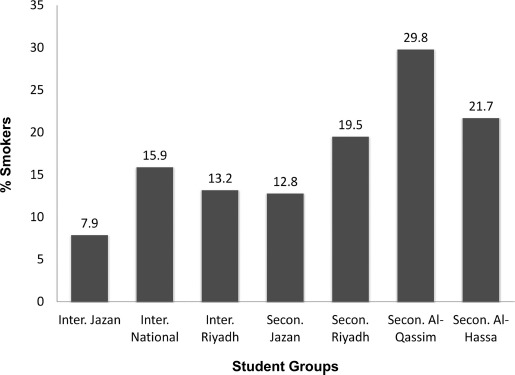
Results: A total of 3923 students from 72 intermediate and secondary schools for males and females in Jazan Region, Saudi Arabia, were included in this study. The ever having smoked prevalence was 17.3%, and the current smoking prevalence was 10.7%. The most important independent predictors of smoking were academic performance (odds ratio [OR]: 5.32), having friends who used khat (OR: 3.23), and having friends who used tobacco (OR: 2.88).
Conclusions: Understanding the factors and predictors associated with tobacco use are crucial to identifying high-risk groups to design tobacco prevention and control programs. For the first time, a strong and statistically significant association was identified between tobacco smoking and khat chewing among intermediate and secondary school students in Jazan Region. Because the use of khat is increasingly spreading outside of its traditional areas to Europe and America, this finding may have an important impact on tobacco control efforts internationally.
Figures
References
-
- World Health Organization. WHO Report on the Global Tobacco Epidemic. Vol. 2011. Geneva: WHO; 2011.
-
- Lien G, DeLand K. Translating the WHO Framework Convention on Tobacco Control (FCTC): can we use tobacco control as a model for other non-communicable disease control? Public Health. 2011;125:847–853. - PubMed
-
- Abdulla H, Rahman A. Qatar (Ages 13–15) Global Youth Tobacco Survey (GYTS), Fact Sheet. GTYS, CDC; 2007. Available at: http://apps.nccd.cdc.gov/GTSSData/Ancillary/DataReports.aspx?CAID=1. Accessed January 2, 2012.
-
- Albedah A. Saudi Arabia (Ages 13–15) Global Youth Tobacco Survey (GYTS), Fact Sheet. GTYS, CDC; 2007. Available at: http://apps.nccd.cdc.gov/GTSSData/Ancillary/DataReports.aspx?CAID=1. Accessed January 2, 2012.
-
- Al-khawlani M. Yemen (Ages 13–15) Global Youth Tobacco Survey (GYTS), Fact Sheet. GTYS, CDC; 2008. Available at: http://apps.nccd.cdc.gov/GTSSData/Ancillary/DataReports.aspx?CAID=1. Accessed January 2, 2012.
Publication types
MeSH terms
LinkOut - more resources
Full Text Sources
Other Literature Sources
Medical
