Review
. 2013 Nov;33(6):557-64.
doi: 10.1016/j.semnephrol.2013.08.006.

Complement in ANCA-associated vasculitis

Affiliations
Review

Complement in ANCA-associated vasculitis

J Charles Jennette et al. Semin Nephrol. 2013 Nov.

Abstract

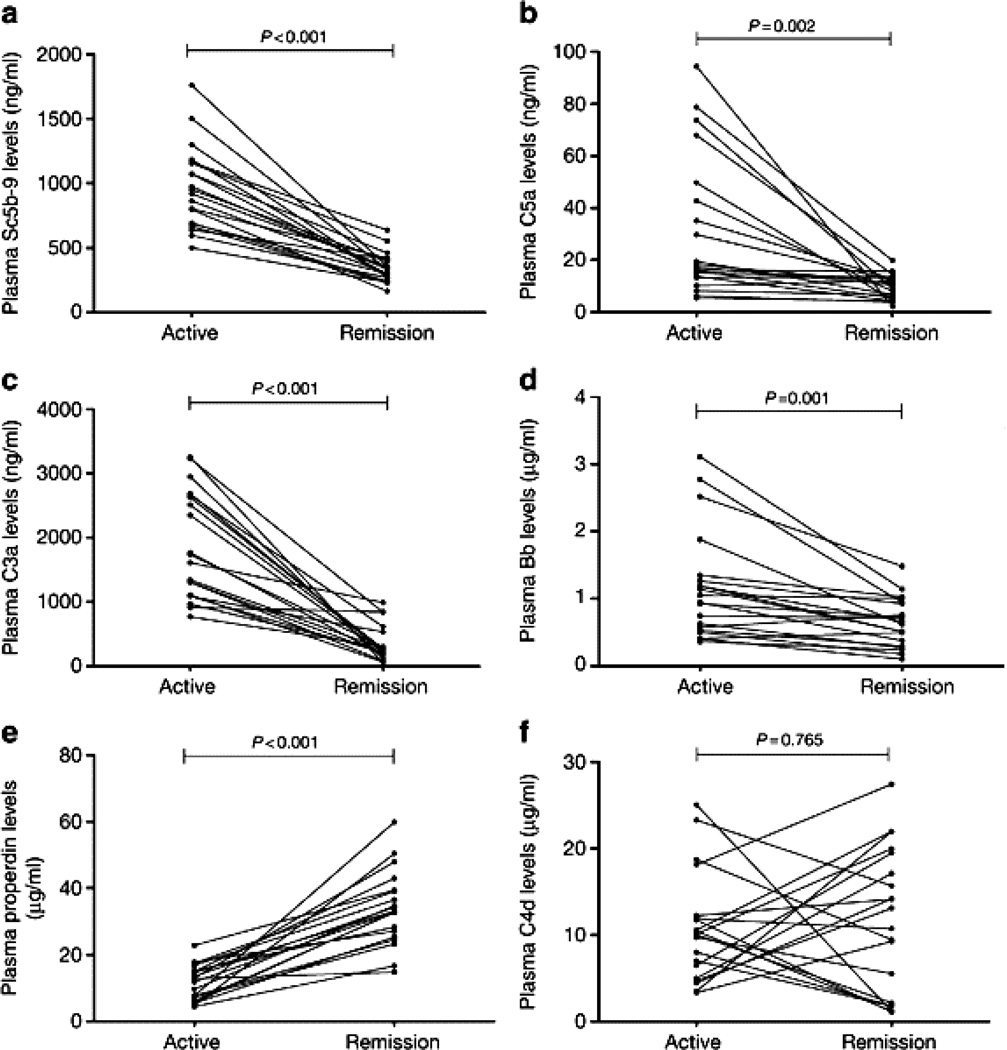
Antineutrophil cytoplasmic autoantibodies (ANCA) are the likely cause for necrotizing small-vessel vasculitis and crescentic glomerulonephritis. Unlike other forms of crescentic glomerulonephritis induced by immune complexes or anti-glomerular basement membrane antibodies that have conspicuous vessel wall immunoglobulin and complement, there is a paucity, although usually not an absence, of vessel wall immunoglobulin and complement in ANCA-associated glomerulonephritis. Despite this comparatively lower level and more localized distribution of vessel wall complement, experimental and clinical observations strongly incriminate alternative complement pathway activation as critically important in the pathogenesis of ANCA disease. Experimental data in animal models and in vitro experiments has shown that primed neutrophils are activated by ANCA, which generates C5a, which engages C5a receptors on neutrophils. This attracts and in turn primes more neutrophils for activation by ANCA. In patients with ANCA disease, plasma levels of C3a, C5a, soluble C5b-9, and Bb have been reported to be higher in active disease than in remission, whereas no difference was reported in plasma C4d in active versus ANCA disease remission. Thus, experimental and clinical data support the hypothesis that ANCA-induced neutrophil activation activates the alternative complement pathway and generates C5a. C5a not only recruits additional neutrophils through chemotaxis but also primes neutrophils for activation by ANCA. This creates a self-fueling inflammatory amplification loop that results in the extremely destructive necrotizing vascular injury.

Keywords: ANCA; antineutrophil cytoplasmic autoantibodies; crescentic glomerulonephritis; vasculitis.


Figures

Figure 1
Figure 1
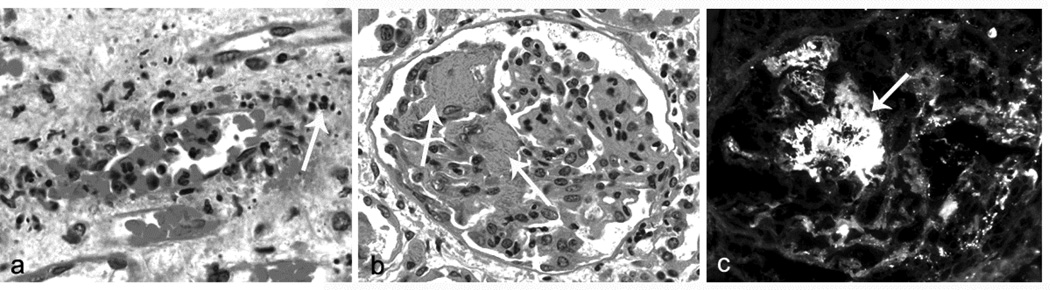
Panel a: Early acute medullary angiitis in a patient with ANCA disease showing margination and diapedesis of neutrophils and adjacent leukocytoclasia (white arrow, H&E stain). Panel b: Early acute necrotizing ANCA glomerulonephritis with a slight increase in glomerular neutrophils and segmental fibrinoid necrosis (white arrows, H&E stain). Panel c: Early acute necrotizing ANCA glomerulonephritis with segmental staining for C3 by immunofluorescence microscopy corresponding to segmental fibrinoid necrosis (FITC anti-C3).
Figure 2
Figure 2
Diagram showing the effects of knockout or blockade of specific elements of the alternative, classical and lectin pathways of complement activation on the pathogenesis of anti-MPO induced murine crescentic glomerulonephritis. Note that disruption of the alternative pathway, and blockade of C5 and C5aR inhibits disease; but not disruption of the classical or lectin pathways, depletion of C6 or blockade of C3aR (shown only in vitro). This figure is based on data reported in references 14, 16, 17 and 20.
Figure 3
Figure 3
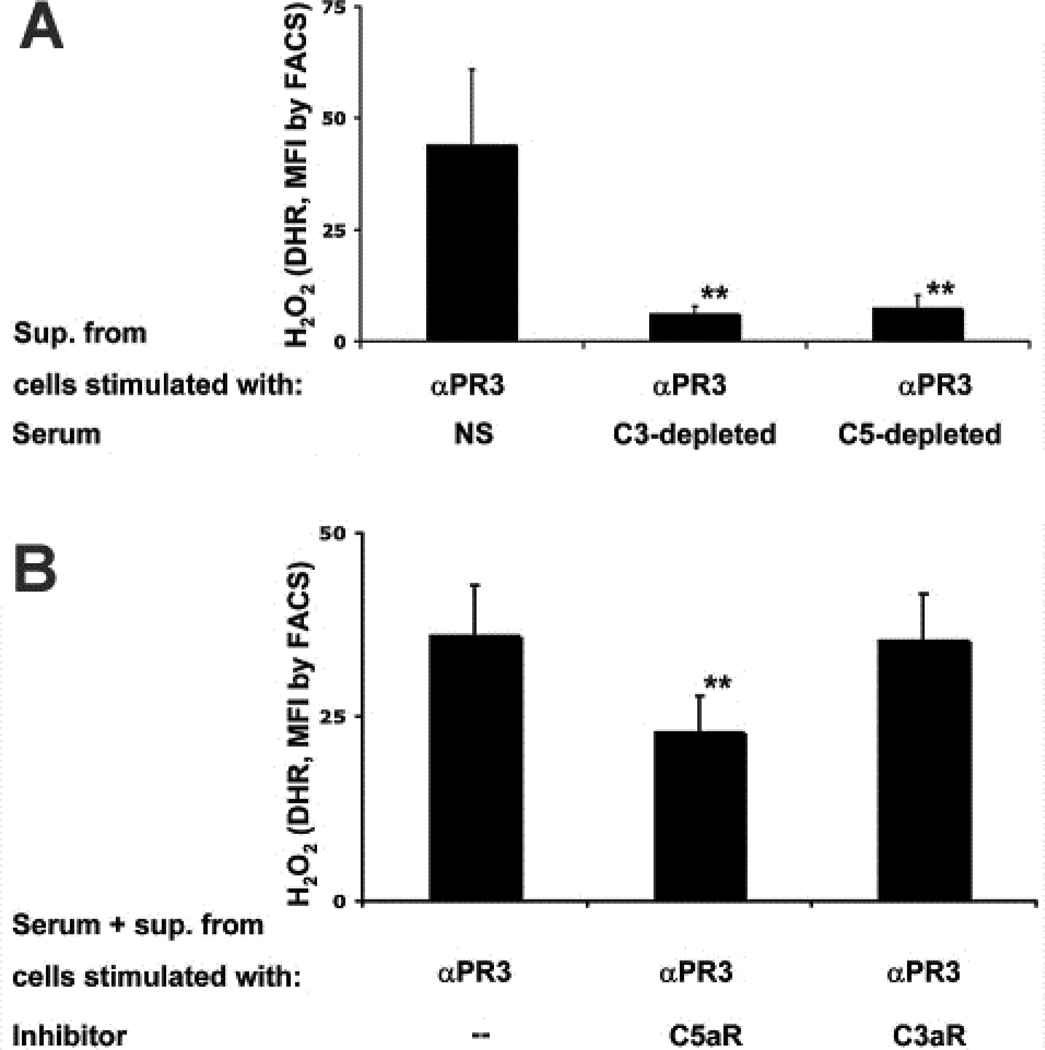
A: TNF-primed neutrophils were stimulated with monoclonal anti-PR3 and their supernatants (conditioned serum) were incubated with normal serum (NS), C3-depleted serum, or C5-depleted serum. These conditioned sera were then used to prime normal neutrophils for activation by anti-PR3 with resultant respiratory burst. Depletion of C3 or C5 from serum prevented the generation of ANCA-induced priming factor(s). B: Normal neutrophils were preincubated with a blocking antibody to C5aR or a C3aR antagonist, followed by priming with conditioned serum and subsequently activated with anti-PR3. Anti-PR3 induced respiratory burst was inhibited by blocking C5aR but not C3aR.
Figure 4
Figure 4
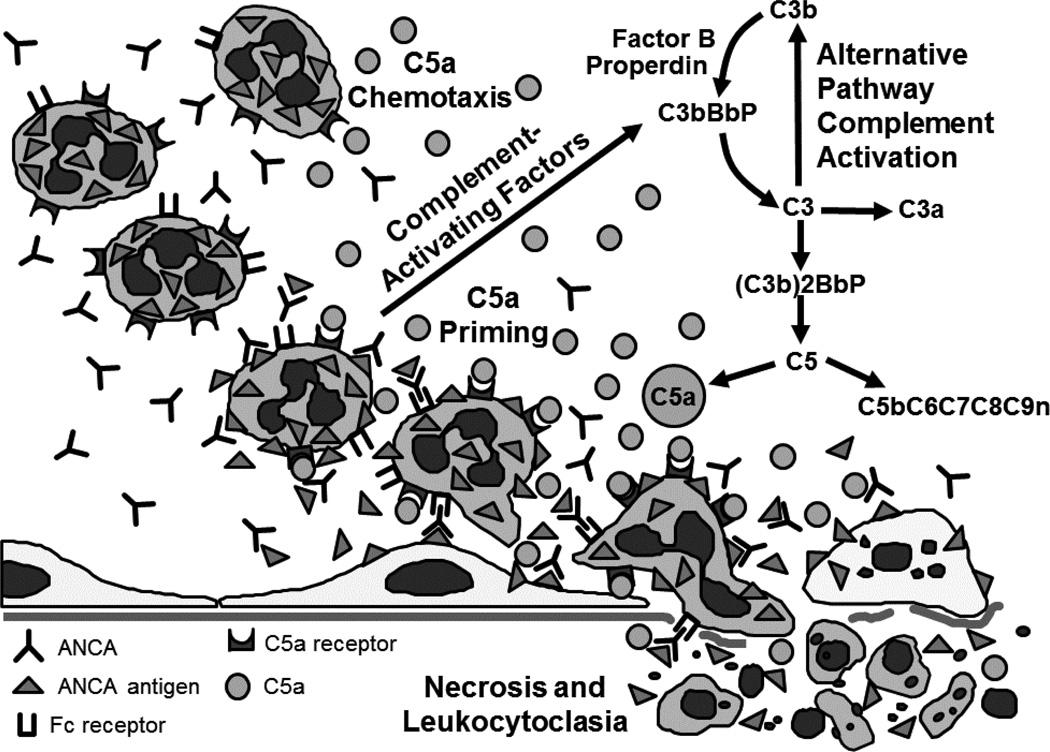
Diagram depicting C5a as a prime mover at the center of an inflammatory amplification loop that mediates ANCA-induced vascular inflammation and nercrosis. Neutrophils activated by ANCA release factors that activate the alternative complement pathway, generating C5a. C5a is chemoattractant for neutrophils and primes neutrophils by C5aR engagement to display ANCA-antigens at the cell surface, which allows neutrophil activation by ANCA through FcR and Fab’2 binding. ANCA-activated neutrophils cause vascular necrosis and undergo leukocytoclasia.
Figure 5
Figure 5
Plasma complement levels in 20 ANCA disease patients during active disease compared to remission. (a) Plasma C5b-9. (b) Plasma C5a. (c) Plasma C3a. (d) Plasma Bb. (e) Plasma properdin. (f) Plasma C4d. Plasma levels of C3a, C5a, C5b-9, and Bb were significantly higher in active disease than remission, whereas plasma properdin were significantly lower in active disease. These findings are consistent with alternative pathway complement activation during active ANCA disease. (Reprinted from Reference 22 with permission)

References

    1. Falk RJ, Jennette JC. ANCA Disease: Where Is This Field Going? J Am Soc Nephrol. 2010;21:745–752. - PubMed
    1. Jennette JC, Falk RJ, Hu P, Xiao H. Pathogenesis of Anti-neutrophil Cytoplasmic Autoantibody Associated Small Vessel Vasculitis. Annu Rev Pathol. 2013;8:139–160. - PMC - PubMed
    1. Jennette JC, Falk RJ, Bacon PA, Basu N, Cid MC, Ferrario F, Flores-Suarez LF, Gross WL, Guillevin L, Hagen EC, Hoffman GS, Jayne DR, Kallenberg CGM, Lamprecht P, Langford CA, Luqmani RA, Mahr AD, Matteson EL, Merkel PA, Ozen S, Pusey CD, Rasmussen N, Rees AJ, Scott DGI, Specks U, Stone JH, Takahashi K, Watts RA. 2012 Revised International Chapel Hill Consensus Conference Nomenclature of Vasculitides. Arthritis Rheum. 2013;65:1–11. - PubMed
    1. Jennette JC, Falk RJ. The role of pathology in the diagnosis of systemic vasculitis. Clin Exp Rheumatol. 2007;25(1 Suppl 44):52–62. - PubMed
    1. Jennette JC. Nomenclature and classification of vasculitis: lessons learned from granulomatosis with polyangiitis (Wegner’s granulomatosis) Clin Exp Immunol. 2011;164(Suppl 1):7–10. - PMC - PubMed

MeSH terms

Substances