


Association between reduced plasma 25-hydroxy vitamin D and increased risk of cancer in patients with inflammatory bowel diseases
- PMID: 24161349
- PMCID: PMC3995841
- DOI: 10.1016/j.cgh.2013.10.011
Association between reduced plasma 25-hydroxy vitamin D and increased risk of cancer in patients with inflammatory bowel diseases
Abstract
Background & aims: Vitamin D deficiency is common among patients with inflammatory bowel diseases (IBD) (Crohn's disease or ulcerative colitis). The effects of low plasma 25-hydroxy vitamin D (25[OH]D) on outcomes other than bone health are understudied in patients with IBD. We examined the association between plasma level of 25(OH)D and risk of cancers in patients with IBD.
Methods: From a multi-institutional cohort of patients with IBD, we identified those with at least 1 measurement of plasma 25(OH)D. The primary outcome was development of any cancer. We examined the association between plasma 25(OH)D and risk of specific subtypes of cancer, adjusting for potential confounders in a multivariate regression model.
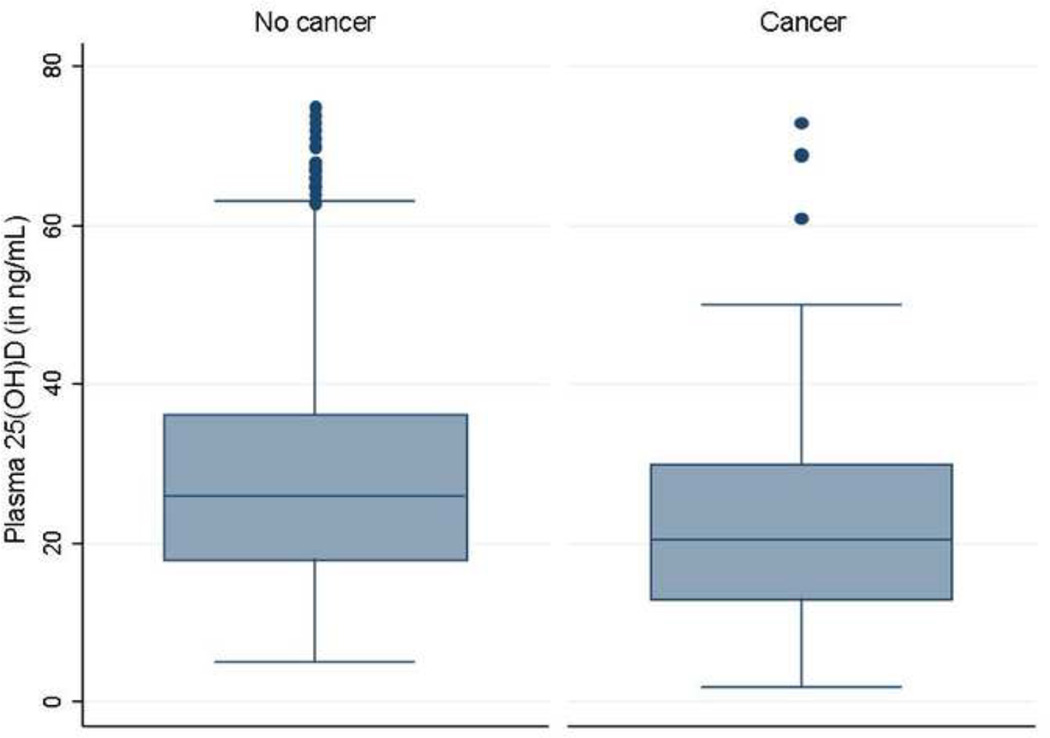
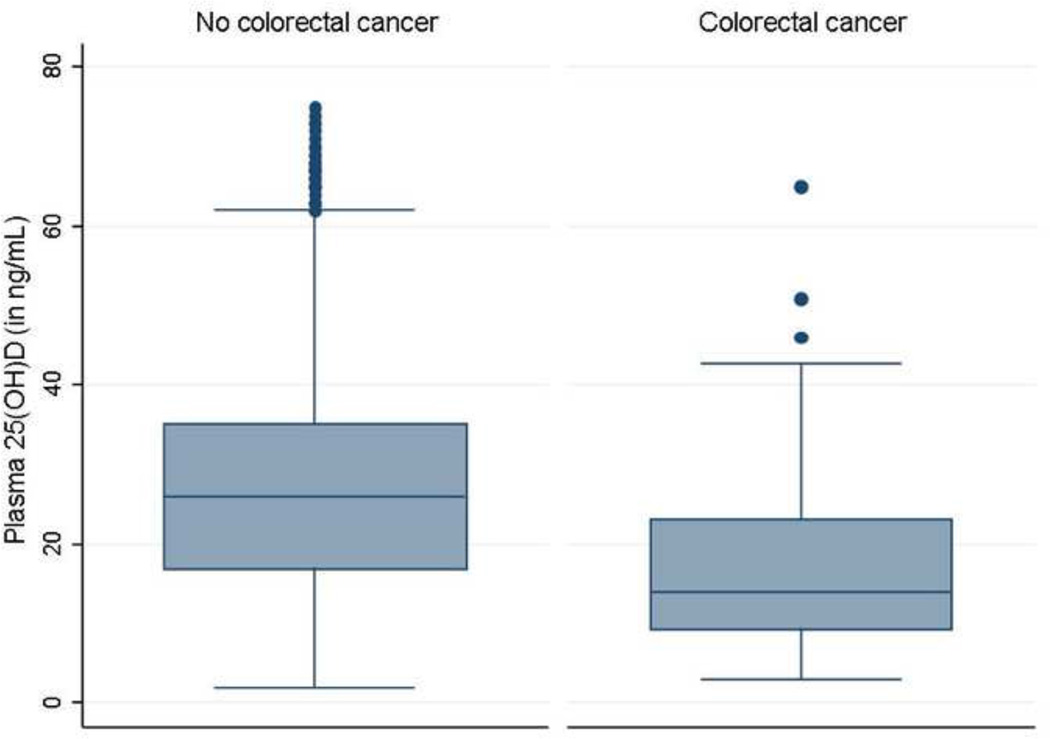
Results: We analyzed data from 2809 patients with IBD and a median plasma level of 25(OH)D of 26 ng/mL. Nearly one-third had deficient levels of vitamin D (<20 ng/mL). During a median follow-up period of 11 years, 196 patients (7%) developed cancer, excluding nonmelanoma skin cancer (41 cases of colorectal cancer). Patients with vitamin D deficiency had an increased risk of cancer (adjusted odds ratio, 1.82; 95% confidence interval, 1.25-2.65) compared with those with sufficient levels. Each 1-ng/mL increase in plasma 25(OH)D was associated with an 8% reduction in risk of colorectal cancer (odds ratio, 0.92; 95% confidence interval, 0.88-0.96). A weaker inverse association was also identified for lung cancer.
Conclusions: In a large multi-institutional IBD cohort, a low plasma level of 25(OH)D was associated with an increased risk of cancer, especially colorectal cancer.
Keywords: Colorectal Cancer; Crohn’s Disease; Malignancy; Ulcerative Colitis; Vitamin D.
Copyright © 2014 AGA Institute. Published by Elsevier Inc. All rights reserved.
Conflict of interest statement
Figures
Comment in
-
Should patients with inflammatory bowel disease take vitamin D to prevent cancer?Clin Gastroenterol Hepatol. 2014 May;12(5):828-30. doi: 10.1016/j.cgh.2013.11.004. Epub 2013 Nov 12. Clin Gastroenterol Hepatol. 2014. PMID: 24239859 No abstract available.
-
Association between reduced plasma 25-hydroxyvitamin D and increased risk of cancer in patients with inflammatory bowel disease.Clin Gastroenterol Hepatol. 2015 Apr;13(4):813-4. doi: 10.1016/j.cgh.2014.04.031. Epub 2014 May 6. Clin Gastroenterol Hepatol. 2015. PMID: 24813176 No abstract available.
-
Reply: To PMID 24161349.Clin Gastroenterol Hepatol. 2015 Apr;13(4):814. doi: 10.1016/j.cgh.2015.01.001. Epub 2015 Jan 7. Clin Gastroenterol Hepatol. 2015. PMID: 25576688 No abstract available.
References
-
- Holick MF. Vitamin D deficiency. N Engl J Med. 2007;357:266–281. - PubMed
-
- Rosen CJ. Clinical practice. Vitamin D insufficiency. N Engl J Med. 2011;364:248–254. - PubMed
-
- Cantorna MT, Zhu Y, Froicu M, Wittke A. Vitamin D status, 1,25- dihydroxyvitamin D3, and the immune system. Am J Clin Nutr. 2004;80:1717S–1720S. - PubMed
-
- Holick MF. Sunlight and vitamin D for bone health and prevention of autoimmune diseases, cancers, and cardiovascular disease. Am J Clin Nutr. 2004;80:1678S–1688S. - PubMed
Publication types
MeSH terms
Substances
Grants and funding
LinkOut - more resources
Full Text Sources
Other Literature Sources
Medical
