


Integrating patient reported outcomes with clinical cancer registry data: a feasibility study of the electronic Patient-Reported Outcomes From Cancer Survivors (ePOCS) system
- PMID: 24161667
- PMCID: PMC3841364
- DOI: 10.2196/jmir.2764
Integrating patient reported outcomes with clinical cancer registry data: a feasibility study of the electronic Patient-Reported Outcomes From Cancer Survivors (ePOCS) system
Abstract
Background: Routine measurement of Patient Reported Outcomes (PROs) linked with clinical data across the patient pathway is increasingly important for informing future care planning. The innovative electronic Patient-reported Outcomes from Cancer Survivors (ePOCS) system was developed to integrate PROs, collected online at specified post-diagnostic time-points, with clinical and treatment data in cancer registries.
Objective: This study tested the technical and clinical feasibility of ePOCS by running the system with a sample of potentially curable breast, colorectal, and prostate cancer patients in their first 15 months post diagnosis.
Methods: Patients completed questionnaires comprising multiple Patient Reported Outcome Measures (PROMs) via ePOCS within 6 months (T1), and at 9 (T2) and 15 (T3) months, post diagnosis. Feasibility outcomes included system informatics performance, patient recruitment, retention, representativeness and questionnaire completion (response rate), patient feedback, and administration burden involved in running the system.
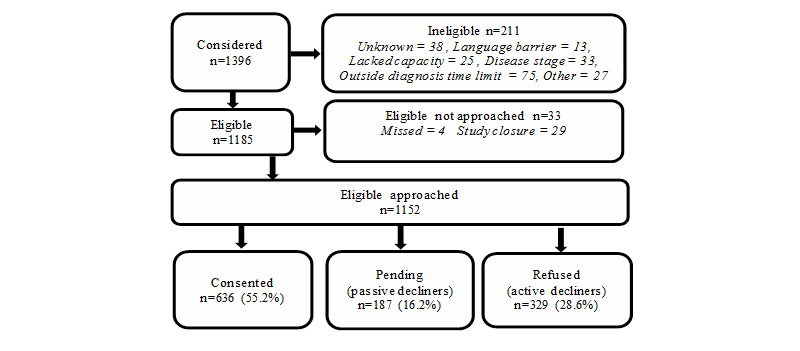
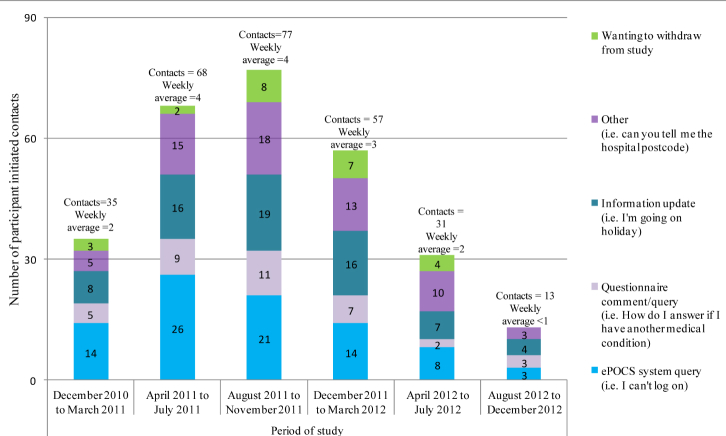
Results: ePOCS ran efficiently with few technical problems. Patient participation was 55.21% (636/1152) overall, although varied by approach mode, and was considerably higher among patients approached face-to-face (61.4%, 490/798) than by telephone (48.8%, 21/43) or letter (41.0%, 125/305). Older and less affluent patients were less likely to join (both P<.001). Most non-consenters (71.1%, 234/329) cited information technology reasons (ie, difficulty using a computer). Questionnaires were fully or partially completed by 85.1% (541/636) of invited participants at T1 (80 questions total), 70.0% (442/631) at T2 (102-108 questions), and 66.3% (414/624) at T3 (148-154 questions), and fully completed at all three time-points by 57.6% (344/597) of participants. Reminders (mainly via email) effectively prompted responses. The PROs were successfully linked with cancer registry data for 100% of patients (N=636). Participant feedback was encouraging and positive, with most patients reporting that they found ePOCS easy to use and that, if asked, they would continue using the system long-term (86.2%, 361/419). ePOCS was not administratively burdensome to run day-to-day, and patient-initiated inquiries averaged just 11 inquiries per month.
Conclusions: The informatics underlying the ePOCS system demonstrated successful proof-of-concept--the system successfully linked PROs with registry data for 100% of the patients. The majority of patients were keen to engage. Participation rates are likely to improve as the Internet becomes more universally adopted. ePOCS can help overcome the challenges of routinely collecting PROs and linking with clinical data, which is integral for treatment and supportive care planning and for targeting service provision.
Keywords: Internet; cancer; cancer registry; electronic data capture; health information technology; health-related quality of life; oncology; patient reported outcome measures; patient reported outcomes; survivorship.
Conflict of interest statement
Conflicts of Interest: None declared.
Figures
References
-
- Coleman MP, Forman D, Bryant H, Butler J, Rachet B, Maringe C, Nur U, Tracey E, Coory M, Hatcher J, McGahan CE, Turner D, Marrett L, Gjerstorff ML, Johannesen TB, Adolfsson J, Lambe M, Lawrence G, Meechan D, Morris EJ, Middleton R, Steward J, Richards MA, ICBP Module 1 Working Group Cancer survival in Australia, Canada, Denmark, Norway, Sweden, and the UK, 1995-2007 (the International Cancer Benchmarking Partnership): an analysis of population-based cancer registry data. Lancet. 2011 Jan 8;377(9760):127–38. doi: 10.1016/S0140-6736(10)62231-3. http://europepmc.org/abstract/MED/21183212 - DOI - PMC - PubMed
-
- Parry C, Kent EE, Mariotto AB, Alfano CM, Rowland JH. Cancer survivors: a booming population. Cancer Epidemiol Biomarkers Prev. 2011 Oct;20(10):1996–2005. doi: 10.1158/1055-9965.EPI-11-0729. http://cebp.aacrjournals.org/cgi/pmidlookup?view=long&pmid=21980007 - DOI - PMC - PubMed
-
- Jefford M, Rowland J, Grunfeld E, Richards M, Maher J, Glaser A. Implementing improved post-treatment care for cancer survivors in England, with reflections from Australia, Canada and the USA. Br J Cancer. 2013 Jan 15;108(1):14–20. doi: 10.1038/bjc.2012.554. http://europepmc.org/abstract/MED/23257892 - DOI - PMC - PubMed
-
- Sullivan R, Peppercorn J, Sikora K, Zalcberg J, Meropol NJ, Amir E, Khayat D, Boyle P, Autier P, Tannock IF, Fojo T, Siderov J, Williamson S, Camporesi S, McVie JG, Purushotham AD, Naredi P, Eggermont A, Brennan MF, Steinberg ML, De Ridder M, McCloskey SA, Verellen D, Roberts T, Storme G, Hicks RJ, Ell PJ, Hirsch BR, Carbone DP, Schulman KA, Catchpole P, Taylor D, Geissler J, Brinker NG, Meltzer D, Kerr D, Aapro M. Delivering affordable cancer care in high-income countries. Lancet Oncol. 2011 Sep;12(10):933–80. doi: 10.1016/S1470-2045(11)70141-3. - DOI - PubMed
-
- Department of Health. Macmillan Cancer Support. NHS Improvement . The National Cancer Survivorship Initiative Vision. London: 2010. [2013-08-13]. http://www.ncsi.org.uk/wp-content/uploads/NCSI-Vision-Document.pdf.
Publication types
MeSH terms
Grants and funding
LinkOut - more resources
Full Text Sources
Other Literature Sources
Miscellaneous
