


Developing a new, national approach to surveillance for ventilator-associated events*
- PMID: 24162674
- PMCID: PMC10847970
- DOI: 10.1097/CCM.0b013e3182a262db
Developing a new, national approach to surveillance for ventilator-associated events*
Abstract
Objective: To develop and implement an objective, reliable approach to surveillance for ventilator-associated events in adult patients.
Design: The Centers for Disease Control and Prevention (CDC) convened a Ventilator-Associated Pneumonia (VAP) Surveillance Definition Working Group in September 2011. Working Group members included representatives of stakeholder societies and organizations and federal partners.
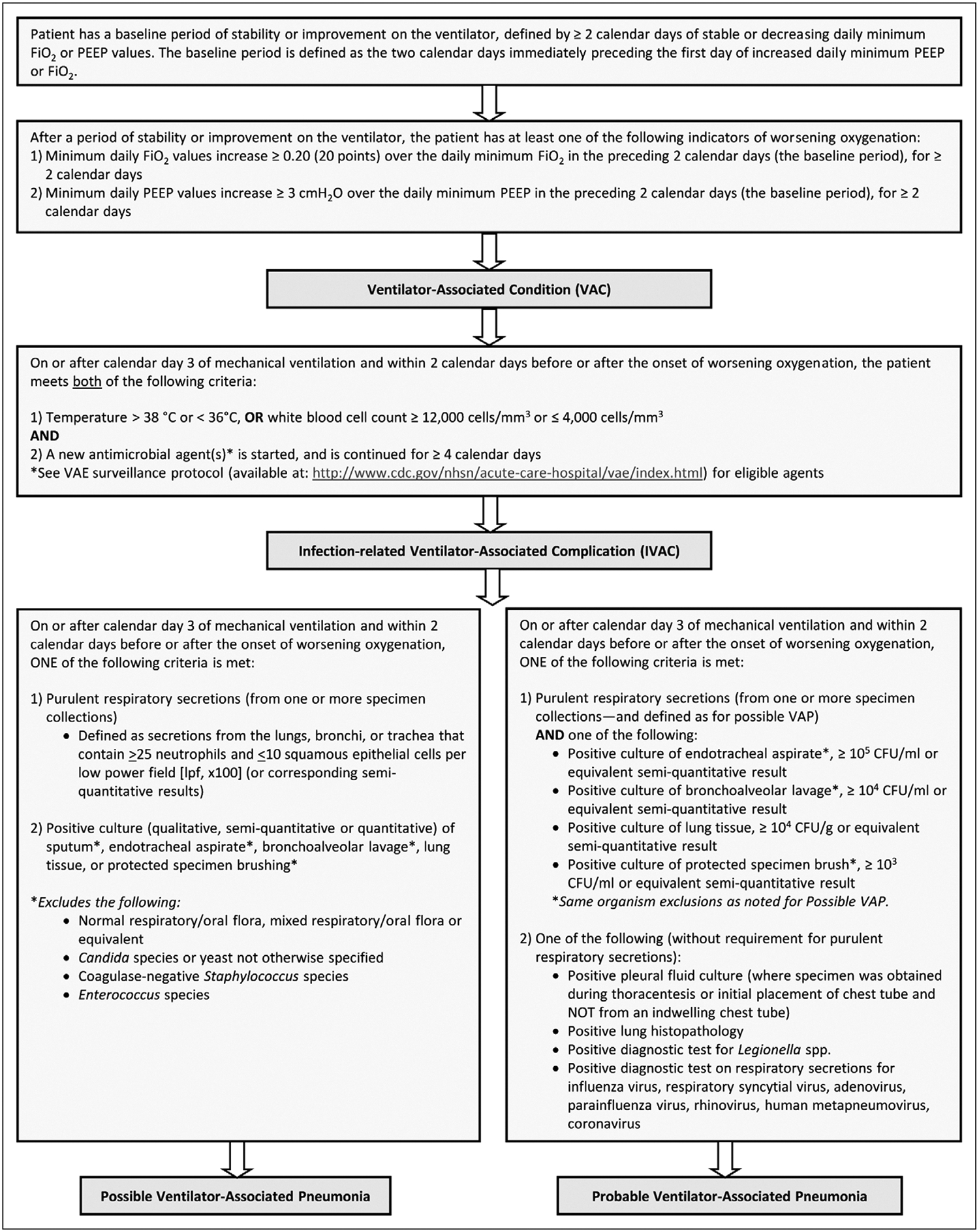
Main results: The Working Group finalized a three-tier, adult surveillance definition algorithm for ventilator-associated events. The algorithm uses objective, readily available data elements and can identify a broad range of conditions and complications occurring in mechanically ventilated adult patients, including but not limited to VAP. The first tier definition, ventilator-associated condition (VAC), identifies patients with a period of sustained respiratory deterioration following a sustained period of stability or improvement on the ventilator, defined by changes in the daily minimum fraction of inspired oxygen or positive end-expiratory pressure. The second tier definition, infection-related ventilator-associated complication (IVAC), requires that patients with VAC also have an abnormal temperature or white blood cell count, and be started on a new antimicrobial agent. The third tier definitions, possible and probable VAP, require that patients with IVAC also have laboratory and/or microbiological evidence of respiratory infection.
Conclusions: Ventilator-associated events surveillance was implemented in January 2013 in the CDC's National Healthcare Safety Network. Modifications to improve surveillance may be made as additional data become available and users gain experience with the new definitions.
Conflict of interest statement
The remaining authors have disclosed that they do not have any potential conflicts of interest.
Figures
Comment in
-
Updated approach for the assessment of ventilator-associated pneumonia.Crit Care Med. 2013 Nov;41(11):2641-2. doi: 10.1097/CCM.0b013e3182a84be1. Crit Care Med. 2013. PMID: 24162675 Free PMC article. No abstract available.
-
Developing a new, national approach to surveillance for ventilator-associated events: executive summary.Chest. 2013 Nov;144(5):1448-1452. doi: 10.1378/chest.13-1640. Chest. 2013. PMID: 24189858 Free PMC article. No abstract available.
References
-
- Andrews CP, Coalson JJ, Smith JD, Johanson WG. Diagnosis of nosocomial bacterial pneumonia in acute, diffuse lung injury. Chest 1981;80:254–258. - PubMed
-
- Kirtland SH, Corley DE, Winterbauer RH, et al. The diagnosis of ventilator-associated pneumonia: a comparison of histologic, microbiologic, and clinical criteria. Chest 1997;112:445–447. - PubMed
-
- Klompas M. Does this patient have ventilator-associated pneumonia? JAMA 2007;297:1583–1593. - PubMed
-
- Papazian L, Thomas P, Garbe L, et al. Bronchoscopic or blind sampling techniques for the diagnosis of ventilator-associated pneumonia. Am J Respir Crit Care Med 1995;152:1982–1991. - PubMed
-
- Wunderink RG, Woldenberg LS, Zeiss J, et al. The radiologic diagnosis of autopsy-proven ventilator-associated pneumonia. Chest 1992;101:458–463. - PubMed
Publication types
MeSH terms
Grants and funding
LinkOut - more resources
Full Text Sources
Other Literature Sources
Medical
