


Roles of cohesin and condensin in chromosome dynamics during mammalian meiosis
- PMID: 24162807
- PMCID: PMC3934126
- DOI: 10.1262/jrd.2013-068
Roles of cohesin and condensin in chromosome dynamics during mammalian meiosis
Abstract
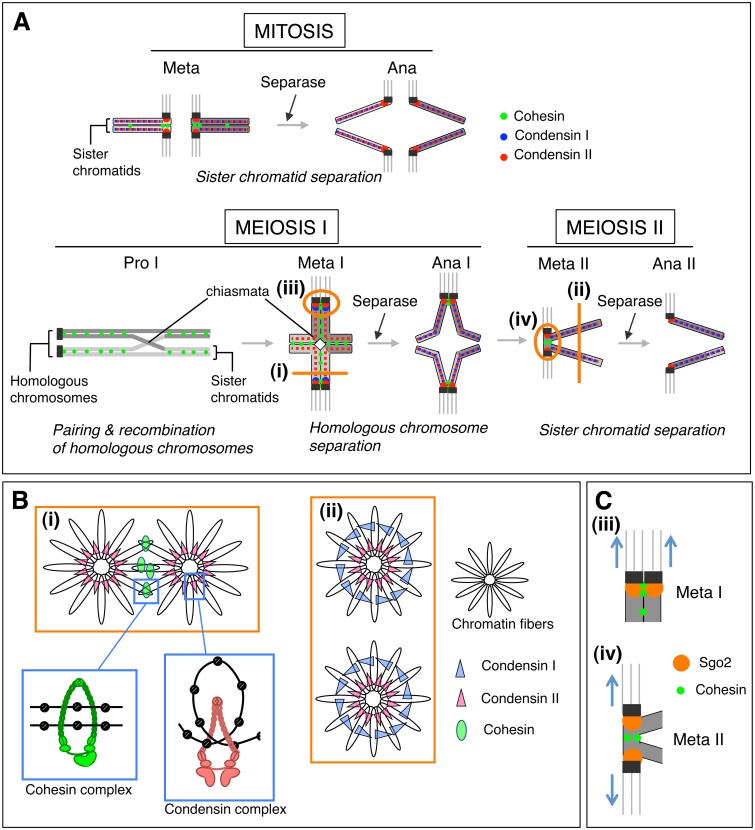
Meiosis is a key step for sexual reproduction in which chromosome number is halved by two successive meiotic divisions after a single round of DNA replication. In the first meiotic division (meiosis I), homologous chromosomes pair, synapse, and recombine with their partners in prophase I. As a result, homologous chromosomes are physically connected until metaphase I and then segregated from each other at the onset of anaphase I. In the subsequent second meiotic division (meiosis II), sister chromatids are segregated. Chromosomal abnormality arising during meiosis is one of the major causes of birth defects and congenital disorders in mammals including human and domestic animals. Hence understanding of the mechanism underlying these unique chromosome behavior in meiosis is of great importance. This review focuses on the roles of cohesin and condensin, and their regulation in chromosome dynamics during mammalian meiosis.
Figures
References
-
- Peters JM, Tedeschi A, Schmitz J. The cohesin complex and its roles in chromosome biology. Genes Dev 2008; 22: 3089–3114 - PubMed
-
- Prieto I, Suja JA, Pezzi N, Kremer L, Martinez AC, Rufas JS, Barbero JL. Mammalian STAG3 is a cohesin specific to sister chromatid arms in meiosis I. Nat Cell Biol 2001; 3: 761–766 - PubMed
-
- Lee J, Iwai T, Yokota T, Yamashita M. Temporally and spatially selective loss of Rec8 protein from meiotic chromosomes during mammalian meiosis. J Cell Sci 2003; 116: 2781–2790 - PubMed
Publication types
MeSH terms
Substances
LinkOut - more resources
Full Text Sources
Other Literature Sources
Research Materials
