Ibuprofen, paracetamol, and steam for patients with respiratory tract infections in primary care: pragmatic randomised factorial trial
- PMID: 24162940
- PMCID: PMC3808081
- DOI: 10.1136/bmj.f6041
Ibuprofen, paracetamol, and steam for patients with respiratory tract infections in primary care: pragmatic randomised factorial trial
Abstract
Objective: To assess strategies for advice on analgesia and steam inhalation for respiratory tract infections.
Design: Open pragmatic parallel group factorial randomised controlled trial.
Setting: Primary care in United Kingdom.
Participants: Patients aged ≥ 3 with acute respiratory tract infections.
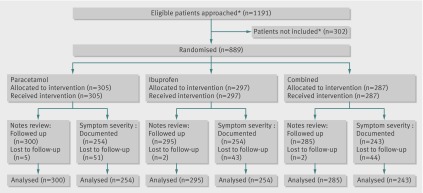
Intervention: 889 patients were randomised with computer generated random numbers in pre-prepared sealed numbered envelopes to components of advice or comparator advice: advice on analgesia (take paracetamol, ibuprofen, or both), dosing of analgesia (take as required v regularly), and steam inhalation (no inhalation v steam inhalation).
Outcomes: Primary: mean symptom severity on days 2-4; symptoms rated 0 (no problem) to 7 (as bad as it can be). Secondary: temperature, antibiotic use, reconsultations.
Results: Neither advice on dosing nor on steam inhalation was significantly associated with changes in outcomes. Compared with paracetamol, symptom severity was little different with ibuprofen (adjusted difference 0.04, 95% confidence interval -0.11 to 0.19) or the combination of ibuprofen and paracetamol (0.11, -0.04 to 0.26). There was no evidence for selective benefit with ibuprofen among most subgroups defined before analysis (presence of otalgia; previous duration of symptoms; temperature >37.5 °C; severe symptoms), but there was evidence of reduced symptoms severity benefit in the subgroup with chest infections (ibuprofen -0.40, -0.78 to -0.01; combination -0.47; -0.84 to -0.10), equivalent to almost one in two symptoms rated as a slight rather than a moderately bad problem. Children might also benefit from treatment with ibuprofen (ibuprofen: -0.47, -0.76 to -0.18; combination: -0.04, -0.31 to 0.23). Reconsultations with new/unresolved symptoms or complications were documented in 12% of those advised to take paracetamol, 20% of those advised to take ibuprofen (adjusted risk ratio 1.67, 1.12 to 2.38), and 17% of those advised to take the combination (1.49, 0.98 to 2.18). Mild thermal injury with steam was documented for four patients (2%) who returned full diaries, but no reconsultations with scalding were documented.
Conclusion: Overall advice to use steam inhalation, or ibuprofen rather than paracetamol, does not help control symptoms in patients with acute respiratory tract infections and must be balanced against the possible progression of symptoms during the next month for a minority of patients. Advice to use ibuprofen might help short term control of symptoms in those with chest infections and in children.
Trial registration: ISRCTN 38551726.
Conflict of interest statement
Competing interests: All authors have completed the ICMJE uniform disclosure form at
Figures
Comment in
-
Neither ibuprofen nor steam improves symptom control compared with paracetamol in patients with acute respiratory tract infections in primary care.Evid Based Med. 2014 Jun;19(3):102. doi: 10.1136/eb-2013-101670. Epub 2014 Jan 22. Evid Based Med. 2014. PMID: 24453087 No abstract available.
References
-
- Feverish illness in children. Assessment and initial management in children younger than 5 years. NICE Clinical Guideline 160, 2013. - PubMed
Publication types
MeSH terms
Substances
Associated data
Grants and funding
LinkOut - more resources
Full Text Sources
Other Literature Sources
Medical
Research Materials