. 2013 Oct 28:8:173.
doi: 10.1186/1750-1172-8-173.

Phenotypic variability in ARCA2 and identification of a core ataxic phenotype with slow progression

Affiliations

Phenotypic variability in ARCA2 and identification of a core ataxic phenotype with slow progression

Cyril Mignot et al. Orphanet J Rare Dis. .

Abstract

Autosomal recessive cerebellar ataxia 2 (ARCA2) is a recently identified recessive ataxia due to ubiquinone deficiency and biallelic mutations in the ADCK3 gene. The phenotype of the twenty-one patients reported worldwide varies greatly. Thus, it is difficult to decide which ataxic patients are good candidates for ADCK3 screening without evidence of ubiquinone deficiency. We report here the clinical and molecular data of 10 newly diagnosed patients from seven families and update the disease history of four additional patients reported in previous articles to delineate the clinical spectrum of ARCA2 phenotype and to provide a guide to the molecular diagnosis. First signs occurred before adulthood in all 14 patients. Cerebellar atrophy appeared in all instances. The progressivity and severity of ataxia varied greatly, but no patients had the typical inexorable ataxic course that characterizes other childhood-onset recessive ataxias. The ataxia was frequently associated with other neurological signs. Importantly, stroke-like episodes contributed to significant deterioration of the neurological status in two patients. Ubidecarenone therapy markedly improved the movement disorders, including ataxia, in two other patients. The 7 novel ADCK3 mutations found in the 10 new patients were two missense and five truncating mutations. There was no apparent correlation between the genotype and the phenotype. Our series reveals that the clinical spectrum of ARCA2 encompasses a range of ataxic phenotypes. On one end, it may manifest as a pure ataxia with very slow progressivity and, on the other end, as a severe infantile encephalopathy with cerebellar atrophy. The phenotype of most patients, however, lies in between. It is characterized by a very slowly progressive or apparently stable ataxia associated with other signs of central nervous system involvement. We suggest undergoing the molecular analysis of ADCK3 in patients with this phenotype and in those with cerebellar atrophy and a stroke-like episode. The diagnosis of patients with a severe ARCA2 phenotype may also be performed on the basis of biological data, i.e. low ubiquinone level or functional evidence of ubiquinone deficiency. This diagnosis is crucial since the neurological status of some patients may be improved by ubiquinone therapy.


Figures
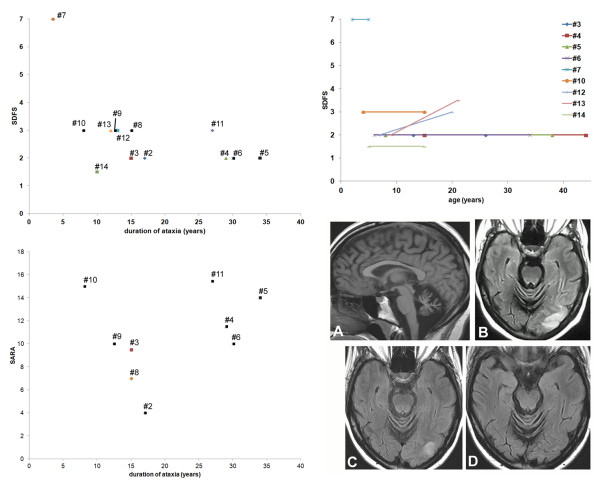
Figure 1
Figure 1
Disability scoring and stroke-like lesions in patients with ARCA2. Functional Score (SDFS, top left) and Scale for the Assessment and Rating of Ataxia (SARA, bottom left) evaluated during the last examination are presented according to the duration of ataxia in 13 and 9 patients (numbered #1 to #14), respectively. Patient #7 with infantile global brain degeneration clearly stands out from other patients with the mild phenotype (top left). SDFS and SARA scores do not appear to be correlated with the duration of ataxia, as confirmed by the Spearman rank correlation analysis (see text). The evolution of the SDFS with time was determined in nine patients (top right). It did not change during childhood, from childhood to adulthood and throughout adulthood in 7/9 patients. Patients #12 is the unique patient with muscular involvement, which may explain the worsening of the SDFS score with time. The neurological status of patient #13 worsened after a SLE, and then partially recovered. Bottom right subpanel: brain MR images of patient #5 showed vermian atrophy (A, T1-weighted image) and stroke-like lesions of the occipital lobe during the episode (B, FLAIR sequence). These images were attenuated one week after (C) the episode and no longer visible seven weeks later (D).
Figure 2
Figure 2
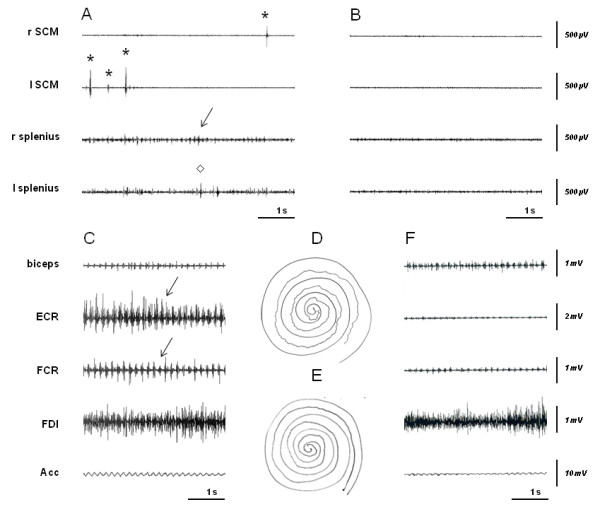
Polymyographic recordings of tremor and myoclonus in two patients with ARCA2 demonstrating the effect of ubidecarenone therapy. Patient #3: note the erratic myoclonus (*) obtained in SCM muscles (90 ms), during writing (A). Dystonic tremor (arrow), can be seen in posterior muscles (right and left splenius), intermingled with myoclonus (◊). All these abnormalities were absent after treatment (B). Patient #4: left upper limb recording performed during spiral drawing displayed a 6 Hz regular tremor (arrow), composed of 120 ms length bursts, alternating in antagonistic forearm muscles (ECR/FCR), associated to an oscillatory signal in Acc (C). Note the dramatic attenuation of tremor amplitude after treatment on spiral drawing (D, before treatment and E, under ubidecarenone), as well as on polymyographic recording (F, under treatment). Abbreviations: r: right, l: left, SCM: sterno-cleido-mastoideous, ECR: extensor carpi radialis, FCR: flexor carpi radialis, FDI: first dorsal interosseous muscles, Acc: accelerometer.

References

    1. Anheim M, Tranchant C, Koenig M. The autosomal recessive cerebellar ataxias. N Engl J Med. 2012;366:636–646. doi: 10.1056/NEJMra1006610. - DOI - PubMed
    1. Gerards M, van den Bosch B, Calis C, Schoonderwoerd K, Van Engelen K, Tijssen M. et al.Nonsense mutations in CABC1/ADCK3 cause progressive cerebellar ataxia and atrophy. Mitochondrion. 2010;10:510–515. doi: 10.1016/j.mito.2010.05.008. - DOI - PubMed
    1. Horvath R, Czermin B, Gulati S, Demuth S, Houge G, Pyle A. et al.Adult-onset cerebellar ataxia due to mutations in CABC1/ADCK3. J Neurol Neurosurg Psychiatry. 2011;83:174–178. - PubMed
    1. Lagier-Tourenne C, Tazir M, Lopez LC, Quinzii CM, Assoum M, Drouot N. et al.ADCK3, an ancestral kinase, is mutated in a form of recessive ataxia associated with coenzyme Q10 deficiency. Am J Hum Genet. 2008;82:661–672. doi: 10.1016/j.ajhg.2007.12.024. - DOI - PMC - PubMed
    1. Mollet J, Delahodde A, Serre V, Chretien D, Schlemmer D, Lombes A. et al.CABC1 gene mutations cause ubiquinone deficiency with cerebellar ataxia and seizures. Am J Hum Genet. 2008;82:623–630. doi: 10.1016/j.ajhg.2007.12.022. - DOI - PMC - PubMed