. 2014 May;19(3):392-401.
doi: 10.1111/adb.12105. Epub 2013 Oct 29.

Long-lasting, experience-dependent alcohol preference in Drosophila

Affiliations

Long-lasting, experience-dependent alcohol preference in Drosophila

Raniero L Peru Y Colón de Portugal et al. Addict Biol. 2014 May.

Abstract

To understand the molecular and neural mechanisms underlying alcohol addiction, many models ranging from vertebrates to invertebrates have been developed. In Drosophila melanogaster, behavioral paradigms from assaying acute responses to alcohol and to behaviors more closely modeling addiction have emerged in recent years. However, both the CAFÉ assay, similar to a two-bottle choice consumption assay, as well as conditioned odor preference, where ethanol is used as the reinforcer, are labor intensive and have low throughput. To address this limitation, we have established a novel ethanol consumption preference assay, called FRAPPÉ, which allows for fast, high throughput measurement of consumption in individual flies, using a fluorescence plate reader. We show that naïve flies do not prefer to consume ethanol, but various pre-exposures, such as ethanol vapor or voluntary ethanol consumption, induce ethanol preference. This ethanol-primed preference is long lasting and is not driven by calories contained in ethanol during the consumption choice. Our novel experience-dependent model of ethanol preference in Drosophila-a highly genetically tractable organism-therefore recapitulates salient features of human alcohol abuse and will facilitate the molecular understanding of the development of alcohol preference.

Keywords: Addiction; Drosophila; alcohol; genetics; model organism; self-administration.


Figures

Figure 1
Figure 1
The FRAPPÉ, an experience-dependent ethanol consumption preference assay in Drosophila. (a) Schematic of the experimental design. (b) Schematic of the consumption plate, where flies chose between 60 mM sucrose and 60 mM sucrose + 15% ethanol after 14–18 hours of food deprivation. The food is labeled with (counter-balanced) fluorescent dyes. (c) Preference index of flies pre-exposed the day before for 20 min to the indicated vaporized ethanol/air (E/A) pressures. Data shown here, as in subsequent preference graphs, are medians, with quartile bars, and 10–90th percentile whiskers. Mock exposed flies (i.e. no ethanol) show mild aversion (PI < 0) to the ethanol-containing food the day after exposure, while flies exposed to 80/70 E/A or higher show significant preference (for this, and following preference graphs, a: p < 0.05 of the indicated group being different from 0, Wilcoxon Signed Rank Test, b: p < 0.01, c: p < 0.001 for each group, where one fly is an n of one.) Statistics for each group from left to right including median, number of flies, p value for preference/avoidance, Sign Test sum (as in following legends) were as follows for 0: −0.29, 130, 0.03, −18; 20: −0.15, 98, 0.42, −5; 50: 0.07, 90, 0.67, 3; 80: 0.54, 144, <0.001, 54; 110: 0.31, 174, <0.001, 37; 130: 0.45, 223, <0.001, 58; 150: 0.46, 107, <0.001, 31.
Figure 2
Figure 2
Pre-exposed flies tested 24 hours later show ethanol preference to various ethanol concentrations. (a) Naïve flies avoid high (≥ 15%) ethanol concentrations. Statistics: 5%: 0.06, 49, 0.98, 0; 10%: 0.06, 57, 0.89, 1; 15%: −0.17, 168, 0.07, −15; 20%: −0.40, 43, 0.018, −11; 25%: −0.30, 92, 0.004, −18. (b) Flies pre-exposed to 80/70 E/A show ethanol preference for ≥ 10% ethanol. Statistics for 5%: −0.24, 79, 0.008, −14; 10%: 0.29, 36, 0.021, 9; 15%: 0.47, 44, 0.003, 15; 20%: 0.37, 73, 0.033, 11; 25%: 0.53, 71, <0.001, 20. (c) Pre-exposure to a high ethanol dose also causes ethanol preference for ≥ 10% ethanol. Statistics for 5%: 0.17, 93, 0.14, 8; 10%: 0.24, 88, 0.011, 16; 15%: 0.69, 144, <0.001, 61; 20%: 0.72, 148, <0.001, 62; 25%: 0.78, 120, <0.001, 57.
Figure 3
Figure 3
Ethanol pre-exposure causes long-lasting preference. (a) Experimental design. Flies were exposed to one dose of 80/70 E/A (or 0/150 mock exposed), and then assayed the indicated number of days later for their ethanol consumption preference. (b) Even 8 days after a one-time exposure, flies still show ethanol preference, while mock exposed flies still avoid ethanol (*** p < 0.001, U = 2056, for 8 days after 80/70 vs. 0/150 exposure, Mann-Whitney U Test). Statistics for 3d: 0.38, 36, 0.009, 9; 5d: 0.45, 55, <0.001, 19; 8d: 0.40, 67, 0.009, 15; 8d mock: −0.31, 100, <0.001, −23.
Figure 4
Figure 4
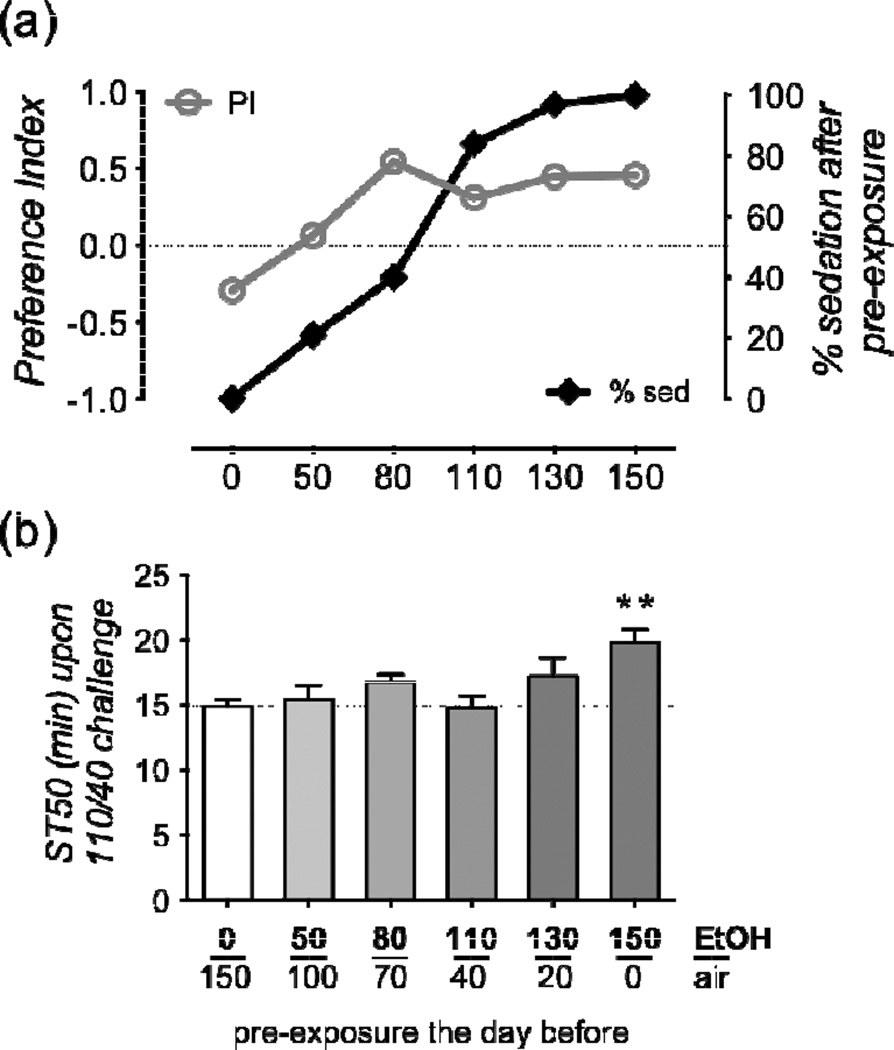
Ethanol consumption preference does not require pre-exposure sedation, or induction of rapid tolerance. Note that the same X-axis applies to both panels. (a) 20 minute pre-exposure leads to levels of sedation (black line, right axis, n ≥ 90 per dose), which steadily increase as a function of the ethanol/air exposure pressure. Ethanol consumption preference 24 hours later, reaches a peak at 80/70 (where only 41% of flies sedate) and does not increase further (grey line, left axis, medians re-plotted from Figure 1c). (b) 24 hours after pre-exposure, a different set of flies shows that only pre-exposure to 150/0 E/A causes increased time to sedation (i.e., tolerance) compared to mock exposed flies (** p < 0.01, q = 3.9, Dunnett’s post-hoc multiple comparison test of all groups vs. 0/150 mock exposure. n = 6 groups of 20 flies per group.)
Figure 5
Figure 5
Voluntary ethanol consumption induces ethanol preference. (a) Experimental design. (b) Flies were fed for 3 days with either 5% sucrose/5% powdered yeast extract (labeled “food”), or sucrose/yeast extract/15% ethanol (labeled as “food + 15% E”), or allowed to choose between those two solutions (labeled as “food + 15% E OR food”). Flies that had prior access to ethanol developed subsequent consumption preference in the FRAPPÉ, while flies that ate ethanol-less food only did not. Statistics for food: 0.04, 140, 0.43, 5; food+ethanol: 0.50, 100, 0.007, 21; food or food+ethanol: 0.37, 187, <0.001, 33.
Figure 6
Figure 6
Ethanol consumption preference is not driven by ethanol calories. (a) Pre-exposed flies given a choice between sucrose+15% ethanol vs. sucrose+1.7M sorbitol (a tasteless but caloric sugar for flies) will prefer ethanol. Note that the two solutions to choose from are nominally isocaloric. Statistics for 0: −0.22, 200, 0.31, −11; 80: 0.60, 253, <0.001, 102. (b) In the absence of ethanol, flies strongly prefer the sorbitol-containing sucrose. Statistics for 0: −0.64, 48, 0.005, −18; 80: −0.87, 64, <0.001, −37. (c) Unlike sucrose and sorbitol, ethanol provides minimal calories for survival, and by 4 days on 15% ethanol alone, all flies die. Isocaloric sugars offered in parallel were 600mM sucrose, or 1.7 M sorbitol (p < 0.001, chi-square = 210, for ethanol vs. sorbitol survival curve, Gehan-Breslow-Wilcoxon Test, n ≥ 149 flies per condition). (d) 15% Ethanol also provided no usable calories when offered together with 60 mM sucrose, and flies die as quickly as with 60 mM sucrose alone. 1.7 M sorbitol significantly extends the survival when added to 60 mM sucrose (p < 0.001, chi-square = 168, for ethanol vs. sorbitol survival curve, Gehan-Breslow-Wilcoxon Test, n ≥ 150 flies per condition).

References

    1. Bellen HJ, Tong C, Tsuda H. 100 years of Drosophila research and its impact on vertebrate neuroscience: a history lesson for the future. Nat Rev Neurosci. 2010;11:514–522. - PMC - PubMed
    1. Berger KH, Kong EC, Dubnau J, Tully T, Moore MS, Heberlein U. Ethanol sensitivity and tolerance in long-term memory mutants of Drosophila melanogaster. Alcohol Clin Exp Res. 2008;32:895–908. - PMC - PubMed
    1. Burke CJ, Waddell S. Remembering Nutrient Quality of Sugar in Drosophila. Curr Biol. 2011;21:746–750. - PMC - PubMed
    1. Devineni AV, Heberlein U. Preferential Ethanol Consumption in Drosophila Models Features of Addiction. Curr Biol. 2009;19:2126–2132. - PMC - PubMed
    1. Devineni AV, McClure KD, Guarnieri DJ, Corl AB, Wolf FW, Eddison M, Heberlein U. The genetic relationships between ethanol preference, acute ethanol sensitivity, and ethanol tolerance in Drosophila melanogaster. Fly. 2011;5 191-19. - PMC - PubMed

Publication types

MeSH terms

LinkOut - more resources