The effects of poverty on childhood brain development: the mediating effect of caregiving and stressful life events
- PMID: 24165922
- PMCID: PMC4001721
- DOI: 10.1001/jamapediatrics.2013.3139
The effects of poverty on childhood brain development: the mediating effect of caregiving and stressful life events
Abstract
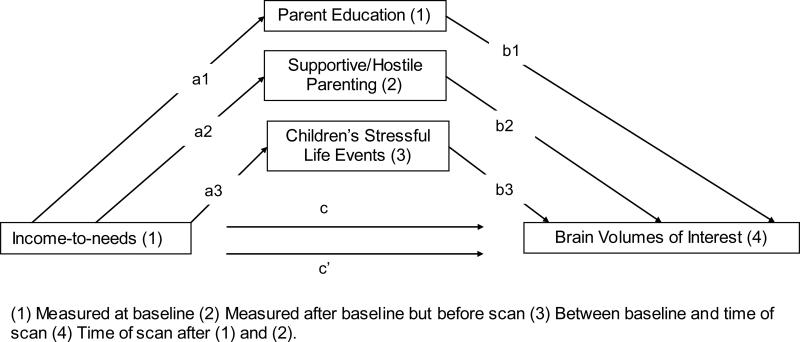
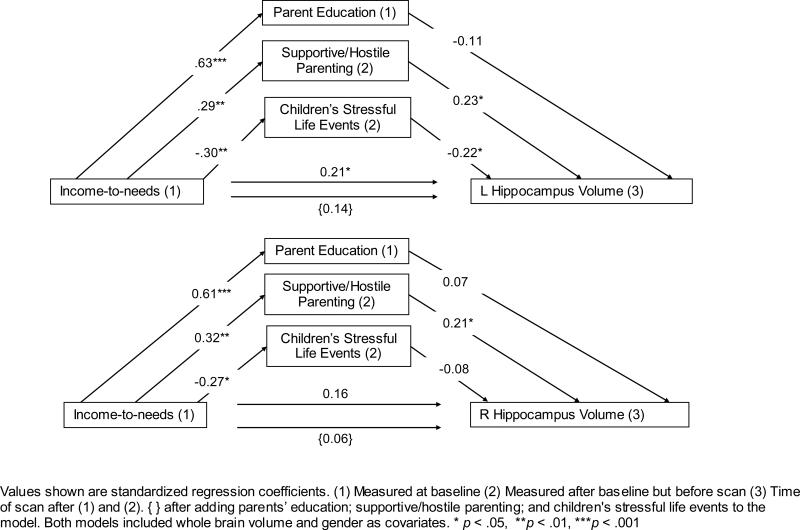
IMPORTANCE The study provides novel data to inform the mechanisms by which poverty negatively impacts childhood brain development. OBJECTIVE To investigate whether the income-to-needs ratio experienced in early childhood impacts brain development at school age and to explore the mediators of this effect. DESIGN, SETTING, AND PARTICIPANTS This study was conducted at an academic research unit at the Washington University School of Medicine in St Louis. Data from a prospective longitudinal study of emotion development in preschool children who participated in neuroimaging at school age were used to investigate the effects of poverty on brain development. Children were assessed annually for 3 to 6 years prior to the time of a magnetic resonance imaging scan, during which they were evaluated on psychosocial, behavioral, and other developmental dimensions. Preschoolers included in the study were 3 to 6 years of age and were recruited from primary care and day care sites in the St Louis metropolitan area; they were annually assessed behaviorally for 5 to 10 years. Healthy preschoolers and those with clinical symptoms of depression participated in neuroimaging at school age/early adolescence. EXPOSURE Household poverty as measured by the income-to-needs ratio. MAIN OUTCOMES AND MEASURES Brain volumes of children's white matter and cortical gray matter, as well as hippocampus and amygdala volumes, obtained using magnetic resonance imaging. Mediators of interest were caregiver support/hostility measured observationally during the preschool period and stressful life events measured prospectively. RESULTS Poverty was associated with smaller white and cortical gray matter and hippocampal and amygdala volumes. The effects of poverty on hippocampal volume were mediated by caregiving support/hostility on the left and right, as well as stressful life events on the left. CONCLUSIONS AND RELEVANCE The finding that exposure to poverty in early childhood materially impacts brain development at school age further underscores the importance of attention to the well-established deleterious effects of poverty on child development. Findings that these effects on the hippocampus are mediated by caregiving and stressful life events suggest that attempts to enhance early caregiving should be a focused public health target for prevention and early intervention. Findings substantiate the behavioral literature on the negative effects of poverty on child development and provide new data confirming that effects extend to brain development. Mechanisms for these effects on the hippocampus are suggested to inform intervention.
Figures
Comment in
-
Biological embedding of early life adversity.JAMA Pediatr. 2013 Dec;167(12):1098-100. doi: 10.1001/jamapediatrics.2013.3768. JAMA Pediatr. 2013. PMID: 24165859 No abstract available.
References
-
- Carneiro PM, Heckman JJ. Human Capital Policy. In: Heckman JJ, Krueger AB, Friedman BM, editors. Inequality in America : What role for human capital policies? MIT Press; Cambridge, MA: 2003.
-
- Brooks-Gunn J, Duncan GJ. The effects of poverty on children. Future Child. 1997;7:55–71. - PubMed
-
- Yoshikawa H, Aber JL, Beardslee WR. The effects of poverty on the mental, emotional, and behavioral health of children and youth: implications for prevention. Am Psychol. 2012;67:272–284. - PubMed
-
- Lipina SJ, Martelli MI, Vuelta B, Colombo JA. Performance on the A-not-B task of Argentinean infants from unsatisfied and satisfied basic needs homes. Revista Interamericana de Psicología. 2005;39:49–60.
-
- Hart B, Risley TR. Meaningful differences in the everyday experience of young American children. Paul H Brookes Publishing; Baltimore, MD: 1995.
Publication types
MeSH terms
Grants and funding
LinkOut - more resources
Full Text Sources
Other Literature Sources
Medical