


Fetal growth and childhood cancer: a population-based study
- PMID: 24167169
- PMCID: PMC3813399
- DOI: 10.1542/peds.2013-1317
Fetal growth and childhood cancer: a population-based study
Abstract
Objective: The etiology of childhood cancers is largely unknown. Studies have suggested that birth characteristics may be associated with risk. Our goal was to evaluate the risk of childhood cancers in relation to fetal growth.
Methods: We conducted a case-control study nested within Nordic birth registries. The study included cancer cases diagnosed in Denmark, Finland, Norway, and Sweden among children born from 1967 to 2010 and up to 10 matched controls per case, totaling 17,698 cases and 172,422 controls. Odds ratios (ORs) and 95% confidence intervals (95% CIs) were derived from conditional logistic regression.
Results: Risks of all childhood cancers increased with increasing birth weight (P trend ≤ .001). Risks of acute lymphoid leukemia and Wilms tumor were elevated when birth weight was >4000 g and of central nervous system tumors when birth weight was >4500 g. Newborns large for gestational age were at increased risk of Wilms tumor (OR: 2.1 [95% CI: 1.2-3.6]) and connective/soft tissue tumors (OR: 2.1 [95% CI: 1.1-4.4]). In contrast, the risk of acute myeloid leukemia was increased among children born small for gestational age (OR: 1.8 [95% CI: 1.1-3.1]). Children diagnosed with central nervous system tumors at <1 year of age had elevated risk with increasing head circumference (P trend < .001). Those with head circumference >39 cm had the highest risk (OR: 4.7 [95% CI: 2.5-8.7]).
Conclusions: In this large, Nordic population-based study, increased risks for several childhood tumors were associated with measures of fetal growth, supporting the hypothesis that tumorigenesis manifesting in childhood is initiated in utero.
Keywords: Nordic countries; birth weight; childhood cancer; fetal growth; nested case-control study.
Figures
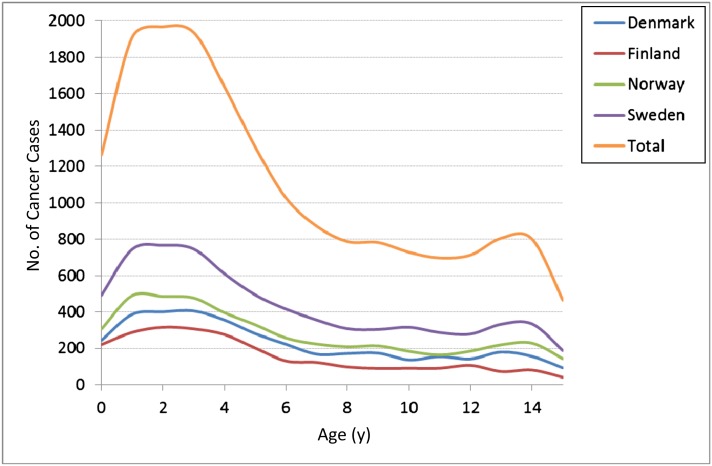


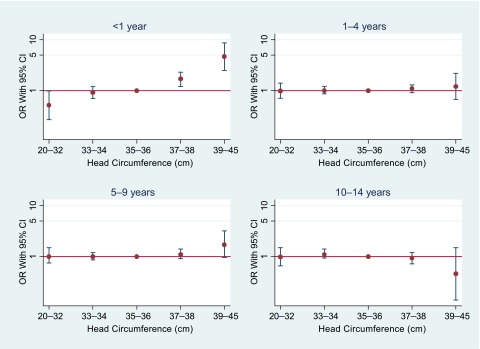
References
-
- Steliarova-Foucher E, Stiller C, Kaatsch P, et al. Geographical patterns and time trends of cancer incidence and survival among children and adolescents in Europe since the 1970s (the ACCISproject): an epidemiological study. Lancet. 2004;364(9451):2097–2105 - PubMed
-
- Callan AC, Milne E. Involvement of the IGF system in fetal growth and childhood cancer: an overview of potential mechanisms. Cancer Causes Control. 2009;20(10):1783–1798 - PubMed
-
- Hjalgrim LL, Rostgaard K, Hjalgrim H, et al. Birth weight and risk for childhood leukemia in Denmark, Sweden, Norway, and Iceland. J Natl Cancer Inst. 2004;96(20):1549–1556 - PubMed
-
- Caughey RW, Michels KB. Birth weight and childhood leukemia: a meta-analysis and review of the current evidence. Int J Cancer. 2009;124(11):2658–2670 - PubMed
-
- Papadopoulou C, Antonopoulos CN, Sergentanis TN, Panagopoulou P, Belechri M, Petridou ET. Is birth weight associated with childhood lymphoma? A meta-analysis. Int J Cancer. 2012;130(1):179–189 - PubMed
Publication types
MeSH terms
Grants and funding
LinkOut - more resources
Full Text Sources
Other Literature Sources
Medical
