


Maternal prenatal weight gain and autism spectrum disorders
- PMID: 24167172
- PMCID: PMC3813395
- DOI: 10.1542/peds.2013-1188
Maternal prenatal weight gain and autism spectrum disorders
Abstract
Background: The rising population of individuals identified with an autism spectrum disorder (ASD) calls for further investigation of its underlying etiology. A disturbance in the fetal steroid hormone environment may be a mechanism in which environmental and genetic risk factors interact. The mother, fetus, and placenta collectively create the fetal steroid environment. Prepregnancy BMI and pregnancy weight gain have served as markers for fetal steroid hormone exposure in other disease states. This study's objective is to determine whether prepregnancy BMI and pregnancy weight gain are associated with increased ASD risk across study designs and cohorts while controlling for important confounding variables.
Methods: A population-based Utah ASD cohort (n = 128) was ascertained in a 3-county surveillance area and gender- and age-matched to 10,920 control subjects. A second, research-based ASD cohort of Utah children (n = 288) and their unaffected siblings (n = 493) were ascertained through participation in an ASD genetics study. Prenatal variables were obtained from birth certificate records.
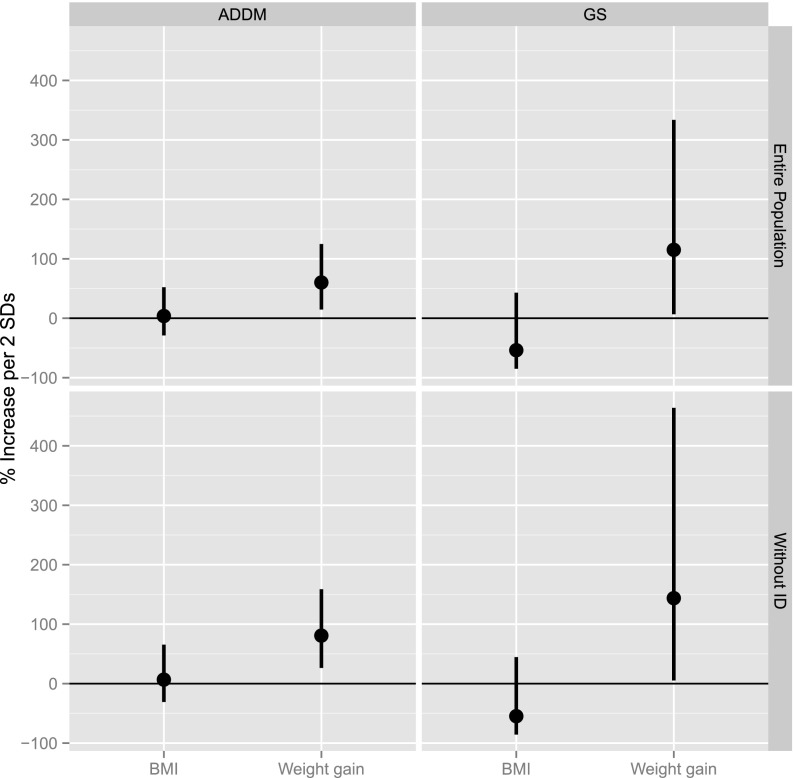
Results: ASD risk was significantly associated with pregnancy weight gain (adjusted odds ratio = 1.10, 95% confidence interval: 1.03 to 1.17; adjusted odds ratio = 1.17, 95% confidence interval: 1.01 to 1.35 for each 5 pounds of weight gained), but not prepregnancy BMI, in population and research-based cohorts, respectively. When analyses were restricted to ASD cases with normal IQ, these associations remained significant.
Conclusions: ASD risk associated with a modest yet consistent increase in pregnancy weight gain suggests that pregnancy weight gain may serve as an important marker for autism's underlying gestational etiology. This justifies an investigation into phenomena that link pregnancy weight gain and ASD independent of prepregnancy BMI.
Keywords: autism; epidemiology; prenatal; risk factors; weight gain.
Figures
References
-
- American Psychiatric Association Diagnostic and Statistical Manual of Mental Disorders. 4th ed. text revision Washington, DC: American Psychiatric Association; 2000
-
- Centers for Disease Control and Prevention, Autism and Developmental Disabilities Monitoring Network Surveillance Year 2006 Principal Investigators . Prevalence of autism spectrum disorders—Autism and Developmental Disabilities Monitoring Network, United States, 2006. MMWR Morb Mortal Wkly Rep. 2009;58(SS10):1–20 - PubMed
-
- Center for Disease Control and Prevention, Autism and Developmental Disabilities Monitoring Network Surveillance Year 2008 Principal Investigators Prevalence of autism spectrum disorders—Autism and Developmental Disabilities Monitoring Network, 14 sites, United States, 2008. MMWR Morb Mortal Wkly Rep. 2012;61(SS03):1–19 - PubMed
-
- Pinborough-Zimmerman J, Bakian AV, Fombonne E, Bilder D, Taylor J, McMahon WM. Changes in the administrative prevalence of autism spectrum disorders: contribution of special education and health from 2002–2008. J Autism Dev Disord. 2012;42(4):521–530 - PubMed
Publication types
MeSH terms
Grants and funding
LinkOut - more resources
Full Text Sources
Other Literature Sources
