


Combining two strategies to improve perfusion and drug delivery in solid tumors
- PMID: 24167277
- PMCID: PMC3832007
- DOI: 10.1073/pnas.1318415110
Combining two strategies to improve perfusion and drug delivery in solid tumors
Abstract
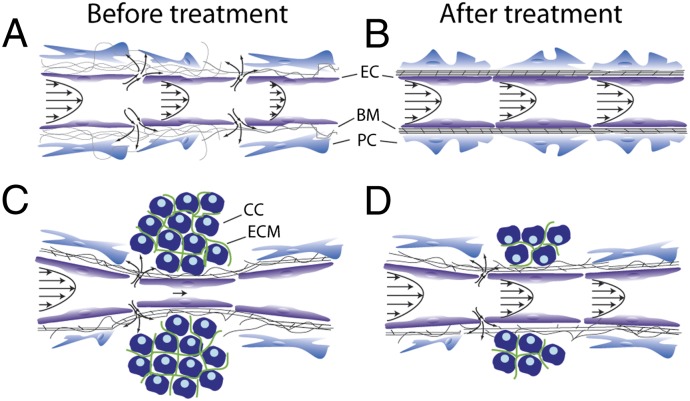
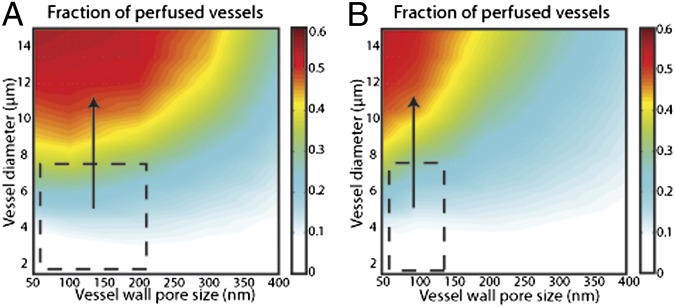
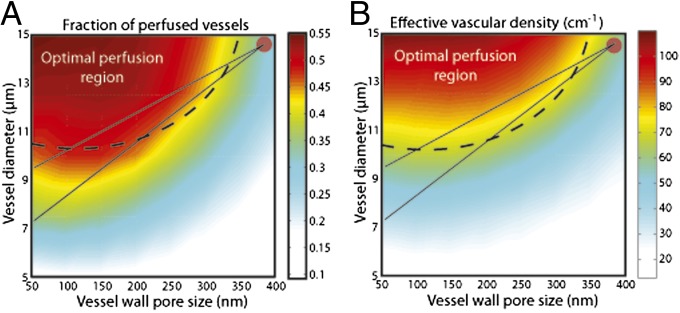
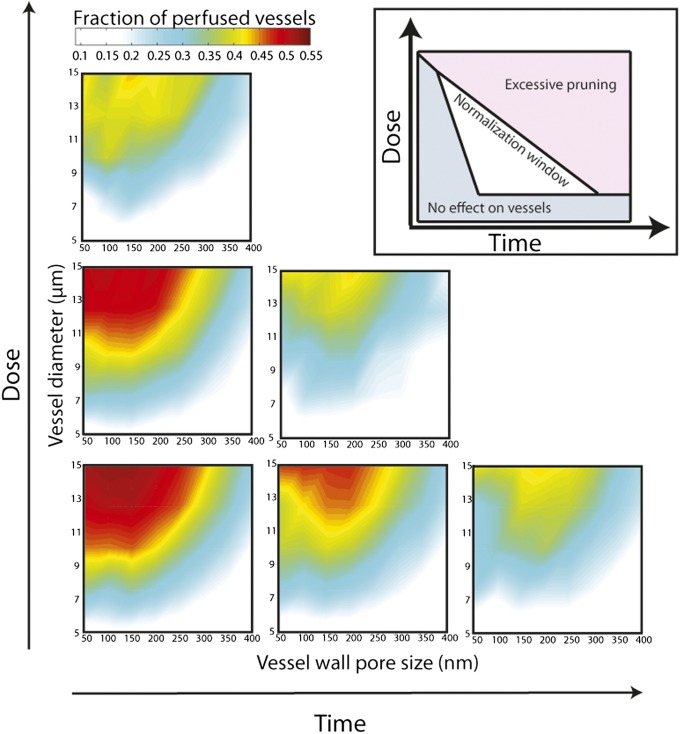
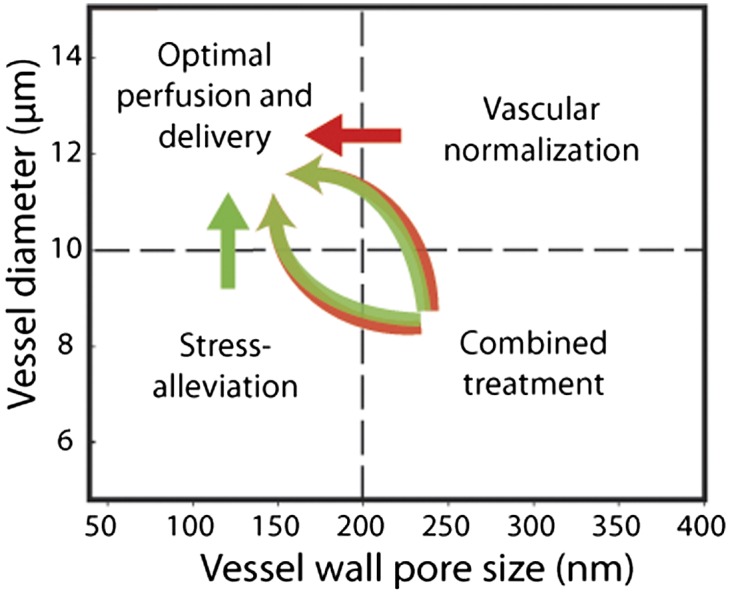
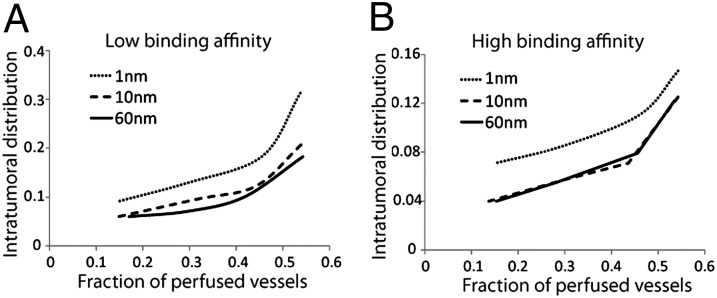
Blood perfusion in tumors can be significantly lower than that in the surrounding normal tissue owing to the leakiness and/or compression of tumor blood vessels. Impaired perfusion reduces oxygen supply and results in a hypoxic microenvironment. Hypoxia promotes tumor progression and immunosuppression, and enhances the invasive and metastatic potential of cancer cells. Furthermore, poor perfusion lowers the delivery of systemically administered drugs. Therapeutic strategies to improve perfusion include reduction in vascular permeability by vascular normalization and vascular decompression by alleviating physical forces (solid stress) inside tumors. Both strategies have shown promise, but guidelines on how to use these strategies optimally are lacking. To this end, we developed a mathematical model to guide the optimal use of these strategies. The model accounts for vascular, transvascular, and interstitial fluid and drug transport as well as the diameter and permeability of tumor vessels. Model simulations reveal an optimal perfusion region when vessels are uncompressed, but not very leaky. Within this region, intratumoral distribution of drugs is optimized, particularly for drugs 10 nm in diameter or smaller and of low binding affinity. Therefore, treatments should modify vessel diameter and/or permeability such that perfusion is optimal. Vascular normalization is more effective for hyperpermeable but largely uncompressed vessels (e.g., glioblastomas), whereas solid stress alleviation is more beneficial for compressed but less-permeable vessels (e.g., pancreatic ductal adenocarcinomas). In the case of tumors with hyperpermeable and compressed vessels (e.g., subset of mammary carcinomas), the two strategies need to be combined for improved treatment outcomes.
Keywords: mathematical modeling; mechanical forces; tumor microenvironment; vessel decompression; vessel permeability.
Conflict of interest statement
Conflict of interest statement: R.K.J. received research grants from MedImmune and Roche; received consultant fees from Enlight, Noxxon, and Zyngenia; owns equity in Enlight, SynDevRx, and XTuit; and serves on the Board of Directors of XTuit and Boards of Trustees of H&Q Healthcare Investors and H&Q Life Sciences Investors. No reagents or funds from these organizations were used in this study.
Figures
Comment in
-
Targeted therapies: early vessel normalization improves glioblastoma outcomes.Nat Rev Clin Oncol. 2014 Jan;11(1):4. doi: 10.1038/nrclinonc.2013.228. Epub 2013 Nov 26. Nat Rev Clin Oncol. 2014. PMID: 24281060 No abstract available.
References
-
- Jain RK. Determinants of tumor blood flow: A review. Cancer Res. 1988;48(10):2641–2658. - PubMed
-
- Jain RK. Normalizing tumor vasculature with anti-angiogenic therapy: A new paradigm for combination therapy. Nat Med. 2001;7(9):987–989. - PubMed
-
- Jain RK. Normalization of tumor vasculature: An emerging concept in antiangiogenic therapy. Science. 2005;307(5706):58–62. - PubMed
Publication types
MeSH terms
Grants and funding
- T32 CA073479/CA/NCI NIH HHS/United States
- R01 CA126642/CA/NCI NIH HHS/United States
- R01-CA085140/CA/NCI NIH HHS/United States
- R01 CA098706/CA/NCI NIH HHS/United States
- R01 CA085140/CA/NCI NIH HHS/United States
- R01-CA115767/CA/NCI NIH HHS/United States
- P01-CA080124/CA/NCI NIH HHS/United States
- R01-CA096915/CA/NCI NIH HHS/United States
- R01 CA115767/CA/NCI NIH HHS/United States
- R01-CA098706/CA/NCI NIH HHS/United States
- 336839/ERC_/European Research Council/International
- P01 CA080124/CA/NCI NIH HHS/United States
- R01-CA126642/CA/NCI NIH HHS/United States
- R01 CA096915/CA/NCI NIH HHS/United States
- T32-CA073479/CA/NCI NIH HHS/United States
LinkOut - more resources
Full Text Sources
Other Literature Sources
