


Total shoulder arthroplasty versus hemiarthroplasty for glenohumeral arthritis: A systematic review of the literature at long-term follow-up
- PMID: 24167403
- PMCID: PMC3807945
- DOI: 10.4103/0973-6042.118915
Total shoulder arthroplasty versus hemiarthroplasty for glenohumeral arthritis: A systematic review of the literature at long-term follow-up
Abstract
Introduction: The optimal surgical treatment of end-stage primary glenohumeral osteoarthritis remains controversial. The objective of this article is to systematically review the current available literature to formulate evidence-based guidelines for treatment of this pathology with an arthroplasty.
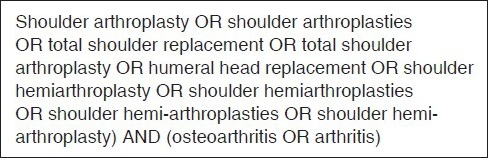
Materials and methods: A systematic literature search was performed to identify all articles from 1990 onward that presented data concerning treatment of glenohumeral arthritis with total shoulder arthroplasty (TSA) or head arthroplasty (HA) with a minimal follow-up of 7 years. The most relevant electronic databases were searched.
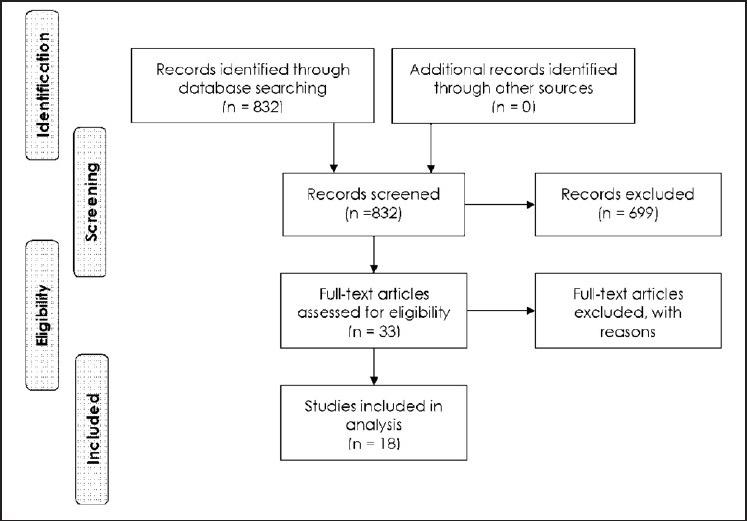
Results: After applying the inclusion and exclusion criteria, we identified 18 studies (of the initial 832 hits). The search included a total of 1,958 patients (HA: 316 and TSA: 1,642) with 2,111 shoulders (HA: 328 + TSA: 1,783). The revision rate for any reason in the HA group (13%) was higher than in the TSA group (7%) (P < 0.001). There was a trend of a higher complication rate (of any kind) in the TSA group (12%) when compared with the HA group (8%) (P = 0.065). The weighted mean improvement in anteflexion, exorotation and abduction were respectively 33°, 15° and 31° in the HA group and were respectively 56°, 21° and 48° in the TSA group. Mean decrease in pain scores was 4.2 in the HA and 5.5 in the TSA group.
Conclusion: Finally, we conclude that TSA results in less need for revision surgery, but has a trend to result in more complications. The conclusions of this review should be interpreted with caution as only Level IV studies could be included.
Level of evidence: IV.
Keywords: Arthroplasty; complication; glenoid; humerus; osteoarthritis; revision rate; shoulder; systematic review.
Conflict of interest statement
Figures
References
-
- The classic: On prosthetic methods intended to repair bone fragments. Clin Orthop Relat Res. 1973;94:4–7. - PubMed
-
- Neer CS., 2nd Articular replacement for the humeral head. J Bone Joint Surg Am. 1955;37-A:215–28. - PubMed
-
- Neer CS., 2nd Indications for replacement of the proximal humeral articulation. Am J Surg. 1955;89:901–7. - PubMed
-
- Carroll RM, Izquierdo R, Vazquez M, Blaine TA, Levine WN, Bigliani LU. Conversion of painful hemiarthroplasty to total shoulder arthroplasty: Long-term results. J Shoulder Elbow Surg. 2004;13:599–603. - PubMed
-
- Cofield RH, Frankle MA, Zuckerman JD. Humeral head replacement for glenohumeral arthritis. Semin Arthroplasty. 1995;6:214–21. - PubMed
LinkOut - more resources
Full Text Sources
Other Literature Sources
Research Materials
