. 2013 Oct;10(10):e1001534.
doi: 10.1371/journal.pmed.1001534. Epub 2013 Oct 22.

Elimination of HIV in South Africa through expanded access to antiretroviral therapy: a model comparison study

Affiliations

Elimination of HIV in South Africa through expanded access to antiretroviral therapy: a model comparison study

Jan A C Hontelez et al. PLoS Med. 2013 Oct.

Abstract

Background: Expanded access to antiretroviral therapy (ART) using universal test and treat (UTT) has been suggested as a strategy to eliminate HIV in South Africa within 7 y based on an influential mathematical modeling study. However, the underlying deterministic model was criticized widely, and other modeling studies did not always confirm the study's finding. The objective of our study is to better understand the implications of different model structures and assumptions, so as to arrive at the best possible predictions of the long-term impact of UTT and the possibility of elimination of HIV.

Methods and findings: We developed nine structurally different mathematical models of the South African HIV epidemic in a stepwise approach of increasing complexity and realism. The simplest model resembles the initial deterministic model, while the most comprehensive model is the stochastic microsimulation model STDSIM, which includes sexual networks and HIV stages with different degrees of infectiousness. We defined UTT as annual screening and immediate ART for all HIV-infected adults, starting at 13% in January 2012 and scaled up to 90% coverage by January 2019. All models predict elimination, yet those that capture more processes underlying the HIV transmission dynamics predict elimination at a later point in time, after 20 to 25 y. Importantly, the most comprehensive model predicts that the current strategy of ART at CD4 count ≤350 cells/µl will also lead to elimination, albeit 10 y later compared to UTT. Still, UTT remains cost-effective, as many additional life-years would be saved. The study's major limitations are that elimination was defined as incidence below 1/1,000 person-years rather than 0% prevalence, and drug resistance was not modeled.

Conclusions: Our results confirm previous predictions that the HIV epidemic in South Africa can be eliminated through universal testing and immediate treatment at 90% coverage. However, more realistic models show that elimination is likely to occur at a much later point in time than the initial model suggested. Also, UTT is a cost-effective intervention, but less cost-effective than previously predicted because the current South African ART treatment policy alone could already drive HIV into elimination. Please see later in the article for the Editors' Summary.


Conflict of interest statement

TBH and MLN are members of the PLOS Medicine Editorial Board. TBH is the director of the HIV Modelling Consortium, a project funded by the Bill & Melinda Gates Foundation, which contributed funding toward this study. TBH did not have a role in deciding that funding should be awarded to this team. All other authors have declared that no competing interests exist.

Figures

Figure 1
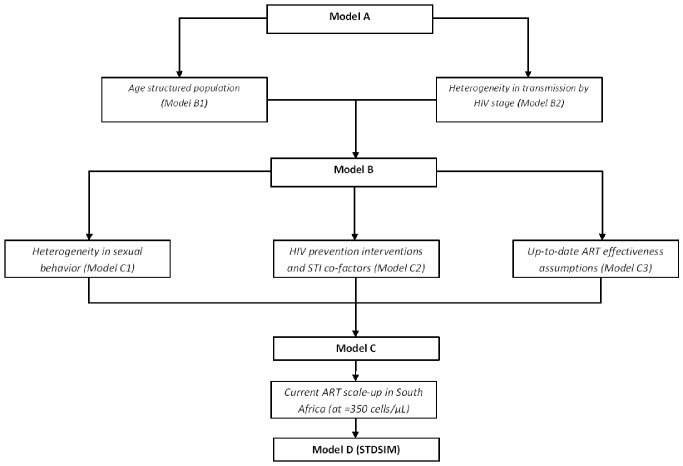
Figure 1. Stepwise approach of developing nine structurally different models with increasing complexity and realism.
Model A resembles the deterministic model used by Granich et al. , now simulated using an event-driven approach. Models A and B are fitted to predict UNAIDS prevalence levels for South Africa by tuning the HIV transmission probabilities and year of HIV introduction. In addition, similar to Granich et al. , models A and B use a prevalence density function to explain the steady-state HIV prevalence observed in South Africa. Models C and D are fitted to represent UNAIDS-predicted HIV prevalence by adjusting overall partner change rates and the year of HIV introduction. A prevalence density function is no longer used, and the scaling-up of condom use in the late 1990s/early 2000s—introduced in model C2 and consistent with observations ,—is now used to explain the steady-state HIV prevalence in South Africa. Finally, models C and D allow for more realistic assumptions on the effectiveness of ART in reducing infectiousness (infectiousness reduction of 90% – instead of 99.4%; survival twice as high [26]).
Figure 2
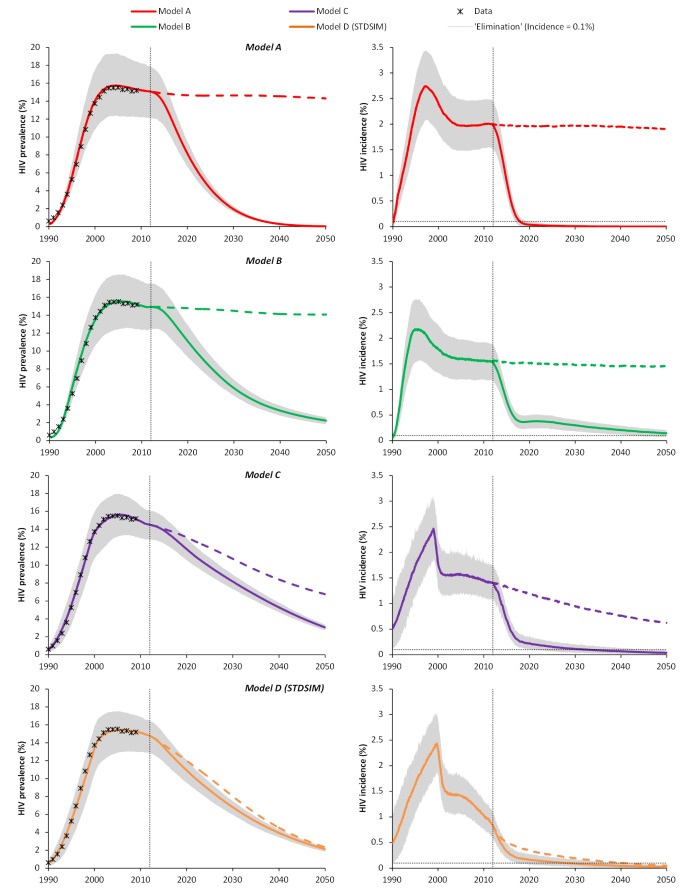
Figure 2. Predicted impact of universal testing and immediate ART for all HIV-infected patients (UTT) on HIV prevalence and incidence in adults (aged 15+ y) for four main models of the South African HIV epidemic over the period 1990–2050.
Left panels: HIV prevalence; right panels: HIV incidence. All models are structurally different. Solid lines represent the impact of the UTT intervention; the dashed lines represent the no-UTT counterfactual. Colored lines are the average result of 1,000 simulations, and the gray areas represent the probability intervals illustrating 95% of the stochastic variation around the baseline estimate. UTT is implemented as annual screening of the adult population (aged 15+ y), and immediate ART for all HIV-infected patients. The intervention is scaled up linearly, starting in 2012 and reaching 90% coverage in 2019 (similar to Granich et al. [9]). The vertical dotted lines give the timing of the start of the intervention. The horizontal dotted lines in the right panels indicate the elimination phase, defined as incidence below 1/1,000 person-years. Structures and components of the different models are explained in Figure 1.
Figure 3
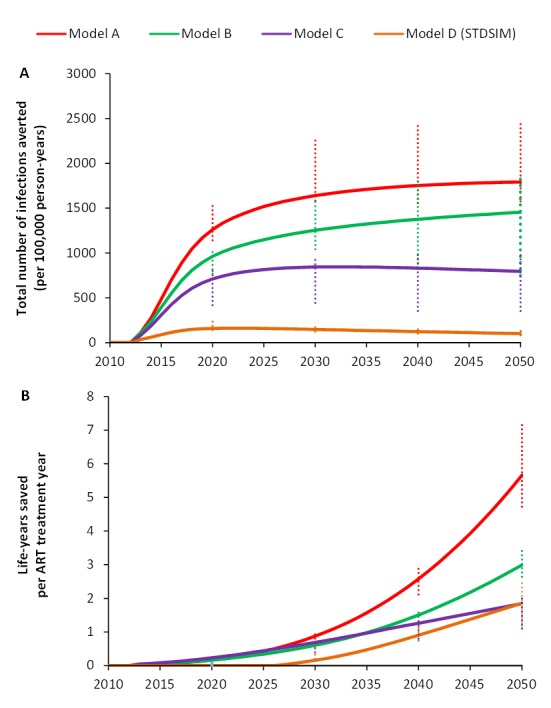
Figure 3. Number of infections averted per 100,000 person-years and cumulative number of life-years saved per ART treatment year for universal testing and immediate ART for all HIV-infected patients (UTT) in South Africa over the period 2010–2050.
The intervention consists of annual screening of the adult population (aged 15+ y), and immediate ART for all HIV-infected patients. Intervention is scaled up linearly starting in 2012 and reaching 90% coverage in 2019. (A) Difference between cumulative numbers of new infections per 100,000 person-years in the UTT intervention scenario versus the baseline (for models A, B, and C, the baseline is no ART; for model D, the baseline is ART at CD4 count ≤350 cells/µl). (B) Cumulative number of life-years saved per person-year on ART treatment in the UTT intervention compared to the baseline (for models A, B, and C, the baseline is no ART; for model D, the baseline is ART at CD4 count ≤350 cells/µl). Error bars reflect ranges due to the uncertainty in the parameter values that were quantified based on fitting the model to the data.
Figure 4
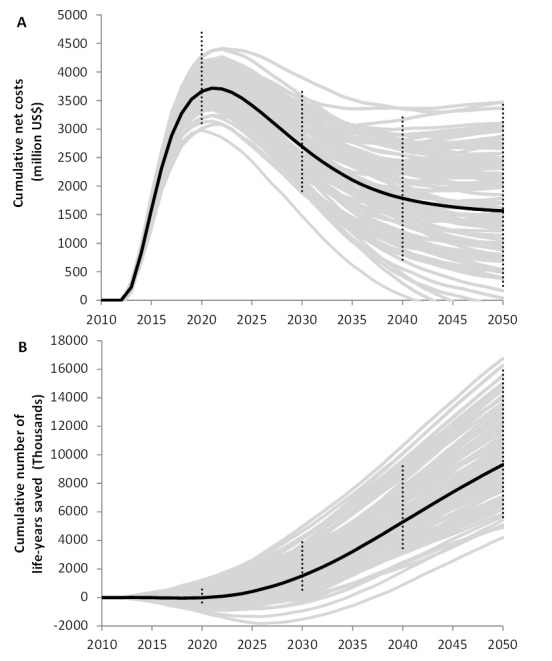
Figure 4. Cumulative net costs and cumulative number of life-years saved of universal testing and immediate ART for all HIV-infected patients (UTT) compared to the current rollout in South Africa of ART at CD4 count ≤350 cells/µl, as predicted with model D.
(A) Cumulative net costs; (B) cumulative number of life-years saved. Grey lines represent 100 individual model runs illustrating stochastic variation; black lines are averages over 1,000 model runs. Error bars reflect ranges due to uncertainty in the parameter values that were quantified based on fitting the model to data. Costs and life-years saved were discounted at an annual rate of 3%.

Comment in

References

    1. Joint United Nations Programme on HIV/AIDS (2012) Report on the global AIDS epidemic 2012. Geneva: Joint United Nations Programme on HIV/AIDS.
    1. Johnson LF, Hallett TB, Rehle TM, Dorrington RE (2012) The effect of changes in condom usage and antiretroviral treatment coverage on human immunodeficiency virus incidence in South Africa: a model-based analysis. J R Soc Interface 9: 1544–1554. - PMC - PubMed
    1. Rehle TM, Hallett TB, Shisana O, Pillay-van Wyk V, Zuma K, et al. (2010) A decline in new HIV infections in South Africa: estimating HIV incidence from three national HIV surveys in 2002, 2005 and 2008. PLoS ONE 5: e11094 doi:10.1371/journal.pone.0011094 - DOI - PMC - PubMed
    1. Cohen MS, Chen YQ, McCauley M, Gamble T, Hosseinipour MC, et al. (2011) Prevention of HIV-1 infection with early antiretroviral therapy. N Engl J Med 365: 493–505. - PMC - PubMed
    1. Tanser F, Bärnighausen T, Grapsa E, Zaidi J, Newell ML (2013) High coverage of ART associated with decline in risk of HIV acquisition in rural KwaZulu-Natal, South Africa. Science 339: 966–971. - PMC - PubMed

Substances