. 2013 Oct 22;8(10):e78154.
doi: 10.1371/journal.pone.0078154. eCollection 2013.

Improved glucose control and reduced body weight in rodents with dual mechanism of action peptide hybrids

Affiliations

Improved glucose control and reduced body weight in rodents with dual mechanism of action peptide hybrids

James L Trevaskis et al. PLoS One. .

Abstract

Combination therapy is being increasingly used as a treatment paradigm for metabolic diseases such as diabetes and obesity. In the peptide therapeutics realm, recent work has highlighted the therapeutic potential of chimeric peptides that act on two distinct receptors, thereby harnessing parallel complementary mechanisms to induce additive or synergistic benefit compared to monotherapy. Here, we extend this hypothesis by linking a known anti-diabetic peptide with an anti-obesity peptide into a novel peptide hybrid, which we termed a phybrid. We report on the synthesis and biological activity of two such phybrids (AC164204 and AC164209), comprised of a glucagon-like peptide-1 receptor (GLP1-R) agonist, and exenatide analog, AC3082, covalently linked to a second generation amylin analog, davalintide. Both molecules acted as full agonists at their cognate receptors in vitro, albeit with reduced potency at the calcitonin receptor indicating slightly perturbed amylin agonism. In obese diabetic Lep(ob)/Lep (ob) mice sustained infusion of AC164204 and AC164209 reduced glucose and glycated haemoglobin (HbA1c) equivalently but induced greater weight loss relative to exenatide administration alone. Weight loss was similar to that induced by combined administration of exenatide and davalintide. In diet-induced obese rats, both phybrids dose-dependently reduced food intake and body weight to a greater extent than exenatide or davalintide alone, and equal to co-infusion of exenatide and davalintide. Phybrid-mediated and exenatide + davalintide-mediated weight loss was associated with reduced adiposity and preservation of lean mass. These data are the first to provide in vivo proof-of-concept for multi-pathway targeting in metabolic disease via a peptide hybrid, demonstrating that this approach is as effective as co-administration of individual peptides.


Conflict of interest statement

Competing Interests: This research was entirely funded by Amylin Pharmaceuticals, LLC. All authors were employed by and were shareholders in Amylin Pharmaceuticals during the study period. Patents filed or issued: United States Patent No 8,076,288, (Hybrid polypeptides having glucose lowering activity). There are no further patents, products in development or marketed products to declare. This does not alter the authors' adherence to all the PLOS ONE policies on sharing data and materials, as detailed online in the guide for authors.

Figures

Figure 1
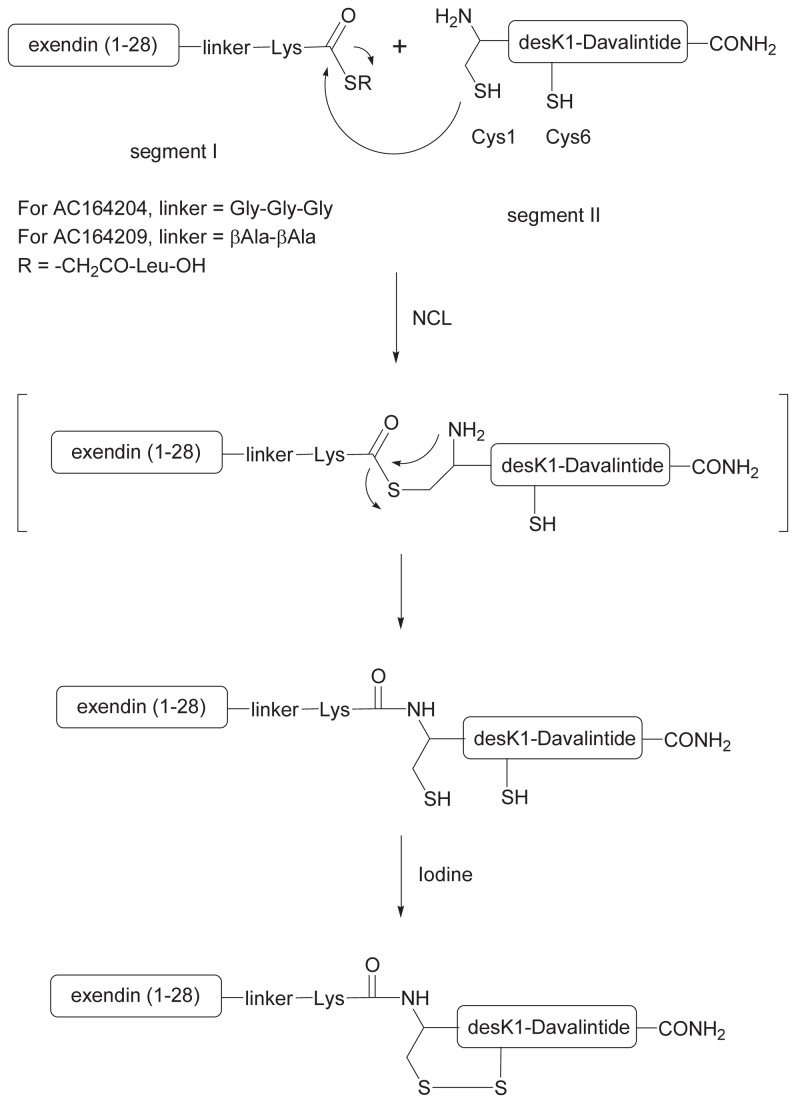
Figure 1. General reaction scheme for the preparation of AC164204 and AC164209.
Two peptide segments I and II were used. Segment I is a thioester that contains AC3082 sequence, a linker portion and a Lysine at the C-terminus. Segment II is uncyclized desK1-Davalintide with a free cysteine at the N-terminus to provide a reactive moiety for the native chemical ligation. The linker in segment I is Gly-Gly-Gly for AC164204 and β-Ala-β-Ala for AC164209. The sequence of AC3082/exendin(1-28) is HGEGTFTSDLSKQMEEEAVRLFIEWLKN and the sequence of desK1-davalintide is CNTATCVLGRLSQELHRLQTYPRTNTGSNTY.
Figure 2
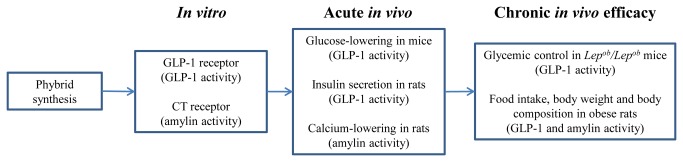
Figure 2. Flowchart of phybrid characterization of receptor activity and in vivo efficacy.
After synthesis, the ability of the GLP-1 and amylinomimetic portions of the phybrid to activate their appropriate receptors was assessed: activation of cAMP in cells expressing the GLP-1R or the CT receptor. Acute in vivo characteristics of GLP-1 and amylin physiology were then assessed: glucose-lowering in mice for GLP-1 activity, insulin secretion in rats for GLP-1 activity and calcium-lowering in rats for amylin activity. In chronic efficacy models to more accurately gauge the ability of the phybrids to render equal or superior metabolic control relative to mono- or dual-therapy we utilized two models: obese, diabetic mice to assess impact on chronic glucose control, and DIO rats to assess impact on food intake, body weight and body composition.
Figure 3
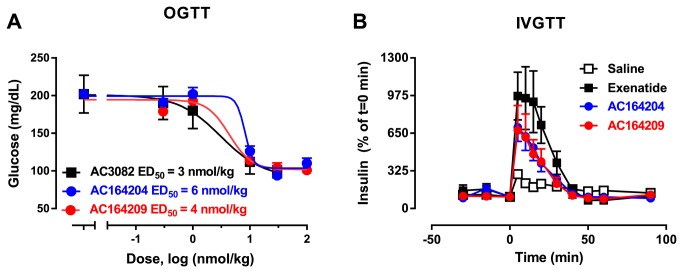
Figure 3. Phybrid compounds reduced 30 min plasma glucose concentrations similar to GLP-1 receptor agonist (AC3082) in non-diabetic mice, and were insulinotropic in Sprague Dawley rats.
(A) Oral glucose tolerance test (OGTT) of AC3082, AC164204 and AC164209 comparing potency and efficacy of both compounds; (B) intravenous glucose tolerance test (IVGTT) showing glucose-dependent insulinotropism of exenatide, AC164204, and AC164209.
Figure 4
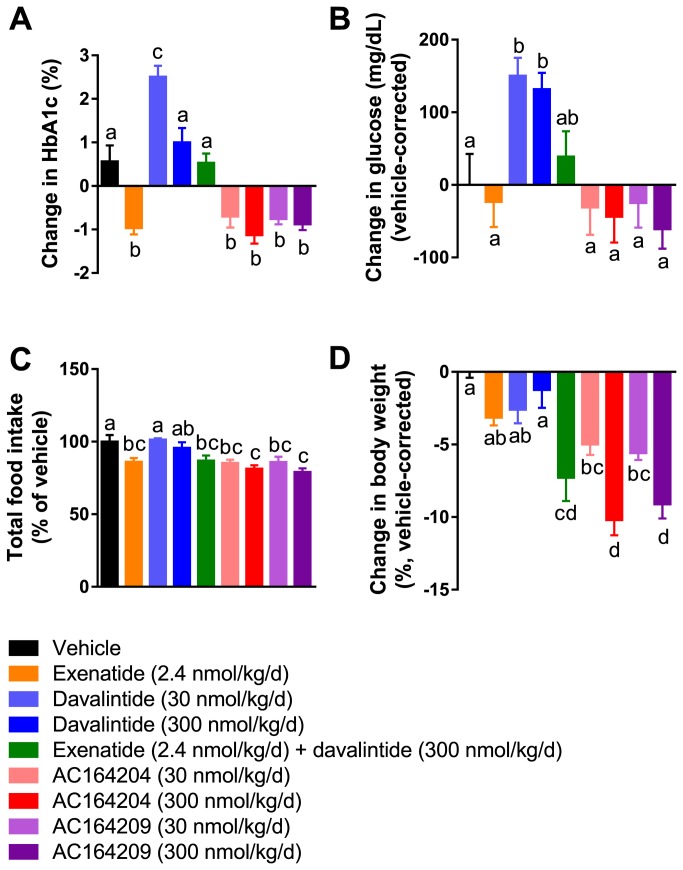
Figure 4. Phybrid peptides induced greater weight loss compared to single peptide treatment and improved glycemic control similar to GLP-1 receptor agonism in obese diabetic Lepob/Lep ob mice.
(A) Change in HbA1c, (B) change in plasma glucose, (C) total food intake, expressed as a percentage of vehicle, and (D) change in body weight following subcutaneous peptide infusion in leptin-deficient Lepob/Lep ob mice for 28 days. Groups not sharing the same superscript letter were significantly different from each other (p<0.05).
Figure 5
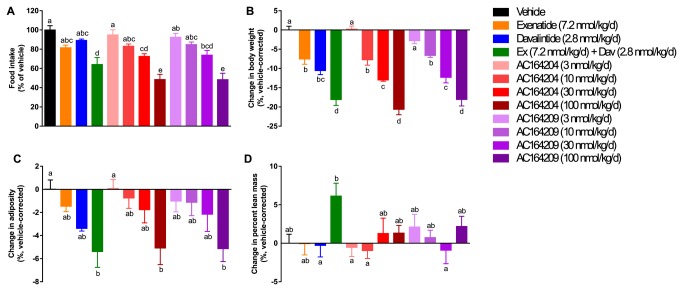
Figure 5. Sustained infusion of AC164204 or AC164209 to diet-induced obese rats dose-dependently inhibited food intake, and reduced body weight and fat mass.
(A) Total cumulative food intake, (B) percent change in body weight, (C) change in adiposity, and (D) change in percent lean mass after 28 days of peptide infusion. Groups not sharing the same superscript letter were significantly different from each other (p<0.05).

References

    1. Wild S, Roglic G, Green A, Sicree R, King H (2004) Global prevalence of diabetes: estimates for the year 2000 and projections for 2030. Diabetes Care 27:1047-1053. doi:10.2337/diacare.27.5.1047. PubMed: 15111519. - DOI - PubMed
    1. Alberti KG, Eckel RH, Grundy SM, Zimmet PZ, Cleeman JI et al. (2009) Harmonizing the metabolic syndrome: a joint interim statement of the International Diabetes Federation Task Force on Epidemiology and Prevention; National Heart, Lung, and Blood Institute; American Heart Association; World Heart Federation; International Atherosclerosis Society; and International Association for the Study of Obesity. Circulation 120:1640-1645. doi:10.1161/CIRCULATIONAHA.109.192644. PubMed: 19805654. - DOI - PubMed
    1. Resnick HE, Foster GL, Bardsley J, Ratner RE (2006) Achievement of American Diabetes Association clinical practice recommendations among U.S. adults with diabetes, 1999-2002: the National Health and Nutrition Examination Survey. Diabetes Care 29:531-537. doi:10.2337/diacare.29.03.06.dc05-1254. PubMed: 16505501. - DOI - PubMed
    1. Turner R, Holman R, Butterfield J (1999) UKPDS: what was the question? UK Prospective Diabetes Study. Lancet 354:600. doi:10.1016/S0140-6736(05)77957-5. - DOI - PubMed
    1. Howes LG (2000) Cardiovascular effects of sulphonylureas: role of K(ATP) channels. Diabetes Obes Metab 2:67-73. doi:10.1046/j.1463-1326.2000.00047.x. PubMed: 11220526. - DOI - PubMed

Publication types