


A randomized controlled trial of cognitive behavioral therapy for adherence and depression (CBT-AD) in patients with uncontrolled type 2 diabetes
- PMID: 24170758
- PMCID: PMC3931377
- DOI: 10.2337/dc13-0816
A randomized controlled trial of cognitive behavioral therapy for adherence and depression (CBT-AD) in patients with uncontrolled type 2 diabetes
Erratum in
-
Erratum. A Randomized Controlled Trial of Cognitive Behavioral Therapy for Adherence and Depression (CBT-AD) in Patients With Uncontrolled Type 2 Diabetes. Diabetes Care 2014;37:625-633.Diabetes Care. 2016 Jun;39(6):1065. doi: 10.2337/dc16-er06. Diabetes Care. 2016. PMID: 27222555 Free PMC article. No abstract available.
Abstract
Objective: To test cognitive behavioral therapy for adherence and depression (CBT-AD) in type 2 diabetes. We hypothesized that CBT-AD would improve adherence; depression; and, secondarily, hemoglobin A1c (A1C).
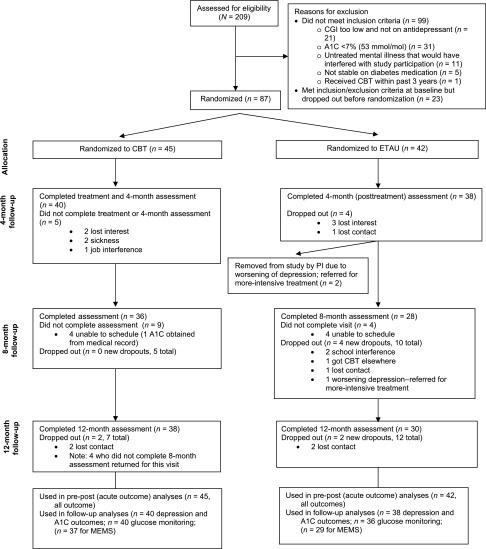
Research design and methods: Eighty-seven adults with unipolar depression and uncontrolled type 2 diabetes received enhanced treatment as usual (ETAU), including medication adherence, self-monitoring of blood glucose (SMBG), and lifestyle counseling; a provider letter documented psychiatric diagnoses. Those randomized to the intervention arm also received 9-11 sessions of CBT-AD.
Results: Immediately after acute treatment (4 months), adjusting for baseline, CBT-AD had 20.7 percentage points greater oral medication adherence on electronic pill cap (95% CI -31.14 to -10.22, P = 0.000); 30.2 percentage points greater SMBG adherence through glucometer downloads (95% CI -42.95 to -17.37, P = 0.000); 6.44 points lower depression scores on the Montgomery-Asberg Depression Rating Scale (95% CI 2.33-10.56, P = 0.002); 0.74 points lower on the Clinical Global Impression (95% CI 0.16-1.32, P = 0.01); and 0.72 units lower A1C (95% CI 0.29-1.15, P = 0.001) relative to ETAU. Analyses of 4-, 8-, and 12-month follow-up time points indicated that CBT-AD maintained 24.3 percentage points higher medication adherence (95% CI -38.2 to -10.3, P = 0.001); 16.9 percentage points greater SMBG adherence (95% CI -33.3 to -0.5, P = 0.043); and 0.63 units lower A1C (95% CI 0.06-1.2, P = 0.03) after acute treatment ended. For depression, there was some evidence of continued improvement posttreatment, but no between-group differences.
Conclusions: CBT-AD is an effective intervention for adherence, depression, and glycemic control, with enduring and clinically meaningful benefits for diabetes self-management and glycemic control in adults with type 2 diabetes and depression.
Trial registration: ClinicalTrials.gov NCT00564070.
Figures
Comment in
-
ACP Journal Club. In uncontrolled type 2 diabetes, CBT improved glycemic control and reduced depression.Ann Intern Med. 2014 Aug 19;161(4):JC3. doi: 10.7326/0003-4819-161-4-201408190-02003. Ann Intern Med. 2014. PMID: 25133382 No abstract available.
References
-
- Hoerger TJ, Segel JE, Gregg EW, Saaddine JB. Is glycemic control improving in U.S. adults? Diabetes Care 2008;31:81–86 - PubMed
-
- Donnan PT, MacDonald TM, Morris AD. Adherence to prescribed oral hypoglycaemic medication in a population of patients with type 2 diabetes: a retrospective cohort study. Diabet Med 2002;19:279–284 - PubMed
-
- Ho PM, Rumsfeld JS, Masoudi FA, et al. Effect of medication nonadherence on hospitalization and mortality among patients with diabetes mellitus. Arch Intern Med 2006;166:1836–1841 - PubMed
-
- Ali S, Stone MA, Peters JL, Davies MJ, Khunti K. The prevalence of co-morbid depression in adults with type 2 diabetes: a systematic review and meta-analysis. Diabet Med 2006;23:1165–1173 - PubMed
Publication types
MeSH terms
Substances
Associated data
Grants and funding
LinkOut - more resources
Full Text Sources
Other Literature Sources
Medical
Miscellaneous
