Review
. 2012 Sep 19:1:183.
doi: 10.1038/bonekey.2012.183.

Bone cell communication factors and Semaphorins

Affiliations
Review

Bone cell communication factors and Semaphorins

Takako Negishi-Koga et al. Bonekey Rep. .

Abstract

Bone tissue is continuously renewed throughout adult life by a process called 'remodeling', which involves a dynamic interplay among bone cells including osteoclasts, osteoblasts and osteocytes. For example, a tight coupling between bone resorption and formation is essential for the homeostasis of the skeletal system. Studies on the coupling mechanism in physiological and pathological settings have revealed that osteoclasts or osteoclastic bone resorption promote bone formation through the production of diverse coupling factors. The classical coupling factors are the molecules that promote bone formation after resorption, but there may be distinct mechanisms at work in various phases of bone remodeling. A recent study revealed that the Semaphorin 4D expressed by osteoclasts inhibits bone formation, which represents a mechanism by which coupling is dissociated. Furthermore, it has been demonstrated that osteoblastic expression of Semaphorin 3A exerts an osteoprotective effect by both suppressing bone resorption and increasing bone formation. Thus, recent advances have made it increasingly clear that bone remodeling is regulated by not only classical coupling factors, but also molecules that mediate cell-cell communication among bone cells. We propose that such factors be called bone cell communication factors, which control the delicate balance of the interaction of bone cells so as to maintain bone homeostasis.


Conflict of interest statement

The authors declare no conflict of interest.

Figures
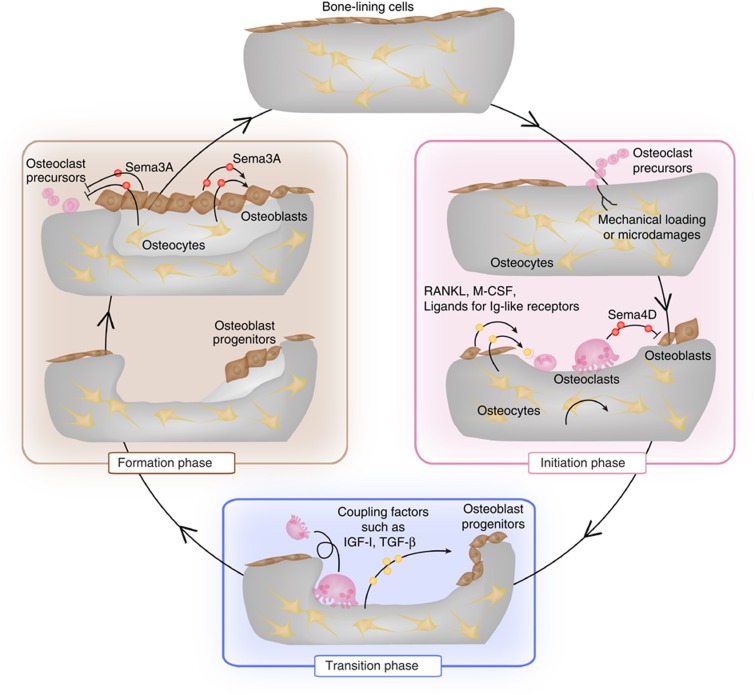
Figure 1
Figure 1. The bone remodeling cycle.
The bone remodeling process is divided into the initiation, transition and formation phases. In the initiation phase, mechanical loading and microdamage are sensed by osteocytes, which stimulate the recruitment of osteoclast precursor cells. Osteoclastogenesis is stimulated by the RANKL, macrophage colony-stimulating factor (M-CSF) and ligands for immunoglobulin-like receptors, which are produced by osteoblast lineage cells including osteocytes, and bone resorption starts. Osteoclasts inhibit bone formation during bone resorption through the expression of Sema4D. In the transition phase, classical coupling factors, including IGF-I and TGF-β1, stimulate the migration of osteoprogenitors to the resorbed sites and promote differentiation into osteoblasts. In the bone formation phase, osteoblasts replenish the resorbed area with new bone. Sema3A, which is produced by osteoblast lineage cells, inhibits osteoclastogenesis and simultaneously promotes bone formation in this phase.
Figure 2
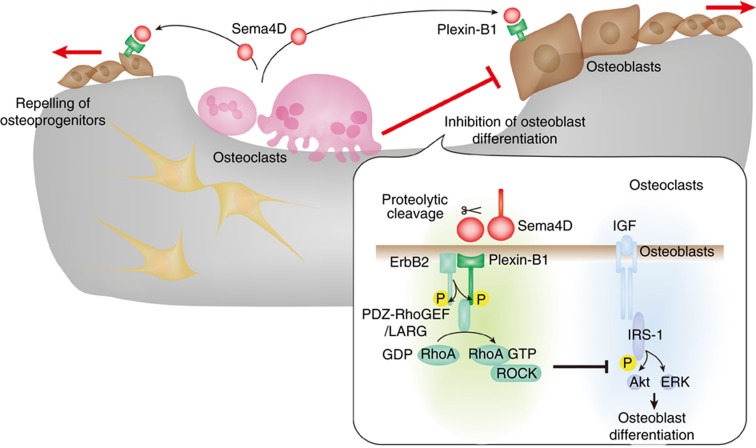
Figure 2. Inhibition of bone formation by the osteoclastic expression of Sema4D in the initiation phase.
During bone resorption, osteoclast-derived Sema4D inhibits osteoblast differentiation in the proximity of osteoclasts and repels osteoblasts by increasing their motility. The binding of Sema4D to its receptor complex, consisting ErbB2 and Plexin-B1, activates RhoA through RhoGEFs, including PDZ-RhoGEF and LARG. The Rho-associated protein kinase Rho-associated kinase (ROCK) inhibits IRS-1 phosphorylation, which is the crucial step in IGF-1 signaling for osteoblast differentiation. The motility of osteoblasts is also controlled by the activation of RhoA-ROCK.
Figure 3
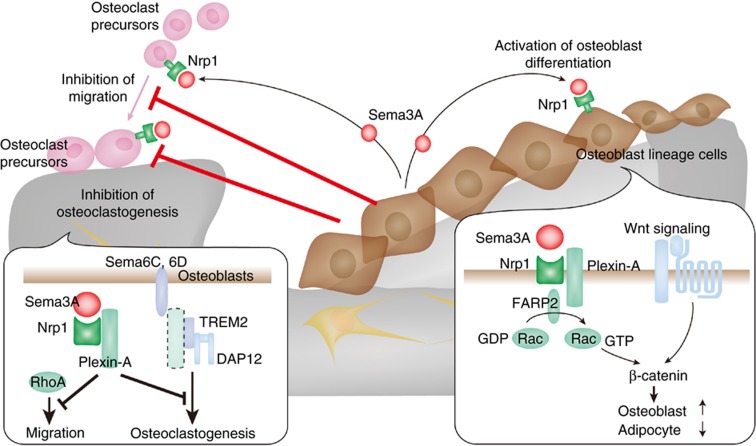
Figure 3. Inhibition of bone resorption by the osteoblastic expression of Sema3A in the bone formation phase.
During bone formation, osteoblast-derived Sema3A inhibits osteoclast differentiation and migration, and at the same time stimulates bone formation. The binding of Sema3A to Nrp1 on osteoclasts inhibits ITAM signaling by sequestering Plexin-A1 from TREM-2. Sema3A–Nrp1–Plexin-A1 also inhibits the migration of osteoclast precursor cells by suppressing RhoA activation. The binding of Sema3A to Nrp1 on osteoblasts activates Rac1 through the RacGEF FARP2. Rac1 activation enhances the Wnt-mediated nuclear localization of β-catenin, which is essential for osteoblast differentiation.

References

    1. Takayanagi H. Osteoimmunology: shared mechanisms and crosstalk between the immune and bone systems. Nat Rev Immunol 2007;7:292–304. - PubMed
    1. Hattner R, Epker BN, Frost HM. Suggested sequential mode of control of changes in cell behaviour in adult bone remodelling. Nature 1965;206:489–490. - PubMed
    1. Feng X, McDonald JM. Disorders of bone remodeling. Annu Rev Pathol 2011;6:121–145. - PMC - PubMed
    1. Seeman E, Delmas PD. Bone quality-the material and structural basis of bone strength and fragility. N Engl J Med 2006;354:2250–2261. - PubMed
    1. Martin TJ, Sims NA. Osteoclast-derived activity in the coupling of bone formation to resorption. Trends Mol Med 2005;11:76–81. - PubMed

LinkOut - more resources